

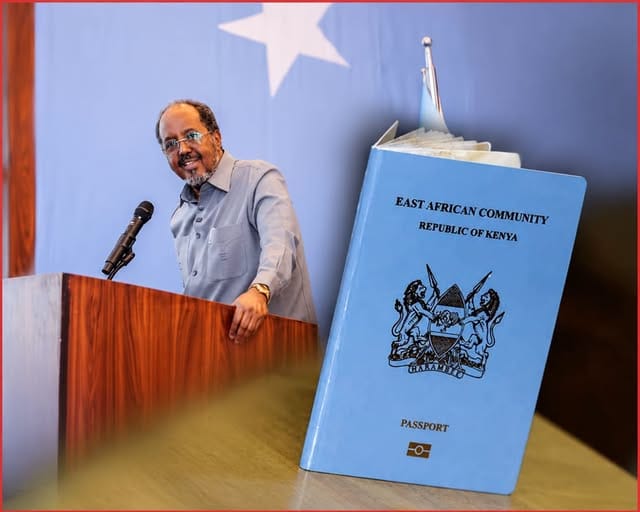
Somali President Hassan Sheikh Mohamud has reportedly ordered Cabinet ministers and senior government officials holding Kenyan passports to surrender them immediately or leave government, in what is emerging as one of the strongest internal directives issued by his administration amid growing tensions over the treatment of Somali officials travelling to Kenya.
According to government sources who spoke to Siyad Report, the President issued the directive while chairing Thursday’s Cabinet meeting, instructing affected ministers to choose between retaining their positions in government or keeping their Kenyan passports. The move follows a series of incidents at Nairobi’s Jomo Kenyatta International Airport (JKIA), where senior Somali officials were reportedly denied entry into Kenya.
The reported order represents a significant shift in the Somali government’s response to the growing controversy surrounding Kenyan travel documents allegedly held by some Somali public officials. It also signals President Hassan Sheikh’s determination to address concerns that have increasingly placed his administration under public and political scrutiny.
According to the sources, ministers affected by the directive were given a strict deadline to comply with the order by surrendering their Kenyan passports if they wished to continue serving in government.
However, the directive reportedly triggered heated debate during the Cabinet meeting, with some ministers objecting to the President’s decision. Those opposed are said to have argued that Somalia’s Constitution and nationality laws recognize dual citizenship, meaning they have a legal right to retain Kenyan passports while serving in public office.
The disagreement highlights what could become one of the most sensitive constitutional and political debates within the Somali government in recent years.
While Somalia permits dual citizenship for its citizens, the issue has become increasingly controversial following repeated reports that Kenyan authorities have intensified scrutiny of Somali officials travelling with Kenyan travel documents.
According to the same sources, Kenya has placed nearly 30 Somali government officials on a watchlist at its airports. The list reportedly includes ministers, senior bureaucrats and other government personnel believed to be holding Kenyan passports or identification documents.
Reports further indicate that at least seven Somali officials, including Cabinet ministers, have already been denied entry into Kenya in recent weeks after arriving at JKIA.
Although Kenyan authorities have not publicly confirmed the existence of such a watchlist, the reports have fuelled growing concern within Mogadishu over the movement of senior government officials between the two neighbouring countries.
The latest directive also comes just days after the Somali government officially confirmed that State Minister at the Presidency Abshir Bukhari had been denied entry into Kenya.
Speaking to Universal TV, Somalia’s State Minister for Foreign Affairs, Ali Omar, acknowledged that the incident had occurred and announced that the government had launched an investigation into the circumstances surrounding the reported denial of entry.
The confirmation followed an earlier incident involving Somalia’s Second Deputy Prime Minister Jibril Abdirashid Haji, who was also reportedly denied entry into Kenya after immigration officials allegedly questioned him over a Kenyan passport. The Deputy Prime Minister denied the allegations and insisted he had travelled using a valid Somali diplomatic passport.
The two incidents intensified debate within Somalia over whether senior public officials should continue holding Kenyan passports while occupying some of the country’s highest offices.
Political observers say President Hassan Sheikh’s latest directive appears aimed at eliminating any ambiguity surrounding the nationality status of senior government officials and restoring public confidence in the integrity of state institutions.
The order also sends a strong political message that loyalty to the Somali state should not be complicated by questions surrounding foreign travel documents, particularly at a time when the issue has become a source of diplomatic friction and domestic political debate.
If implemented, the directive could have significant consequences for the composition of the Somali Cabinet and the wider civil service.
Any minister or senior official unwilling to surrender a Kenyan passport may be forced to choose between remaining in government and retaining their Kenyan citizenship documents. Such a decision could lead to Cabinet changes if some officials decide against complying with the President’s order.
At the same time, the directive is expected to generate further legal and political discussion over the interpretation of Somalia’s laws on dual citizenship.
Supporters of the President’s decision argue that senior government officials should owe undivided allegiance to Somalia and avoid situations that could create questions about national loyalty or diplomatic complications.
Critics, however, are likely to contend that dual citizenship is protected under Somali law and that holding another country’s passport does not automatically disqualify an individual from public service.
The coming days are expected to reveal how ministers respond to the directive and whether any resignations or dismissals follow.
The issue is also likely to remain closely watched in Kenya, where authorities have yet to publicly respond to the reports surrounding the alleged watchlist or the repeated denial of entry to Somali officials.
For President Hassan Sheikh Mohamud, the directive represents one of the clearest indications yet that his administration intends to confront the issue directly rather than allow it to continue generating political controversy.
Whether the order succeeds in resolving the matter or sparks further constitutional debate within Somalia remains to be seen. What is already clear, however, is that the question of Kenyan passports among Somali officials has evolved from an immigration issue into a major political matter with implications for governance, public accountability and the future composition of Somalia’s government.