

Climate change is no longer a distant environmental concern discussed only in international conferences. Across the Kenya–Somalia border, it has become a daily humanitarian crisis that is transforming lives, uprooting communities, and redrawing the future of one of the Horn of Africa’s most vulnerable regions.
For decades, pastoralist communities have relied on seasonal rainfall, healthy grazing lands, and livestock to sustain their families. Cattle, goats, sheep and camels are not merely economic assets; they represent food security, culture, identity and dignity. Today, however, increasingly unpredictable rainfall, prolonged droughts and rising temperatures are pushing thousands of families to the brink of survival.
The consequences extend far beyond failed rainy seasons. Climate change is accelerating displacement, worsening poverty, straining humanitarian systems and increasing pressure on already fragile host communities. Along the Kenya–Somalia border, particularly in northern Kenya and southern Somalia, drought has become one of the strongest drivers of human mobility.
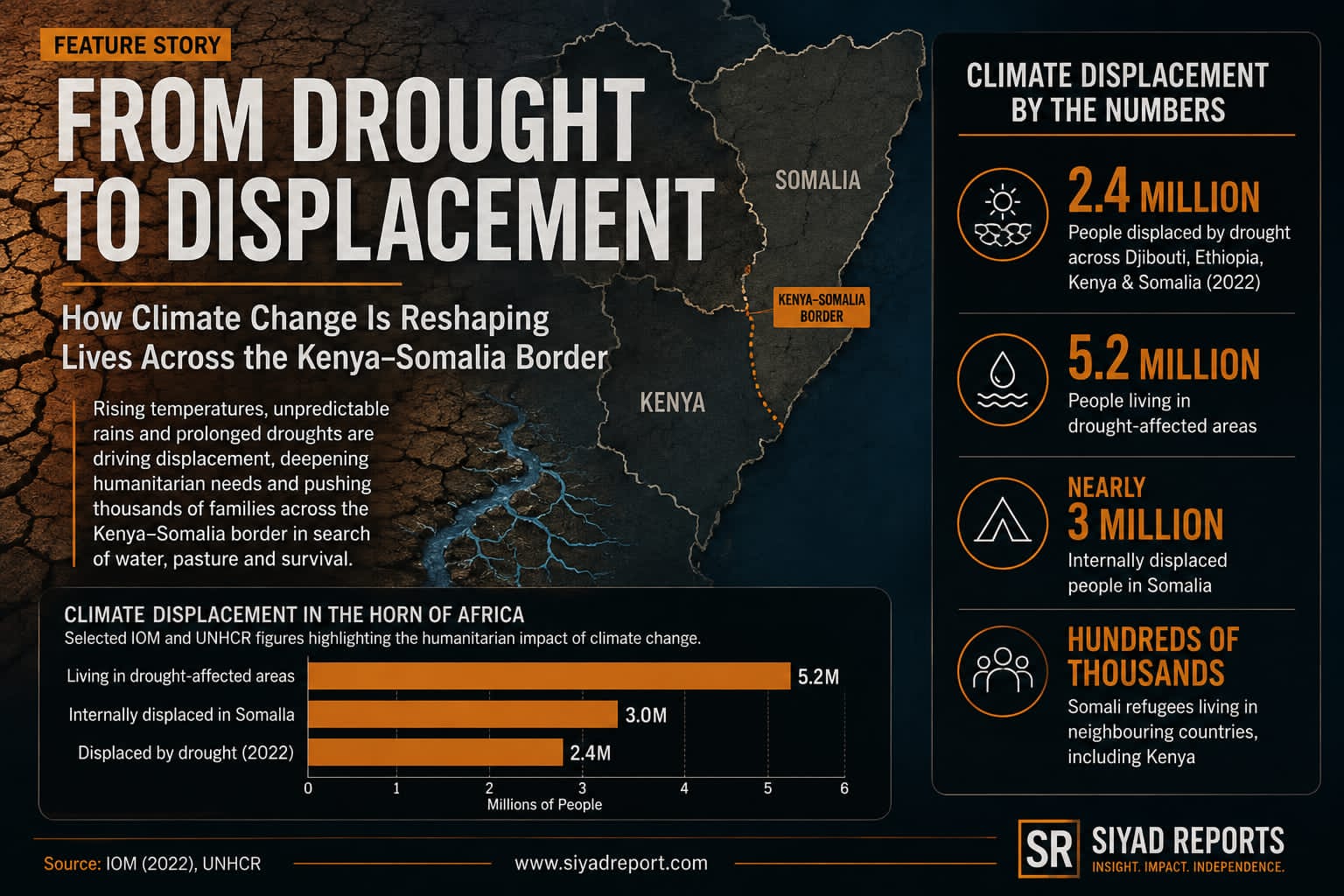
According to the International Organization for Migration (IOM), an estimated 2.4 million people were displaced by drought across Djibouti, Ethiopia, Kenya and Somalia during the 2022 crisis. Millions more continue to live in drought-affected areas, while the United Nations High Commissioner for Refugees (UNHCR) estimates that nearly three million people remain internally displaced in Somalia, with hundreds of thousands seeking refuge in neighbouring countries, including Kenya.
These figures reveal a humanitarian emergency whose causes are increasingly linked to climate change.
Ahmed Shakur, Regional Communications Officer at the Rural Agency for Community Development and Assistance (RACIDA), says recurring drought has fundamentally altered life across the borderlands.
“Climate change has significantly intensified the frequency and severity of droughts across the Kenya–Somalia border,” he told Siyad Reports.
“Rainfall has become increasingly unpredictable, while prolonged dry spells and rising temperatures have depleted water sources, degraded pasture and led to massive livestock losses.”
His observations reflect what humanitarian agencies have documented over recent years. Families who once depended on livestock are increasingly forced to abandon their homes after losing entire herds. For pastoralists, the death of livestock is not simply an economic setback it often marks the collapse of an entire way of life.
Shakur explains that livestock represent income, nutrition and financial security for many households.
“When these assets are lost, households are often left with no option but to migrate in search of water, grazing land or humanitarian assistance.”
Such displacement often occurs in stages. Families first move short distances in search of pasture. When conditions fail to improve, many travel farther, crossing county or international borders before eventually arriving in displacement camps or informal settlements.
The humanitarian consequences are severe.
Displaced households frequently arrive with little more than the clothes they are wearing. Access to food, clean water, shelter and healthcare immediately becomes their greatest concern. Children often suffer interrupted education, while malnutrition rates rise as food supplies diminish.
Women and girls experience unique vulnerabilities during displacement.
According to Shakur, they shoulder increased caregiving responsibilities while facing heightened protection risks as they travel longer distances in search of water and other basic necessities.
“Repeated displacement erodes livelihoods, weakens community support systems and increases competition over scarce natural resources,” he says, warning that these pressures can also increase tensions between neighbouring communities.
For humanitarian organisations such as RACIDA, responding to these emergencies requires balancing immediate relief with long-term resilience building.
Across Kenya, Somalia and Ethiopia, the organisation supports vulnerable communities through emergency food assistance, improved water infrastructure, nutrition programmes, livestock vaccination campaigns and cash transfers for vulnerable households.
Beyond emergency response, RACIDA also promotes climate-smart livelihoods including fodder production, dryland farming, disaster risk reduction and peacebuilding initiatives.
These interventions are designed not only to save lives during crises but also to reduce future dependence on humanitarian assistance.
Yet even humanitarian organisations acknowledge that emergency aid alone cannot solve a crisis driven by climate change.
“Humanitarian assistance remains critical,” Shakur says, “but our focus is equally on enabling communities to recover and adapt to a changing climate.”
When Climate Change Becomes a Human Story
Statistics illustrate the scale of the crisis, but individual stories reveal its human cost.
For Mohammed Adan, now living in Kenya’s Dadaab refugee complex after fleeing Jubaland in southern Somalia, climate change was experienced not through scientific reports but through the gradual disappearance of everything his family depended upon.
“Livestock was our life our food, our income and our identity,” he recalls.
“The rains failed year after year. First the pastures dried up, and then the water points disappeared. We watched our cattle and goats weaken and die one by one until there was nothing left.”
Eventually, survival became impossible.
“The drought left us with no choice: stay and watch our children starve, or walk toward the border in search of refuge.”
His family’s journey reflects that of thousands of Somali pastoralists who have crossed into Kenya seeking safety and humanitarian assistance after repeated climate shocks destroyed their livelihoods.
Life inside Dadaab, however, presents new hardships.
Mohammed says his family now depends entirely on shrinking humanitarian food rations.
“Back home we were self-sufficient pastoralists. Now we depend entirely on monthly aid.”
His children have lost years of education because of displacement, while overcrowded classrooms and limited resources continue to undermine learning opportunities.
Healthcare also remains difficult to access.
“Clean water is rationed, preventable diseases spread quickly, and accessing specialised healthcare is a constant struggle.”
Perhaps most striking is his description of everyday life.
“Life in the camp is defined by waiting—waiting for food, waiting for water and living in constant uncertainty about tomorrow.”
His testimony illustrates an important but often overlooked reality.
Climate displacement is rarely temporary.
Families who leave expecting to return after one failed rainy season often remain displaced for years because climate shocks occur repeatedly before recovery becomes possible.
Scientists say these patterns are consistent with broader climatic changes occurring across the Horn of Africa.
Climate resilience expert Dr. Amina Hassan says scientific observations demonstrate that the region is experiencing rising temperatures and increasingly erratic rainfall.
“Rainy seasons are becoming less reliable, while droughts are occurring more frequently and lasting longer,” she explains.
Reduced rainfall limits water availability, prevents pasture regeneration and places enormous pressure on pastoralist communities whose survival depends almost entirely on natural resources.
As livestock productivity declines, household incomes collapse.
Families become less able to purchase food, access healthcare or keep children in school.
Repeated droughts also reduce communities’ capacity to recover before another climate shock arrives, creating a cycle of chronic vulnerability.
Dr. Hassan argues that the solution requires moving beyond emergency response toward long-term resilience.
Investment in climate-smart water infrastructure, drought-resilient agriculture, improved livestock management, early warning systems and livelihood diversification will be essential if future displacement is to be reduced.
She also stresses that communities themselves must remain central to climate adaptation planning because local knowledge often provides valuable guidance for sustainable resource management.
Her assessment aligns closely with humanitarian organisations working across the region.
Both humanitarian practitioners and climate scientists increasingly agree that displacement cannot be addressed solely through emergency food assistance.
Instead, climate adaptation must become a development priority.
Cross-border cooperation will also play an increasingly important role.
Climate hazards do not recognise political boundaries. Drought affecting southern Somalia inevitably places pressure on northern Kenya as displaced families cross borders seeking water, pasture and safety.
Regional cooperation on water resource management, disaster preparedness, livestock mobility and climate adaptation therefore becomes essential rather than optional.
The Horn of Africa also presents an uncomfortable global paradox.
Although countries in the region contribute only a tiny fraction of global greenhouse gas emissions, they remain among those experiencing the harshest consequences of climate change.
This imbalance has strengthened calls for increased climate financing directed toward frontline communities already living with the impacts of global warming.
For Mohammed Adan, however, policy debates remain secondary to immediate survival.
His priorities are straightforward: enough food for his family, reliable healthcare, clean water, shelter and an opportunity to rebuild his life.
“We don’t want to rely on hand-outs forever,” he says.
“Climate change destroyed our old way of life, but with the right support, we can rebuild.”
His words capture both the tragedy and resilience that define thousands of families across the Kenya–Somalia border.
The climate crisis in the Horn of Africa is no longer simply about changing weather patterns. It is about displaced children growing up without stable education, parents losing livelihoods built over generations, women walking ever greater distances to find water, and communities struggling to preserve their dignity amid repeated humanitarian emergencies.
Without sustained investment in climate adaptation, resilient livelihoods and regional cooperation, displacement driven by environmental shocks is likely to continue rising.
The challenge facing governments, humanitarian agencies and the international community is therefore not merely responding to today’s drought but preparing communities for tomorrow’s climate realities.
Ultimately, climate resilience is no longer just an environmental objective.lit has become a humanitarian necessity, a development priority and a foundation for lasting peace and stability across the Kenya–Somalia border.
The future of millions will depend not only on the return of the rains, but on whether governments and the international community act with the urgency that this unfolding crisis demands.