

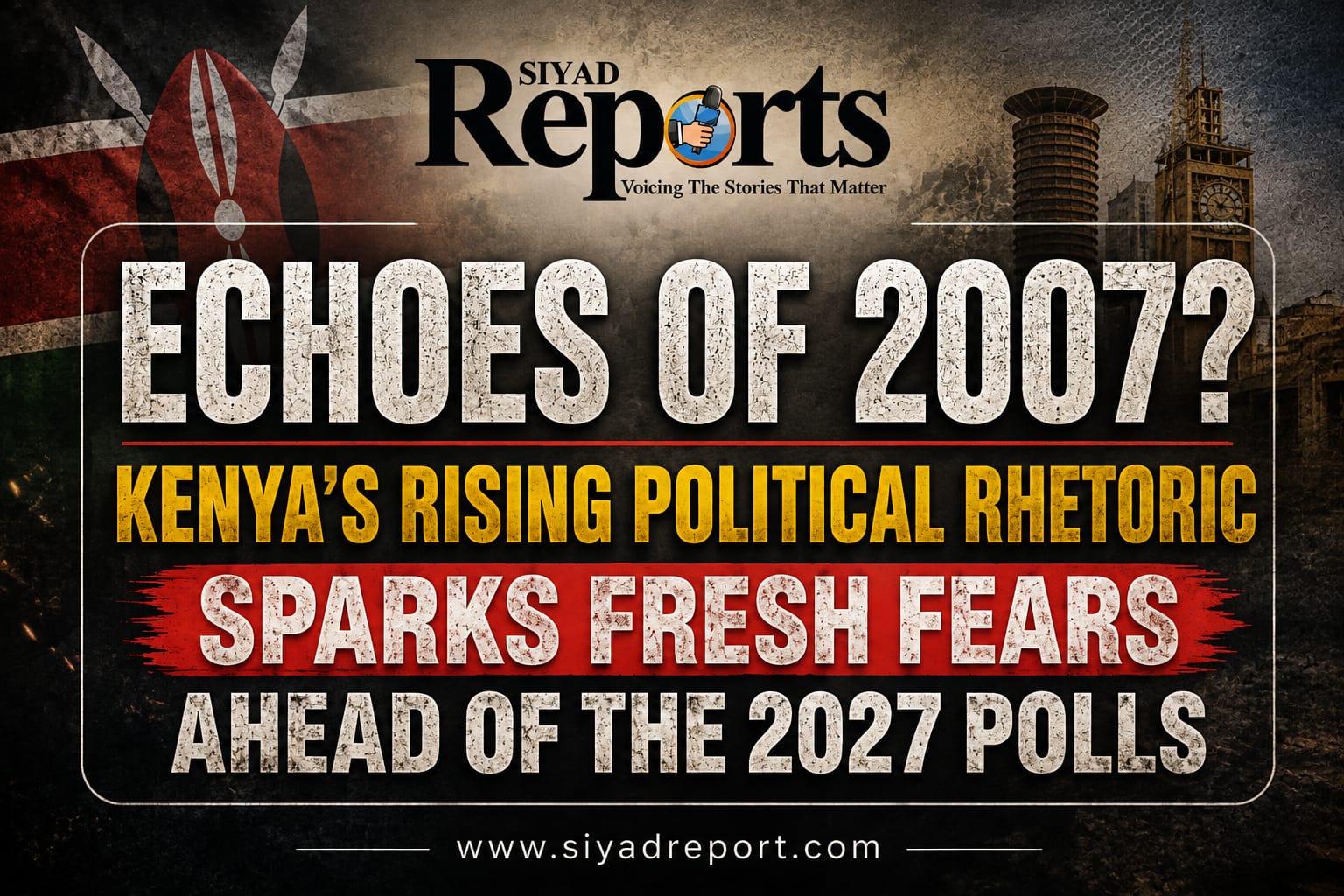
As Kenya edges closer to the 2027 General Election, a noticeable rise in inflammatory political rhetoric is once again placing the country’s fragile national cohesion under the spotlight.
Public exchanges between rival political camps have grown increasingly combative in recent months, with several leaders accused of making remarks that authorities say could incite hatred and deepen divisions.
The latest developments have reignited concerns over whether Kenya is beginning to witness the early warning signs of a highly polarised election season, nearly two decades after the country experienced the devastating 2007–08 post-election violence.
Those concerns intensified after the National Cohesion and Integration Commission (NCIC) summoned Health Cabinet Secretary Aden Duale, former Deputy President Rigathi Gachagua, Public Service Cabinet Secretary Geoffrey Ruku and Mukurwe-ini MP John Kaguchia to record statements over allegations of hate speech.
The Commission said the four leaders are expected to appear before investigators beginning next week. It further confirmed that the investigation file relating to Gachagua has already been forwarded to the Office of the Director of Public Prosecutions (ODPP) for consideration after investigators completed their work.
The Commission also warned that its summonses carry the force of law and that any individual who fails to honour them risks the issuance of a warrant of arrest.
The latest action by the NCIC marks one of the most significant interventions by the cohesion watchdog since political activity began intensifying ahead of the next election cycle.
Although investigations into alleged hate speech involving politicians are not new, the decision to summon senior government officials alongside one of the country’s most prominent opposition figures demonstrates the Commission’s attempt to show that the law applies across the political divide.
Whether these investigations ultimately lead to prosecutions remains to be seen, but the move has already sparked renewed national debate over political accountability and the limits of acceptable campaign rhetoric.
The Commission has, in recent months, repeatedly expressed concern about the tone adopted by politicians during public rallies, warning that careless or inflammatory language can easily inflame existing political and ethnic tensions.
It has consistently reminded leaders that freedom of expression, while protected under the Constitution, does not extend to speech that promotes hatred, discrimination or violence against individuals or communities.
As political mobilisation gathers pace, the Commission says leaders have a responsibility to exercise restraint and ensure that their supporters remain peaceful.
The latest summonses also come against a backdrop of increasingly heated political competition. Across the country, weekend rallies have become major platforms for political messaging as leaders seek to strengthen their influence, defend their records and criticise rivals.
While robust political debate is expected in any democracy, the language used in some of these gatherings has become increasingly confrontational. Sharp personal attacks, accusations, emotionally charged remarks and statements perceived to target particular communities have become more common, drawing criticism from religious leaders, civil society organisations and peace-building groups.
For many Kenyans, these developments inevitably revive memories of the 2007–08 post-election violence, when political tensions escalated into one of the country’s darkest periods.
More than 1,100 people were killed, hundreds of thousands displaced and entire communities left traumatised after violence erupted following the disputed presidential election. Businesses collapsed, families were separated and the country’s economy suffered significant losses.
Nearly two decades later, the events remain a painful reminder of how quickly political competition can deteriorate when inflammatory rhetoric is allowed to flourish unchecked.
While Kenya has since undergone major constitutional, electoral and institutional reforms, concerns continue to emerge whenever political temperatures begin to rise.
The creation of institutions such as the NCIC, electoral reforms and stronger legal safeguards were intended to reduce the risk of election-related violence. However, every election cycle has tested the country’s ability to balance vigorous political competition with the need to preserve national unity.
The latest investigations therefore arrive at a critical moment, with political alliances shifting and preparations for the 2027 elections already beginning to take shape.
Political analysts argue that the current situation differs significantly from that of 2007, noting that Kenya’s institutions are stronger, civic awareness has increased and security agencies are better prepared to respond to emerging threats. Nevertheless, they caution that divisive rhetoric should never be ignored because history has shown that political violence rarely begins with physical confrontation.
Instead, it often starts with words that gradually normalise hostility, deepen mistrust and harden divisions between communities. That is why the language used by influential political leaders continues to attract close scrutiny.
Another defining feature of today’s political environment is the influence of social media. Speeches delivered at political rallies are now transmitted live, clipped into short videos and circulated widely within minutes across multiple digital platforms.
Statements capable of provoking outrage can spread far beyond the original audience, often amplified by supporters and critics alike. This rapid circulation has transformed the nature of political communication, making it easier for controversial remarks to shape public debate and increasing the pressure on authorities to respond quickly whenever allegations of hate speech arise.
The NCIC’s latest action therefore represents more than an investigation into individual leaders. It serves as an early test of Kenya’s readiness for what is expected to be an increasingly competitive election period.
The Commission’s willingness to summon senior political figures sends a message that inflammatory speech will be subject to scrutiny regardless of political affiliation.
At the same time, the outcome of these investigations will likely determine public confidence in whether the country’s institutions can enforce the law fairly, consistently and without political interference.
As political activity gathers momentum over the coming months, attention is likely to remain firmly fixed on the conduct of political leaders, the response of oversight institutions and the tone of national discourse.
Whether the NCIC’s intervention succeeds in encouraging greater restraint or becomes another chapter in Kenya’s recurring political disputes will become clearer as investigations continue. What is certain, however, is that the country is entering a crucial period where every speech, every rally and every political statement will carry greater significance than ever before.
For many Kenyans, the hope is that the lessons of the past will guide the choices of today’s leaders, ensuring that the road to the 2027 General Election is defined by peaceful democratic competition rather than divisive rhetoric that risks reopening old wounds.