

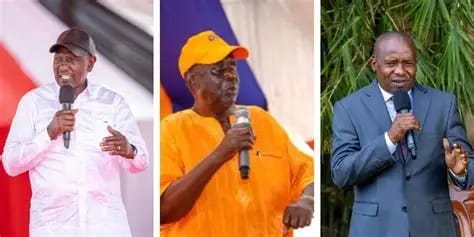
As political realignments ahead of Kenya’s 2027 General Election continue to gather momentum, a statement by veteran politician Oburu Odinga has ignited fresh debate over the future of the ODM Kenya Kwanza partnership and the race for the country’s second-highest office.
His remarks have renewed discussion about how political alliances could shape the next government and whether ODM is positioning itself to negotiate a greater share of power should President William Ruto seek and secure a second term.
Speaking during a public engagement in state house Oburu Odinga declared that ODM would not field a presidential candidate in the next election but would instead support President William Ruto’s re-election bid.
“Wakati huu sisi ODM hatuna candidate, candidate wetu ni President William Ruto,” Oburu said.
He went on to suggest that while the presidential ticket was settled from ODM’s perspective, every other senior position remained open for discussion.
“All the other positions are negotiable, particularly number two. Don’t you think I can be number two? mimi nimetosha!” he added.
The remarks immediately attracted political attention because they appeared to go beyond endorsing President Ruto. By specifically identifying the deputy president’s office as “negotiable,” Oburu introduced a new dimension to the growing political conversation surrounding the cooperation between ODM and the Kenya Kwanza administration.
For months, the relationship between President Ruto and ODM leader Oburu Odinga has continued to evolve through political consultations and cooperation on several national issues. While both leaders have maintained that their engagement is aimed at promoting national stability and addressing key governance concerns, critics and supporters alike have continued to speculate that the partnership could eventually develop into a formal political alliance ahead of the 2027 General Election.
Oburu’s comments are likely to add momentum to that debate. By stating that ODM’s presidential candidate would be President Ruto, he appeared to reinforce the perception that sections of the Orange party are increasingly comfortable backing Ruto instead of presenting their own presidential challenger.
His remarks also suggest that attention within ODM may now be shifting from winning the presidency independently to negotiating influence within a future administration. In coalition politics, such negotiations are often centred on positions that guarantee political relevance and decision-making authority. Among those offices, none carries greater political significance than the deputy presidency.
Although Oburu spoke about his own suitability for the role, his comments are widely expected to be interpreted as a broader indication that ODM believes its support should be reflected in the sharing of senior government positions should the alliance with President Ruto continue into the next electoral cycle.
The statement has inevitably drawn attention to Deputy President Kithure Kindiki, who currently occupies the country’s second-highest office. However, Oburu’s remarks should not be interpreted as evidence that President Ruto intends to replace his deputy or that any decision has been made regarding the 2027 ticket. No official communication from State House or the Kenya Kwanza coalition has suggested any change to the current leadership arrangement.
Nevertheless, Kenyan politics is often driven by public signalling long before formal negotiations begin. Senior politicians frequently use public platforms to communicate political expectations, test public reaction and strengthen their bargaining position before coalition talks officially commence. In that context, Oburu’s statement may be viewed as an early indication of the kind of discussions ODM expects to have if it formally backs President Ruto in the next election.
The remarks also highlight how dramatically Kenya’s political landscape has shifted in recent years. ODM, which has spent decades leading the opposition and fielding presidential candidates against successive governments, now finds itself publicly discussing support for the very administration it once fiercely opposed. That transformation reflects the fluid nature of Kenyan politics, where alliances can change rapidly in response to evolving political interests and electoral calculations.
For President Ruto, maintaining a strong working relationship with ODM could significantly strengthen his prospects for re-election. The party commands substantial political influence in several regions, particularly Nyanza, and its support could help broaden the President’s national coalition while reducing the strength of any opposition alliance that may emerge before 2027.
At the same time, coalition expansion requires careful political balancing. Existing Kenya Kwanza leaders and supporters will expect continuity and recognition for their loyalty, while new political partners will naturally seek meaningful representation in any future government. Managing those competing interests is likely to become one of President Ruto’s biggest political challenges as the election draws closer.
Oburu’s statement also reflects a familiar pattern in Kenyan politics, where negotiations often begin with ambitious public declarations before eventually producing compromises. Political parties frequently open discussions by expressing interest in the highest offices available before settling on arrangements that satisfy the interests of all coalition partners.
Whether the deputy presidency ultimately becomes part of any agreement remains uncertain and will depend on negotiations closer to the election period.
Ultimately, Oburu Odinga’s remarks are significant not because they determine who will become President William Ruto’s running mate, but because they reveal that conversations about power-sharing in a possible post-2027 government are already taking shape.
His comments suggest that if ODM formally throws its weight behind President Ruto, the party expects to play a central role in the next administration rather than merely offering electoral support.
Whether those expectations translate into the deputy presidency or another influential position remains to be seen. That decision will ultimately rest on political negotiations, electoral calculations, regional considerations and President Ruto’s assessment of the coalition most likely to secure victory in 2027.
What is already clear, however, is that Oburu Odinga’s declaration has shifted national attention toward one of the most consequential political questions ahead of the next General Election not only who will seek the presidency, but also who could stand beside President William Ruto on the ballot.