

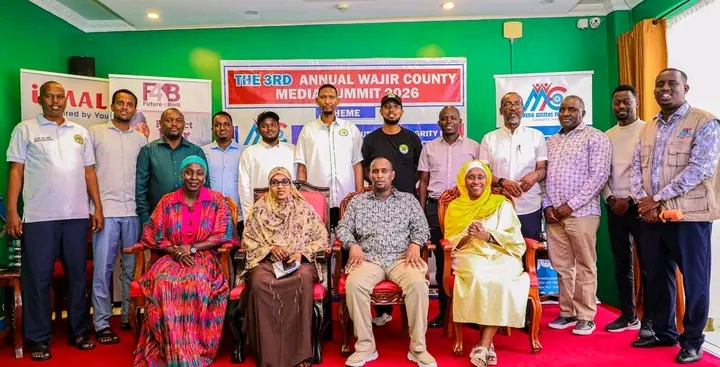
The Third Annual Wajir County Media Summit has officially concluded, bringing together journalists, media practitioners, youth, women, opinion leaders and members of the public under one shared message: Country First, and Kenya Must Remain Peaceful. As the country gradually approaches the 2027 General Election, the summit has reinforced the media’s responsibility to promote national unity, safeguard democratic values and ensure that journalism remains a force for peace rather than division.
Held in Wajir County, the two-day gathering provided an important platform for conversations on the changing media landscape, electoral integrity, professional ethics and the responsibility of journalists in shaping public discourse.
Through panel discussions and engagements, participants examined the challenges facing the media ahead of the next general election, particularly the growing influence of misinformation, political propaganda and emerging digital technologies.
At the centre of the discussions was a collective call for journalists to uphold professionalism, accuracy, editorial independence and accountability while reporting on political developments and electoral processes.
Speaking during the summit on Saturday, Chief Guest Dr. Fatuma Hirsi challenged journalists to remain committed to the principles of ethical journalism, warning that misinformation, unverified reporting and political propaganda could heighten tensions, undermine public confidence and threaten peaceful coexistence.
She emphasised that journalists must prioritise accuracy over the pressure to publish breaking news, particularly during election periods when information can influence public perception and political attitudes.
Dr. Hirsi urged media practitioners to verify election figures through official sources, distinguish facts from allegations and exercise caution when reporting on politically sensitive matters.
“The media must report election results, not manufacture election winners,” she said, underscoring the importance of maintaining public trust and protecting the credibility of the electoral process.
Her remarks highlighted the critical distinction between responsible election reporting and the circulation of unverified information, particularly in an environment where social media platforms have increasingly become major sources of political communication.
Beyond election coverage, Dr. Hirsi called on journalists to play a more active role in educating citizens about their electoral rights, scrutinising political promises and holding elected leaders accountable even after elections have concluded.
She noted that the responsibility of the media should not end when voters cast their ballots, but must continue throughout the electoral cycle through consistent public-interest reporting, investigative journalism and constructive engagement with those entrusted with public leadership.
The growing use of Artificial Intelligence (AI) in media production and information sharing also featured prominently in the discussions. Dr. Hirsi cautioned against the misuse of AI technologies to manipulate images, videos and audio recordings, warning that such practices could create misleading narratives and compromise the credibility of journalism.
She urged media houses and individual journalists to strengthen their digital verification capabilities, ensuring that technological advancements complement professional journalism rather than undermine its fundamental principles.
The discussions further examined how journalists can responsibly incorporate AI into their work while retaining human oversight, editorial accountability and ethical standards.
As the summit progressed into its second day, attention shifted towards the broader question of inclusion and the role of different sections of society in promoting peaceful and credible elections.
Day Two brought together journalists, youth, women, members of the public and opinion leaders, who shared the same platform to discuss peaceful election advocacy, respect for the rule of law and the sanctity of the Constitution.
The conversations centred on inclusive participation in the 2027 General Election, responsible journalism and community dialogue, recognising that peaceful elections require more than the participation of political actors and electoral institutions.
Participants reflected on the importance of creating space for diverse voices in public discourse, ensuring that women, young people and other community stakeholders are meaningfully represented in conversations that shape the country’s democratic future.
The emphasis on community dialogue also highlighted the media’s position as an important link between citizens, institutions and leadership. Through balanced reporting, public education and constructive engagement, journalists can help communities understand electoral processes, challenge misinformation and address emerging tensions before they escalate.
The summit reaffirmed that the protection of peace and national cohesion is a shared responsibility that requires cooperation among journalists, political leaders, communities, civil society and public institutions.
With the 2027 General Election approaching, participants were encouraged to remain conscious of the power of their platforms and the consequences that irresponsible reporting can have on individuals, communities and the country at large.
The gathering officially came to a close in the presence of Hon. Ahmed Abdisalan, Principal Secretary, National Government Coordination Office, under the Office of the Prime Cabinet Secretary, whose presence marked the conclusion of the two-day engagement.
His attendance further underscored the importance of collaboration between government institutions, media practitioners and other stakeholders in advancing peaceful civic participation and strengthening democratic processes.
Throughout the summit, the recurring message remained clear: journalism must serve the public interest, protect the truth and provide citizens with credible information upon which they can make informed decisions.
For Wajir County and the wider Northern Kenya region, the summit also offered an opportunity to reflect on the unique responsibilities of local media practitioners in covering political developments, community concerns and governance issues while promoting peaceful coexistence.
As journalists return to their respective newsrooms and communities, the challenge now lies in translating the summit’s resolutions and discussions into everyday professional practice. Responsible reporting must be reflected in the stories published, the voices amplified, the information verified and the editorial decisions made, particularly during politically sensitive moments.
Ultimately, the Third Annual Wajir County Media Summit concluded not merely as a gathering of media practitioners but as a renewed commitment to the values of truth, professionalism, accountability and national unity.
With the 2027 General Election on the horizon, the message from Wajir carries significance beyond the media fraternity: the country must come first, democracy must be protected, and peace must remain a national priority.
As Kenya prepares for another electoral season, the question is whether every journalist, political leader and citizen will uphold the responsibility of ensuring that the pursuit of political power never comes at the expense of national peace and unity.