

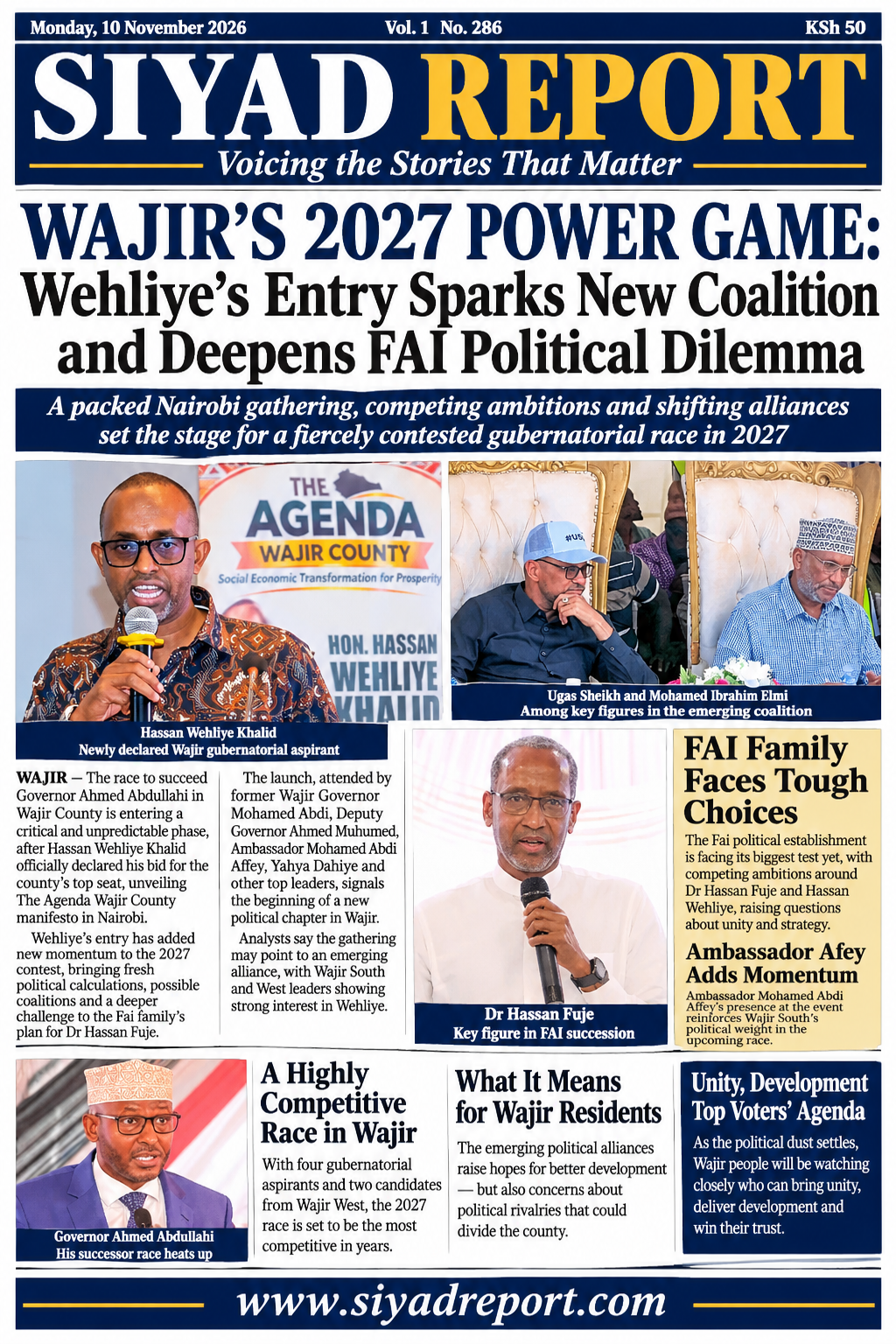
The race to succeed Governor Ahmed Abdullahi in Wajir County is entering a politically consequential phase, with new developments suggesting that the 2027 gubernatorial contest could be shaped as much by alliances, political calculations and regional power arrangements as by individual ambitions.
The latest development is the entry of Hassan Wehliye Khalid into the gubernatorial race, a move that has added another dimension to an already complicated political landscape. However, beyond his declaration and unveiling of The Agenda Wajir County manifesto, the political significance of his candidature lies in the personalities surrounding his political engagement and the possible realignments taking shape ahead of the next General Election.
His gathering in Nairobi brought together a notable collection of political figures, including former Governor Mohamed Abdi, Deputy Governor Ahmed Muhumed, Mohamed Ibrahim Elmi, Ugas Sheikh, Yahya Dahiye, Ambassador Mohamed Abdi Affey, Nasri Sahal and other influential personalities.
But the bigger political question is what this gathering communicates about the future of Wajir politics.
Among the most interesting aspects was the presence of political figures associated with different parts of the county, particularly Wajir South and Wajir West. The appearance of leaders and individuals with their own political ambitions in a gathering organised to advance Wehliye’s gubernatorial candidature raises questions about whether a broader political understanding is beginning to emerge.
Could this be the beginning of a coalition around Wehliye, or was it simply an expression of political solidarity?
At this stage, there is no publicly established agreement confirming that the leaders have committed themselves to a common gubernatorial candidate. Nevertheless, the political symbolism of such a gathering cannot be dismissed. In a county where regional arithmetic, clan considerations, political relationships and personal ambitions frequently influence electoral calculations, the coming together of influential figures deserves attention.
The political figures at the centre of this unfolding contest include Hassan Wehliye Khalid, the newly declared gubernatorial aspirant; Yahya Dahiye, another contender for the county’s top seat; Ugas Sheikh, whose political interests are closely associated with Tarbaj; Mohamed Ibrahim Elmi, an influential political figure in the emerging political conversations; Ambassador Mohamed Abdi Affey, a Wajir South political figure and gubernatorial aspirant; and Dr Hassan Fuje, who remains central to the Fai family’s gubernatorial succession plans.
The appearance of these personalities does not mean they have all endorsed one candidate. Rather, their political positions and possible future alignments illustrate the increasingly complex nature of the contest.
Perhaps the most interesting political dilemma emerging from these developments concerns the Fai political establishment.
For a considerable period, the Fai family has been associated with discussions about producing a gubernatorial candidate, with Dr Hassan Fuje emerging as the preferred figure in the family’s political succession calculations. The expectation surrounding this arrangement was that the family would consolidate its political influence behind one candidate and present a united front in the race for the county’s top seat.
However, the unfolding developments suggest that achieving that unity may not be as straightforward as initially anticipated.
The emergence of Hassan Wehliye, alongside other Fai-associated political ambitions, has complicated the equation. What was expected to be a relatively coordinated political project now appears to be facing competing interests, different ambitions and questions about who ultimately carries the family’s political mandate.
This is where the political future of the Fai establishment becomes particularly interesting.
A family’s political influence does not automatically translate into an electoral victory. It requires agreement, political discipline, negotiations and the ability to convince supporters that a particular candidate represents a collective interest.
If the family has settled on Dr Hassan Fuje, the critical question is whether that decision can command the support of all influential political actors associated with the Fai political network.
Hassan Wehliye’s candidature introduces an uncomfortable question into that calculation: can the family maintain a common political position when different individuals are pursuing ambitions within the same gubernatorial contest?
It is important to recognise that political ambition and family political strategy are not always the same thing. An individual may have the resources, networks and determination to pursue elective office even when the wider political establishment has a different preferred candidate.
For Dr Hassan Fuje, this presents a significant political test. Being the preferred candidate of a family political establishment is one thing; translating that endorsement into a broad countywide political movement is another.
If competing ambitions persist, he could find himself having to do more than simply rely on an internal family endorsement. He may need to demonstrate his independent political strength, build alliances beyond his immediate political constituency and convince voters that his candidature has a viable path to victory.
The implications could extend beyond the gubernatorial contest itself.
Ugas Sheikh’s political positioning is another important piece of the puzzle. His previous public appearance alongside Mohamed Fai, accompanied by the indication that the two would not contest the gubernatorial seat together, raised questions about possible political negotiations and alternative electoral arrangements.
Could the political relationship between the two eventually produce a broader understanding involving different elective positions? Could Tarbaj parliamentary politics become part of the negotiations? These remain possibilities rather than established agreements, but they illustrate how gubernatorial ambitions can influence calculations elsewhere in the county.
Meanwhile, Ambassador Mohamed Abdi Affey’s presence in the wider political conversation introduces another important dimension.
As a Wajir South political figure with gubernatorial ambitions, Affey represents a political interest that cannot simply be overlooked in any discussion about the county’s next governor. If he eventually aligns himself with a coalition supporting another candidate, it could significantly alter the political arithmetic. Equally, if he maintains an independent campaign, the contest could become even more competitive.
Mohamed Ibrahim Elmi and Ugas Sheikh are also among the figures whose political positioning deserves close attention. Reports and political conversations suggesting that some of these personalities could be moving towards a common understanding raise questions about the emergence of competing political camps.
For Yahya Dahiye, another gubernatorial aspirant, the changing landscape presents its own strategic considerations. The more candidates and political groupings enter the contest, the greater the need for each aspirant to establish a distinctive political identity, build a reliable support base and determine whether alliances offer a stronger route to the governorship than an independent campaign.
Wajir West, too, is becoming an important part of the conversation, with two candidates from the region eyeing the county’s top seat. This adds another layer to the regional arithmetic and raises questions about whether the eventual contest will produce regional consolidation or divide potential support among competing personalities.
The bigger picture is that Wajir’s 2027 gubernatorial contest is no longer simply about identifying who wants to become governor. It is increasingly about understanding who can assemble the strongest political coalition, who can negotiate effectively and who can bring different interests together under one electoral arrangement.
There is also the question of whether the emerging political groupings will be built around shared development priorities or primarily around individual political interests. Wajir residents will ultimately want to know what these alliances mean for healthcare, water access, education, livestock development, infrastructure, employment and the management of public resources.
The county has experienced years of political competition, and the next election presents an opportunity for voters to examine not only the personalities seeking leadership but also the credibility of their proposed development agendas.
For the moment, Governor Ahmed Abdullahi’s eventual successor remains an open political question. But the speed at which new candidates are entering the contest and political figures are positioning themselves suggests that the race is moving much faster than many may have anticipated.
Hassan Wehliye’s candidature has undoubtedly added pressure to the existing political calculations. His political entry has reopened questions about the Fai family’s internal strategy, introduced new possibilities for regional alliances and made the gubernatorial contest considerably more unpredictable.
The most consequential question, however, may be whether the Fai political establishment can resolve its internal political differences before the contest gathers further momentum.
Will Dr Hassan Fuje eventually emerge as the family’s consolidated choice, or will competing ambitions weaken the very political arrangement intended to strengthen its influence? Will Wehliye become the centre of a wider political coalition, or will the personalities currently appearing around his political engagement eventually pursue separate paths? And where will Ambassador Affey, Ugas Sheikh, Yahya Dahiye and Mohamed Ibrahim Elmi position themselves when the real negotiations begin?
These are questions that will increasingly define the political conversation in Wajir.
One thing is becoming clear: the battle to replace Ahmed Abdullahi is no longer a distant political ambition. It is an unfolding contest of personalities, alliances, political calculations and competing visions.
In Wajir’s 2027 gubernatorial race, the biggest political question may not simply be who wants to become governor, but who can bring enough of the county’s political forces together to actually win.