

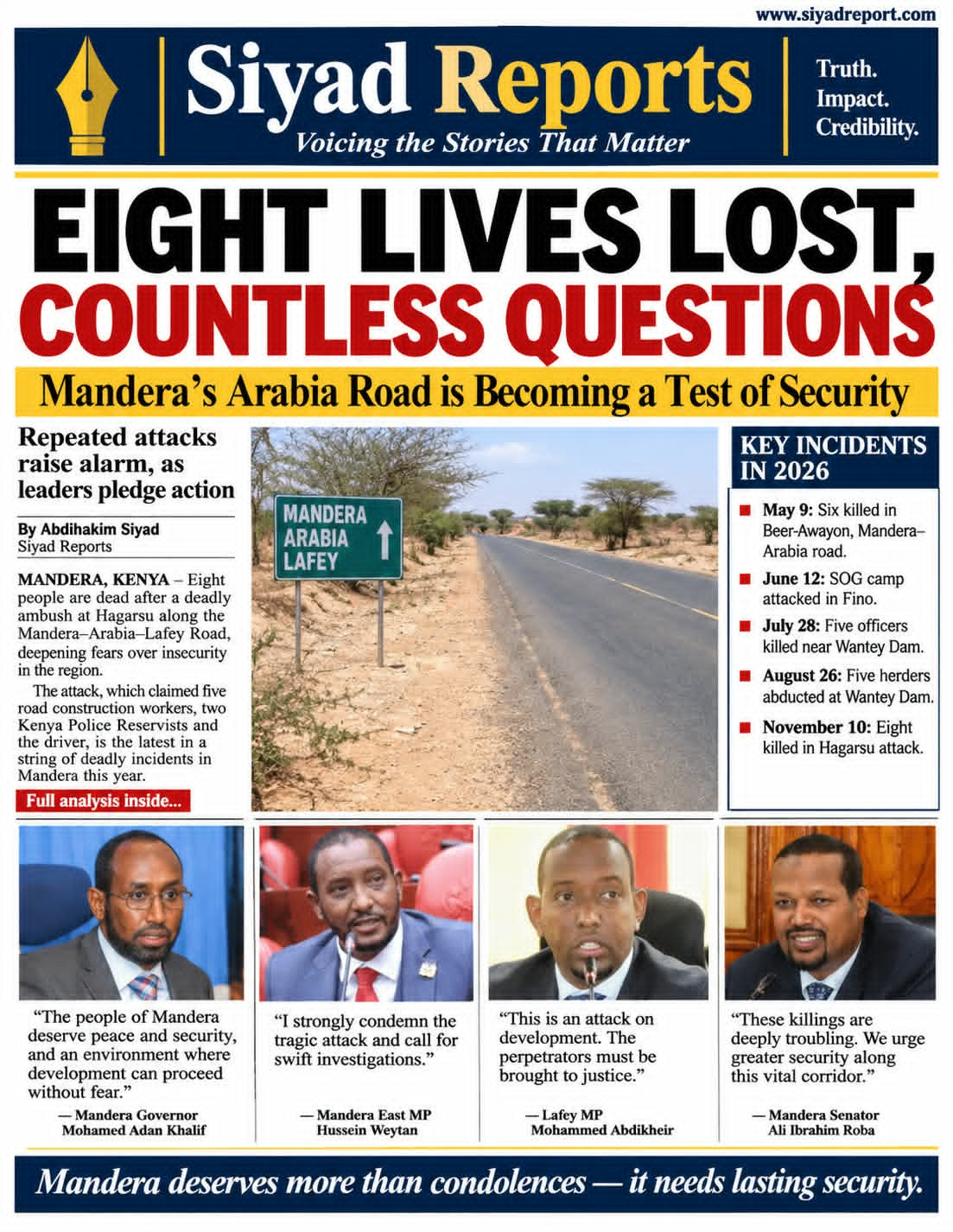
Eight people are dead. Five were road construction workers, two were Kenya Police Reservists and one was the driver of the security vehicle assigned to protect them. They left home to undertake work on a road meant to improve connectivity, open up communities and support economic development. They never returned.
The Tuesday morning ambush at Hagarsu, near Koromey along the Mandera–Arabia–Lafey Road, is another painful reminder that insecurity remains a serious obstacle to the lives and livelihoods of communities living in Kenya’s northeastern borderlands.
But beyond the condolences, condemnations and promises of investigations, one uncomfortable question demands attention: how safe are ordinary residents travelling along this corridor, and what exactly is being done to protect them?
The latest attack cannot be discussed in isolation. It must be examined against the wider security situation that has unfolded across Arabia, Lafey and surrounding areas throughout 2026.
On May 9, six people were killed when armed attackers ambushed a passenger vehicle travelling from Mandera town towards Arabia. The victims were members of a family travelling to attend a religious gathering. Three other passengers sustained injuries. The attack occurred at Beer-Awayon, between Mandera and Arabia, sending shockwaves across the county and raising immediate concerns about civilian safety on the route.
The incident was particularly disturbing because the victims were ordinary travellers, people using public transport to attend a family and religious occasion. Their journey ended in tragedy, demonstrating that insecurity is not merely a concern for security officers or government installations. It directly affects families, passengers and ordinary citizens.
A month later, on June 12, suspected militants attacked the Special Operations Group (SOG) camp at Fino. According to reports carried by The Standard, the attackers used rocket-propelled grenades and machine guns in an assault that lasted approximately 25 minutes. Three officers sustained injuries. The attack was repulsed, but it demonstrated the continuing security pressure on installations in the wider Lafey area.
In July, the situation remained worrying. On July 24, suspected militants reportedly launched attacks in Fino and Arabia, prompting security deployments and panic among residents. Five security officers were subsequently killed on July 28 in an attack near Wantey Dam, according to police reports carried by The Star and Reuters on July 29. The officers were part of a patrol operating in the Lafey border area.
The insecurity did not end there. In August, suspected militants abducted five herders at Wantey Dam, according to a report published by the Daily Nation on August 26. The incident involved ransom demands, with local elders reportedly engaged in efforts to secure the victims’ release.
These incidents occurred across the wider Arabia–Lafey security corridor, although they should not all be presented as attacks on the same stretch of road. Together, however, they illustrate the security challenges facing communities in this part of Mandera.
Then came November 10.
Armed attackers opened fire on a security vehicle escorting road construction personnel at Hagarsu. Seven people were initially reported killed at the scene, while the driver succumbed to injuries as he was being rushed to Mandera County Teaching and Referral Hospital, bringing the death toll to eight.
Mandera County Police Commander Robinson Ndiwa confirmed the deaths and said a multi-agency security operation had been launched to pursue the attackers. The identity of the assailants and their motive had not been conclusively established at the time of reporting. Police expressed suspicion of possible Al-Shabaab involvement, but investigations remain necessary before responsibility can be established.
There is an important detail in this latest incident. According to the Kenya News Agency, the Arabia–Lafey road construction project had been ongoing since April without previously reported security incidents along that particular route. This makes the November attack particularly significant: it demonstrates that even an active construction project with an existing security arrangement can become vulnerable to a deadly ambush.
The question is not simply why the attackers struck. It is also whether the security arrangements were adequate, whether intelligence had identified emerging threats and whether the protection of personnel was regularly reassessed.
Following the tragedy, leaders across Mandera issued statements condemning the killings.
Governor Mohamed Adan Khalif described the incident as a devastating loss to the families and the county, and called on security agencies to investigate and bring those responsible to justice. He also reaffirmed the county government’s commitment to working with security agencies to promote peace and stability.
Mandera East MP Hussein Weytan similarly condemned the attack, expressing condolences to the families of the deceased and urging swift investigations.
Nominated MP Abdisirat Khalif described the killings as a painful loss and called for those responsible to be brought to justice.
Lafey MP Mohammed Abdikheir condemned the attack in strong terms, describing it as an assault on development and public safety. He also called for strengthened security measures around critical infrastructure projects.
Senator Ali Ibrahim Roba expressed concern over the killings, particularly coming at a time when terror-related incidents had reportedly reduced, and demanded thorough investigations and stronger security.
Mandera East MP aspirant Ahmed Ali Madey also conveyed condolences and called for intensified security operations and efforts to apprehend the perpetrators. Former senator Engineer Mohammed Mumad joined other leaders in condemning the killings and demanding justice.
These statements reflect the grief and concern across the county. The leaders have spoken, and their condolences to the bereaved families are appropriate. But Mandera must now move beyond the familiar language of condemnation.
The recurring pattern is becoming difficult to ignore. An attack happens, lives are lost, leaders issue statements, security agencies announce investigations and residents are urged to remain calm. Yet another incident eventually places the same communities back into mourning.
Condolence statements are necessary, but they cannot become the principal response to recurring insecurity.
They must not become another set of statistics in a region where tragedy is repeatedly followed by familiar statements.
Mandera does not need another round of political condolences without a corresponding change on the ground.
It needs protection for its residents, accountability for security failures, justice for victims and an environment where development can proceed without fear.
The road should connect communities, not become a source of anxiety for the people who use it.
The question Mandera must now ask its leaders and security institutions is simple: what will be different after Hagarsu?
Because eight lives have been lost, and the people of Mandera deserve more than another promise.