


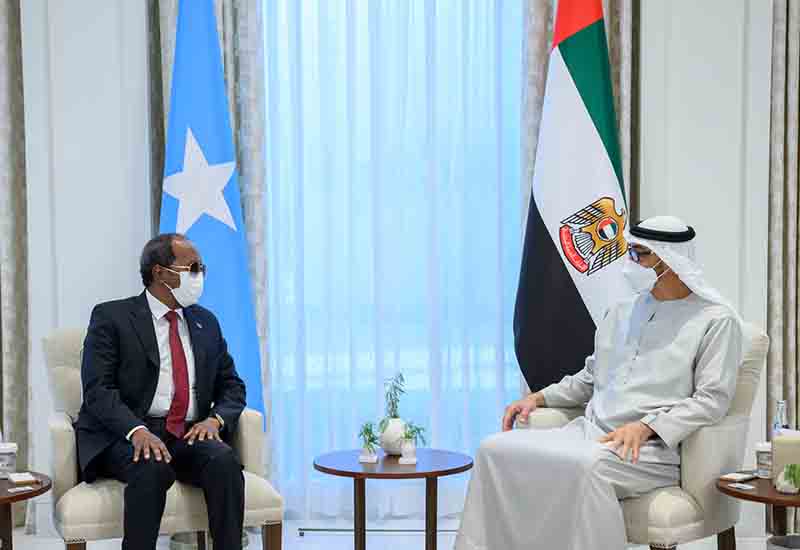
UAE Aligns Publicly With Somalia’s Unity
For the first time, the United Arab Emirates has openly opposed Somaliland’s controversial recognition claims, declaring full respect for the sovereignty and territorial unity of the Federal Republic of Somalia.
In a rare and carefully worded statement, the UAE Ministry of Foreign Affairs affirmed that Abu Dhabi “respects the independence, unity, and territorial integrity of Somalia.”
The announcement came shortly after a joint communiqué released by the African Union and the UAE a move widely interpreted as a turning point of Abu Dhabi’s regional diplomacy.
This development marks a significant turn in the Horn of Africa political landscape, where tensions have recently intensified over Somaliland’s international outreach and claims to statehood.
Diplomatic Pressures and Regional Realignment
The timing of the UAE declaration is crucial.
It follows increased friction triggered by Somaliland’s attempts to secure external recognition including the controversial visit to Hargeisa by Israeli Foreign Minister Gideon Sa’ar. Mogadishu condemned that trip as a violation of Somalia’s sovereignty and a direct challenge to its territorial authority.
The UAE’s latest position appears aimed at reducing diplomatic heat in a region already tense over geopolitical rivalries in the Red Sea and the Gulf of Aden. For months, Abu Dhabi faced mounting criticism for its perceived role in Somaliland’s recognition push and broader security activities in the Horn of Africa.
Regional heavyweight capitals including Riyadh, Ankara and Cairo have reportedly urged restraint and encouraged the UAE to reinvest in formal diplomatic channels rather than unilateral initiatives. This shift signals Abu Dhabi’s renewed interest in stabilizing relations with Mogadishu and aligning with broader international consensus on Somalia’s territorial integrity.
Resetting Relations With Mogadishu
The arrival of UAE Minister of State for Foreign Affairs, Sheikh Shakhboot bin Nahyan, in the Horn of Africa underscores efforts to repair diplomatic ties and deepen dialogue with the Somali Federal Government.
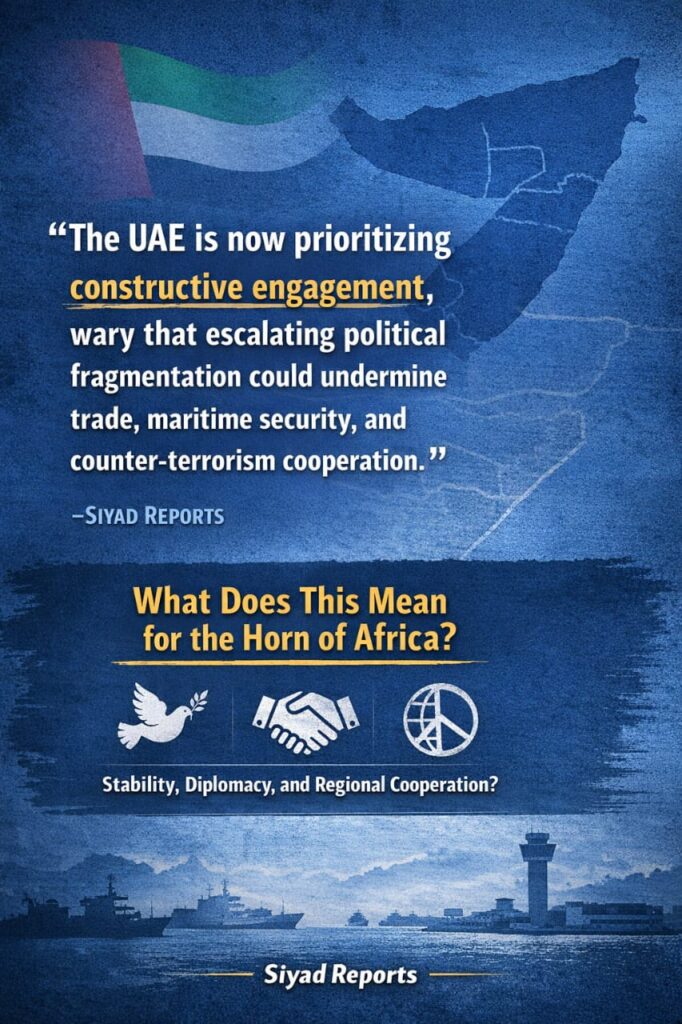
Analysts believe the UAE a key economic and security partner in the region is now prioritising constructive engagement, wary that escalating political fragmentation could undermine trade, maritime security and counter-terrorism cooperation.
Abu Dhabi’s revised tone also suggests recognition of the growing costs associated with being seen as a destabilizing force in the Horn. By publicly acknowledging Somalia’s unity, the UAE positions itself as a responsible regional actor seeking stability at a time of increasing geopolitical competition.
A Turning Point in the Somaliland Question
For Somaliland, the statement represents a diplomatic setback. It underscores the reality that despite growing international conversations formal recognition remains elusive and tightly constrained by African Union policy on territorial integrity.
For Somalia, it is a symbolic victory reinforcing Mogadishu’s international legitimacy at a sensitive political moment.
And for the region, the UAE announcement signals a broader trend, external powers are realigning theie strategies in favour of stability, negotiation and multilateral diplomacy.
Whether this shift brings lasting calm remains to be seen but it is undeniably a decisive moment in the Horn of Africa’s evolving geopolitical chessboard.