

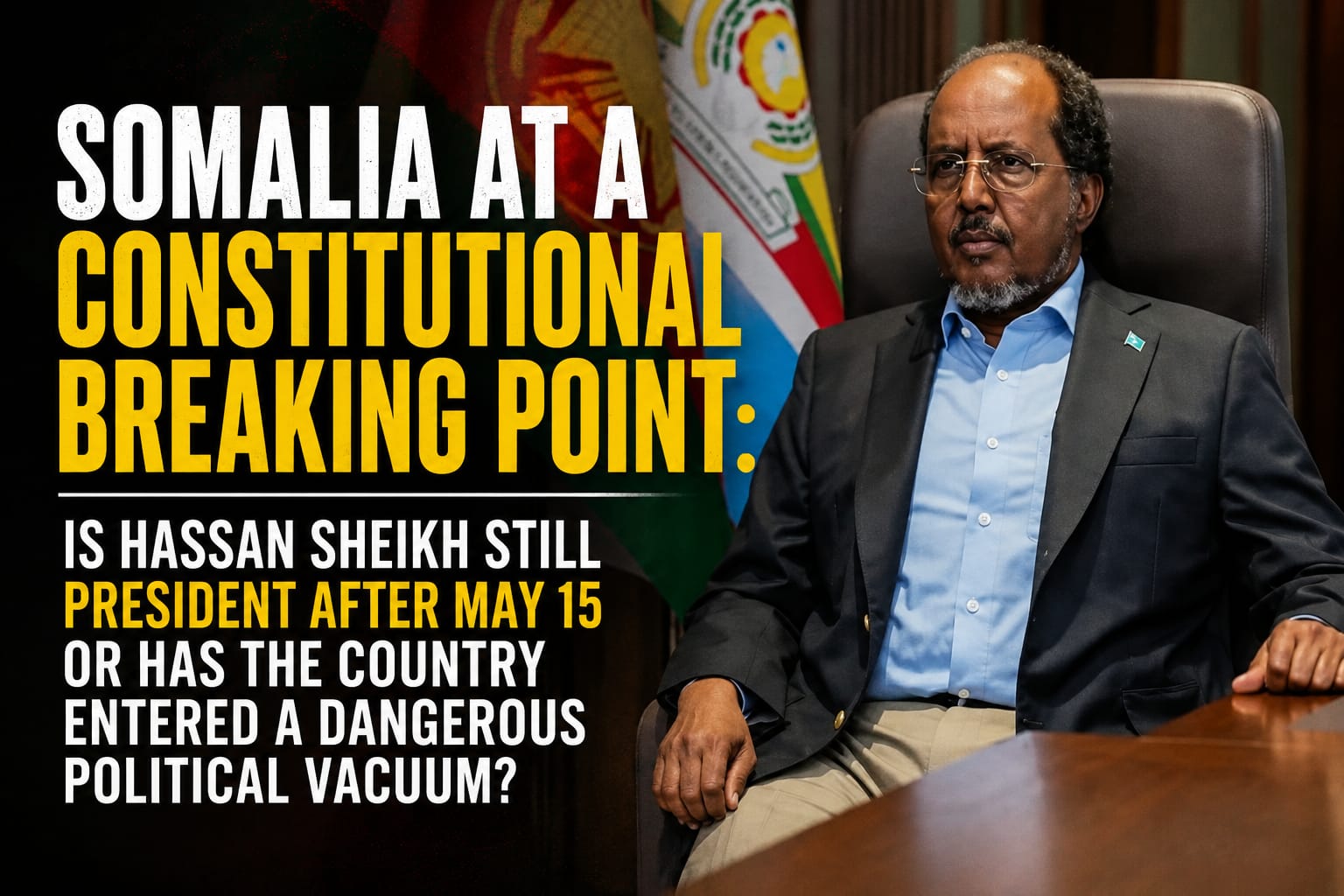
As the clock strikes May 15, Somalia finds itself standing on the edge of one of the most serious constitutional and political confrontations in recent years, with fierce disagreement erupting between the federal government and opposition leaders over a question now dominating the country’s political landscape: Is President Hassan Sheikh Mohamud still the legitimate leader of Somalia after today, or has his mandate officially expired?
The answer to that question may determine not only the future of Hassan Sheikh’s presidency, but also the stability of Somalia’s entire federal system, the direction of upcoming elections, and whether the country moves toward compromise or deeper political uncertainty.
Inside Mogadishu’s tense political corridors, opposition leaders are now openly declaring that the mandates of the president and federal institutions came to an end on May 15, 2026. According to their interpretation, Hassan Sheikh Mohamud is no longer a constitutionally mandated president and should now only remain in office under a negotiated caretaker arrangement until a new electoral process is agreed upon.
The federal government, however, rejects that argument entirely.
Villa Somalia insists that under the recently amended constitution approved by parliament, the mandates of federal institutions remain valid for another year, meaning Hassan Sheikh Mohamud continues to serve as the lawful president of Somalia and his administration remains fully constitutional.
This legal and political clash has now become the single most explosive issue in Somalia’s ongoing political talks.
What makes this moment particularly sensitive is that both sides are using constitutional arguments to justify completely opposing political realities. The opposition says the current government’s mandate ended today under the previous constitutional arrangement and electoral timeline. The government argues that the amended constitutional framework changed the political calendar and legally extended institutional mandates to facilitate the transition toward a one-person, one-vote election system.
In simple terms, Somalia is now facing two competing constitutional interpretations at the same time.
For opposition leaders, May 15 is not just another date on the political calendar. They see it as the official expiration point of the current administration’s legitimacy. This is why opposition figures involved in the Mogadishu negotiations reportedly pushed for the formation of a transitional unity government that would include major opposition leaders in top state positions such as prime minister and Speaker of Parliament.
Under that proposal, Hassan Sheikh Mohamud would remain temporarily as a caretaker president while a consensus-based administration organizes elections within a limited timeframe.
To the opposition, this formula is meant to prevent a constitutional vacuum while also ensuring that no single political side monopolizes power during the transition period.
The government sees the matter differently.
Officials close to Villa Somalia argue that Somalia cannot continue repeating the cycle of transitional arrangements and indirect elections indefinitely. According to government allies, the constitutional amendments recently approved by parliament are now part of the country’s legal framework and therefore extend the authority of state institutions as Somalia prepares for broader electoral reforms.
Government negotiators have reportedly told mediators and opposition figures that Somalia must now move toward universal suffrage instead of returning to indirect elections negotiated by political elites.
This is where the real battle lies.
The crisis is no longer only about Hassan Sheikh Mohamud personally. It is about whether Somalia’s amended constitution itself is accepted as legitimate.
If the opposition rejects the constitutional amendments, then it also rejects the legal foundation the government is using to justify the extension of its mandate. If the government insists the amendments are valid, then Villa Somalia considers all federal institutions constitutionally protected for another year.
This creates an extremely dangerous political contradiction.
On one side, the government continues functioning normally, holding meetings, leading national security operations, and engaging international partners as a legitimate administration. On the other side, opposition leaders increasingly argue that the country has entered a post-mandate phase that requires a new political settlement.
So what actually happens after May 15?
In practical terms, Somalia is unlikely to witness an immediate collapse of government institutions today. State institutions will continue operating, security agencies will remain under federal command, and international partners are expected to continue engaging Hassan Sheikh Mohamud’s administration as the recognized government unless a major political rupture occurs.
However, politically, May 15 could mark the beginning of a new and more fragile phase in Somali politics.
Opposition leaders may intensify pressure on the government by refusing to recognize decisions made after today unless a political agreement is reached. Some federal member states and political actors may also begin openly questioning the authority of federal institutions if negotiations fail.
That could deepen political polarization across the country.
The biggest fear among diplomats and analysts is not necessarily an immediate institutional collapse, but a gradual erosion of consensus around the legitimacy of federal governance.
Somalia has experienced similar constitutional crises before, particularly during disputes over elections and term extensions. Those confrontations often produced political paralysis, tensions between Mogadishu and federal member states, and fears of instability.
This time, however, the stakes are even higher because the dispute is directly tied to constitutional amendments and the future electoral system itself.
At the center of the debate is the controversial push toward one-person, one-vote elections.
President Hassan Sheikh Mohamud’s administration argues that Somalia must finally move beyond clan-based indirect elections and transition toward a democratic system where citizens directly elect their leaders. Supporters of the government say the country cannot build stable institutions while remaining trapped in endless transitional arrangements.
But opposition figures argue that the security situation, political divisions, and institutional weaknesses make such elections unrealistic at this stage. They accuse the government of using the one-person, one-vote agenda to extend its political control without achieving broad national consensus.
International actors are now quietly trying to prevent this disagreement from spiraling into a wider crisis.
Reports indicate that diplomats from the United States and Britain have been deeply involved in facilitating discussions between the two sides. Sources familiar with the talks say mediators are attempting to convince opposition leaders to accept a phased pathway toward universal suffrage while also encouraging the government to accommodate opposition concerns regarding inclusivity, electoral oversight, and political guarantees.
Behind closed doors, negotiators are believed to be exploring compromise formulas that could allow Hassan Sheikh Mohamud to remain in office while broadening political participation within government institutions.
One proposal reportedly discussed involves transforming the current administration into a more inclusive unity-style government while negotiations on elections continue. Another possibility includes reforms to the electoral commission and guarantees regarding timelines for elections.
But as of now, no final agreement has been reached.
The atmosphere in Mogadishu remains tense, uncertain, and politically charged.
For ordinary Somalis, the constitutional arguments dominating elite political circles may appear distant, but the outcome of this dispute could affect the country’s stability, governance, security, and democratic future for years to come.
If negotiations succeed, Somalia could emerge with a political compromise that preserves stability while paving the way for electoral reforms.
If the talks collapse, however, Somalia risks entering a prolonged legitimacy crisis in which the government insists it is constitutional while the opposition rejects its authority.
That is why May 15 has become far more than just a political deadline.
It has become a defining test of Somalia’s constitutional order, the authority of its institutions, and the country’s ability to manage political disagreement without sliding into deeper instability.
Whether Hassan Sheikh Mohamud is viewed as a fully legitimate president or a caretaker leader may ultimately depend less on legal texts alone and more on whether Somali political actors can reach a consensus capable of preventing the country from entering another dangerous chapter of uncertainty.