

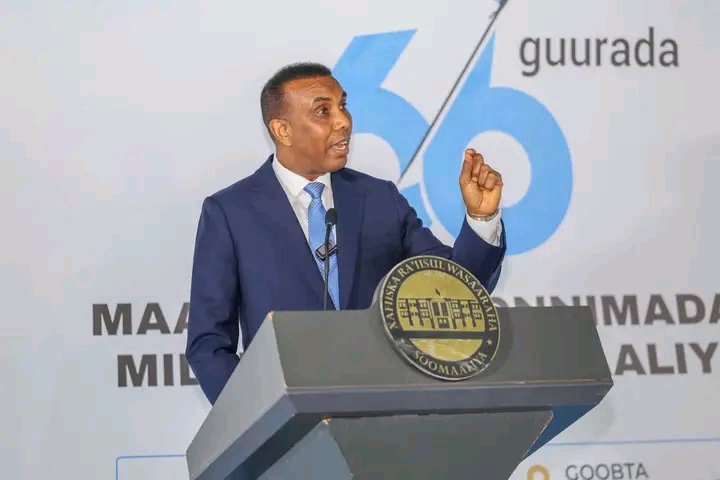
Somalia’s long-running political standoff between the Federal Government and Puntland took a dramatic turn on Thursday night after Prime Minister Hamza Abdi Barre delivered one of his strongest public attacks yet against Puntland President Said Abdullahi Deni, defending the Federal Government’s recruitment of security personnel from Puntland and declaring that the soldiers stationed in Bosaso ultimately answer to the national government.
Speaking during the closing ceremony of Somalia’s Independence Week celebrations in Mogadishu, Prime Minister Hamza delivered a passionate speech that many political observers are likely to interpret as the clearest indication yet of the Federal Government’s determination to expand its authority in Puntland despite growing opposition from the regional administration.
In remarks that immediately ignited political debate across Somalia, the Prime Minister rejected criticism over the recruitment of Puntland security personnel into the Somali National Armed Forces, insisting that every Somali citizen has the constitutional right to serve the nation regardless of their region of origin.
“We are his leaders, we represent him, and we will pay him,” Hamza declared while narrating the story of a soldier who, according to the Prime Minister, travelled from Bosaso through Jowhar and Baidoa before reaching Mogadishu in pursuit of serving his country.
He described the soldier as someone who swore an oath to defend Somalia, fought on the battlefield, and lost fellow soldiers during military operations, only to later have his freedom questioned because he chose to receive a federal government salary and promotion.
“That logic is upside down,” the Prime Minister said, arguing that no Somali should be punished for joining the national armed forces.
Hamza went further, sending a direct political message to Puntland’s leadership by insisting that the Federal Government would continue recruiting soldiers from Puntland irrespective of objections from the regional administration.
“Whether you accept it or not, we will recruit 10,000, 20,000, even 30,000 more,” he declared, maintaining that recruiting and paying members of the national armed forces is the constitutional responsibility of the Federal Government.
In perhaps the most striking moment of the speech, the Prime Minister directly challenged Puntland President Said Abdullahi Deni over the question of authority in Bosaso.
“The soldiers stationed in Bosaso are under my authority, and I am the one providing their rights. Forget 200 dollars I will give them 1,000 dollars. As for you, you can exhaust yourself trying, but you will not be able to confine or control them,” Hamza said.
The comments represent one of the most direct verbal confrontations between Somalia’s Federal Government and Puntland in recent months and are expected to further strain already fragile relations between Mogadishu and Garowe.
The Prime Minister also accused Puntland’s administration of deliberately preventing its own citizens from benefiting from national opportunities, alleging that the regional government has blocked the recruitment of teachers into federal programmes and rejected federally funded infrastructure projects, including road construction initiatives.
According to Hamza, such actions have politicised development and denied Puntland residents employment opportunities and improved public services.
“We will continue paying our soldiers, continue recruiting our youth and continue fulfilling our national responsibilities,” he suggested, arguing that the Federal Government cannot abandon citizens simply because regional leaders disagree with Mogadishu.
The latest exchange follows reports that the Federal Government intends to deploy additional federal troops and establish a direct military command structure in Bosaso, Puntland’s commercial capital and one of Somalia’s most strategically important port cities.
Those reports were met with immediate resistance from Puntland authorities, who argued that such a move would violate the federal constitutional arrangement governing relations between the Federal Government and Federal Member States.
President Said Abdullahi Deni responded by insisting that Puntland’s own security forces remain fully capable of protecting the region against terrorism, piracy and other security threats without additional federal military intervention.
He further declared that Puntland would not accept what his administration views as unauthorized deployment of federal troops or interference in matters falling under Puntland’s constitutional security mandate.
The disagreement reflects broader political tensions that have characterised relations between Mogadishu and Puntland over recent years, particularly regarding constitutional interpretation, power-sharing, elections, resource management and the balance of authority between the Federal Government and regional administrations.
Prime Minister Hamza’s latest remarks are therefore being viewed not merely as a response to President Deni but as a broader assertion of the Federal Government’s interpretation of its constitutional authority over national defence and security institutions.
Supporters of the Federal Government argue that Somalia’s armed forces must remain unified under a single national command and that every Somali citizen should have equal access to military recruitment, salaries and promotions regardless of regional political disputes.
Meanwhile, Puntland officials and their supporters maintain that any deployment of federal troops within Puntland requires consultation and agreement with the regional administration, warning that unilateral actions risk undermining Somalia’s federal system and creating unnecessary political confrontation.
Political analysts say the increasingly public exchange between Mogadishu and Garowe illustrates the widening divide over the future structure of Somalia’s federal governance.
The dispute now extends beyond military deployments and recruitment to broader questions surrounding constitutional authority, political legitimacy and the relationship between the Federal Government and Federal Member States.
As both sides continue to defend their respective constitutional interpretations, observers warn that the escalating rhetoric could further complicate efforts aimed at strengthening national unity and cooperation at a time when Somalia continues confronting major security challenges, including the fight against Al-Shabaab, constitutional reforms and preparations for future political transitions.
For now, Prime Minister Hamza Abdi Barre’s declaration that the Federal Government will continue recruiting, paying and commanding soldiers from Puntland “whether you accept it or not” has set the stage for yet another chapter in the increasingly tense relationship between Mogadishu and Garowe, with the political consequences likely to reverberate well beyond the current dispute over Bosaso.