

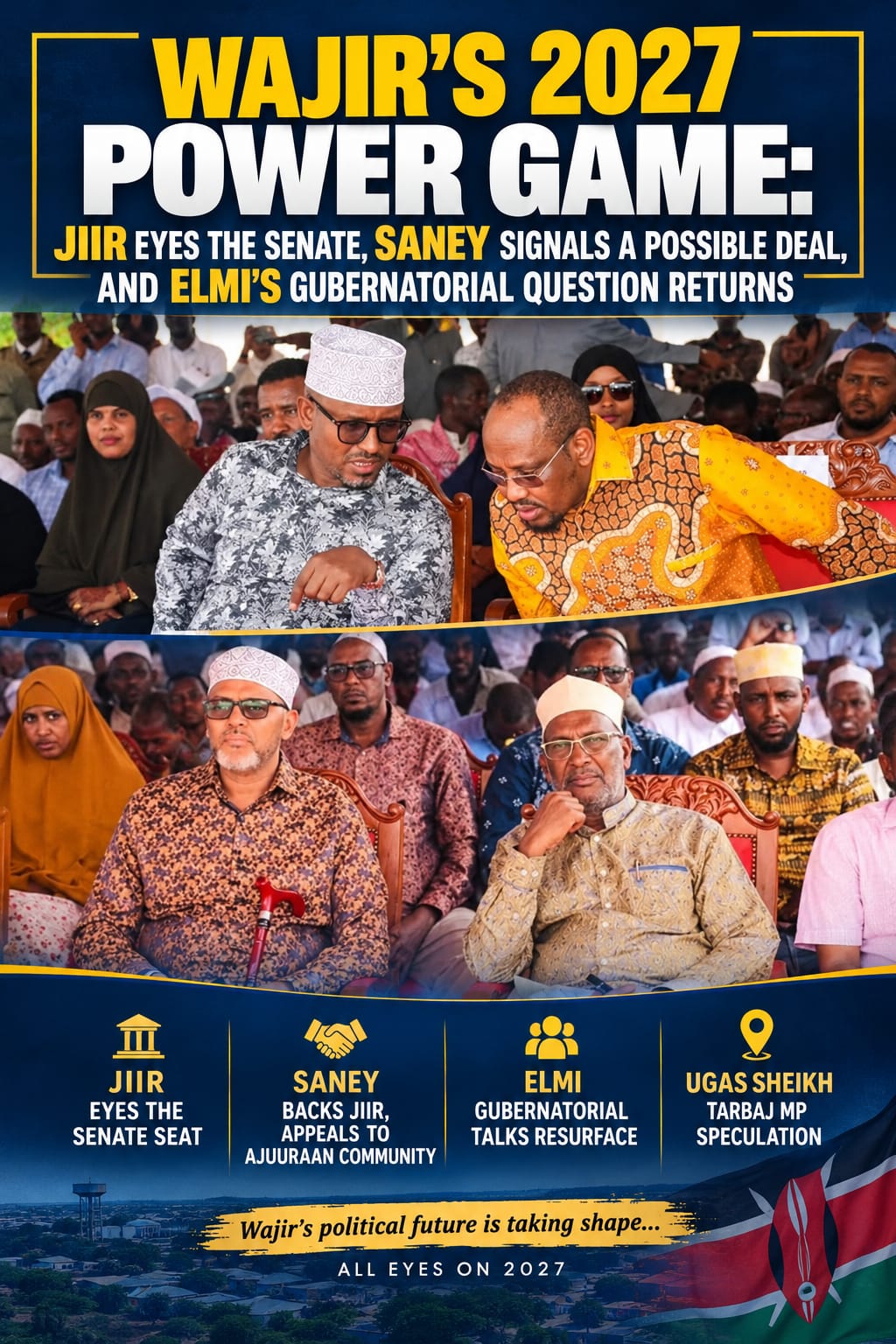
Mashujaa Day celebrations in Korondille, Wajir North, may have been organised to honour Kenya’s heroes, but the political conversation that unfolded on the podium offered something far more consequential: a glimpse into the calculations, ambitions and possible alliances that could shape Wajir County’s political future ahead of the 2027 General Election.
At the centre of the unfolding political drama is Governor Ahmed Abdullahi Jiir, whose possible transition from the county’s top office to the Senate is increasingly becoming a subject of political discussion. Alongside him stands Wajir North MP Ibrahim Abdi Saney, whose public endorsement of Jiir for the senatorial seat, appeal to the Ajuuraan community and remarks hinting at a possible political lineup have opened a new chapter in the county’s emerging succession debate.
But the significance of the Korondille gathering extends beyond the governor and the outspoken legislator. Former Cabinet Minister Mohammed Ibrahim Elmi and Ugas Sheikh Mohammed also shared the political stage, adding another dimension to speculation about the future of the gubernatorial contest, the Tarbaj parliamentary seat and the possibility of a broader political coalition.
Could Wajir be witnessing the early stages of a heavyweight alliance designed to redistribute political influence across several elective positions? Could Jiir be preparing to exchange the governor’s office for a seat in the Senate? And could Elmi, Saney and Ugas emerge as central figures in a political arrangement that reshapes the county’s leadership contest?
These are questions that Korondille has placed firmly on the political table. Yet, while the signals are intriguing, the difference between a political possibility and an actual agreement remains crucial.
Saney’s remarks were arguably the most consequential political signal to emerge from the celebrations. The Wajir North MP did not merely express admiration for Jiir; he publicly urged members of the Ajuuraan community to support the governor’s senatorial ambitions, challenging the perception that the community would never vote for him.
“I urge my fellow members of the Ajuuraan community to support Ahmad Jiir for the Senate seat. There is nothing wrong with Jiir, but it is said that he believes the Ajuuraan community will never vote for him,” Saney said in his remarks.
He went further, suggesting that the community had an opportunity to disprove that perception by demonstrating genuine support for the governor, whom he credited with doing a good job.
This was a calculated political message, regardless of whether it formed part of a wider agreement. By appealing directly to the Ajuuraan community, Saney placed the question of Jiir’s Senate bid within the broader politics of community support, electoral arithmetic and the building of cross-community alliances.
His intervention also raises an important question: why is a sitting MP from Wajir North investing political capital in a governor’s possible Senate bid before the 2027 election campaigns have formally taken shape?
One interpretation is straightforward. Saney genuinely believes Jiir deserves the Senate seat and wants to help him overcome a perceived political obstacle. Another possibility is that the endorsement reflects a wider calculation in which support for one candidate could become part of negotiations over other elective positions.
The second possibility becomes particularly interesting when considered alongside Saney’s hints about a potential political lineup and his suggestion that he could provide a Deputy Governor within such an arrangement.
However, it would be premature to conclude that an agreement has already been reached. Political endorsements can be expressions of personal conviction, strategic positioning or early attempts to build alliances. Without explicit confirmation from the individuals involved, the precise motive behind Saney’s remarks remains an open question.
What is clear is that his statement has given Jiir’s potential Senate bid an important public endorsement and introduced the possibility of a broader conversation about who could succeed the governor.
For Jiir, the Senate question presents a potentially significant political transition. Having served as governor, he would enter the senatorial contest with the experience of leading the county and a record that could form the basis of his campaign. Yet the Senate is a different political arena, requiring a distinct electoral coalition and the ability to convince voters that his next political chapter should be at the national legislative level.
Jiir himself has maintained that he is still assessing the political situation in the region and will speak when the time is right. He has also called on Wajir residents to elect leaders committed to fairness, justice and equal treatment for all communities.
His public position leaves room for interpretation. It neither confirms a Senate bid nor rules out other political options. Nevertheless, Saney’s direct endorsement has made the senatorial possibility harder to dismiss as mere corridor speculation.
If Jiir eventually decides to contest the Senate seat, the immediate question will be the succession of the governorship. Who would command sufficient support to inherit the county’s top office, and what political arrangement could bring competing interests behind a single candidate?
This is where Mohammed Ibrahim Elmi’s presence at the Korondille gathering becomes politically noteworthy.
A former Cabinet Minister, Elmi is a figure whose appearance alongside other influential political actors invites questions about whether his name could feature in the county’s next gubernatorial contest. If Jiir were to pursue the Senate, Elmi could emerge as one of the names discussed in conversations about the succession battle.
A possible arrangement involving Elmi for governor and Saney for Deputy Governor would, on paper, bring together two political figures with different bases of influence. Such a partnership could offer an avenue for consolidating support across constituencies and negotiating a common political platform.
But this remains a hypothetical scenario, not an announced ticket. Neither the shared podium nor Saney’s remarks, as presented here, establish that Elmi and Saney have agreed to contest together.
The distinction matters because Wajir’s gubernatorial succession is unlikely to be determined by appearances alone. Any viable candidate would need to navigate competing ambitions, community expectations, political networks and the challenge of assembling a coalition broad enough to win across the county.
Elmi’s potential candidacy would therefore need to be assessed against the ambitions of other aspirants, including figures already positioning themselves for the next election. If a governor-to-Senate transition becomes a serious prospect, the succession contest could intensify rather than automatically produce a consensus candidate.
Saney’s possible role in a future administration also deserves careful scrutiny. His reference to providing a Deputy Governor suggests that he is thinking beyond the immediate Senate contest and considering the distribution of political positions within a potential alliance.
Whether this points to his own ambitions, a candidate he would support or a broader negotiation remains unclear. Nevertheless, it introduces an important dimension to the unfolding debate: the possibility that political actors are beginning to consider how support for one position might translate into influence over another.
The appearance of Ugas Sheikh Mohammed on the same stage adds another layer of uncertainty. Ugas has featured in discussions surrounding Wajir’s gubernatorial politics, and his presence alongside Elmi and other influential figures raises questions about whether he could be part of a wider political understanding.
One possible scenario is that Ugas could eventually redirect his ambitions towards the Tarbaj parliamentary seat if a broader coalition emerged around the governorship. In a hypothetical arrangement, Jiir would pursue the Senate, Elmi would seek the governorship, Saney would be considered for the Deputy Governor position, and Ugas would contest the Tarbaj parliamentary seat.
Such a lineup would represent an ambitious attempt to coordinate several political contests within one arrangement. Rather than allowing influential figures to compete against one another for a limited number of positions, a negotiated coalition could seek to distribute political opportunities across different seats.
The potential attraction is obvious: candidates could pool their networks, coordinate their support and reduce the risk of internal competition undermining their respective campaigns.
Yet the same arrangement would face substantial obstacles. Political ambitions do not always align neatly, and a candidate’s willingness to support another contender may depend on personal calculations, community preferences and the strength of competing offers. A possible Tarbaj parliamentary bid for Ugas, for instance, cannot be assumed simply because the governorship may become available.
There is also the question of whether the political figures involved would agree on the terms of such a coalition. Who would lead it? How would its candidates be selected? What commitments would each participant make, and how would disagreements be resolved?
These questions are central to understanding whether the Korondille gathering represents the beginning of meaningful negotiations or simply a moment when several political ambitions happened to converge on the same podium.
Another significant factor is the position of the Ajuuraan community in the emerging Senate debate. Saney’s appeal suggests that he considers its support important to Jiir’s prospects. His statement also challenges the idea that community voting preferences are fixed and predictable.
However, no community should be treated as a single political bloc whose votes can automatically be transferred from one candidate to another. Voters make their own assessments, and community leaders’ endorsements do not necessarily guarantee uniform support at the ballot.
If Jiir seeks the Senate, his challenge will be to build a credible coalition that extends beyond endorsements and demonstrates why his candidacy deserves the confidence of Wajir’s electorate.
For Saney, the next test will be whether his public endorsement develops into a sustained political position. Will he continue to advocate for Jiir, clarify his own plans for 2027 and identify the kind of leadership arrangement he wants to support? Or will further developments reveal that his remarks were an early expression of support rather than part of a settled political deal?
The answers could provide a clearer indication of the direction Wajir’s political landscape is taking.
The presence of Elmi and Ugas on the same stage may eventually prove significant, but it should not be mistaken for proof of an alliance. Political history is full of shared platforms that never translated into electoral partnerships, just as apparently casual public exchanges have sometimes preceded major political realignments.
For now, the most defensible conclusion is that Korondille has exposed several questions that Wajir’s political establishment will have to confront: Jiir’s next move, the contest to succeed him, Saney’s ambitions and the possible role of Elmi and Ugas in the county’s next political configuration.
As the 2027 General Election approaches, the decisive developments may take place away from public celebrations, in private consultations, negotiations and conversations about how competing interests can be reconciled.
The real test will not be who shared the podium in Korondille, but who eventually stands together when the political choices become irreversible.
If Jiir declares for the Senate, the gubernatorial contest could enter a new phase. If Saney sustains his support and develops a wider political programme, his influence over the succession debate could grow. If Elmi and Ugas clarify their ambitions, the outlines of possible alliances may become easier to discern.
Until then, the proposed Jiir–Elmi–Saney–Ugas lineup remains a political hypothesis rather than a confirmed coalition.
But one thing is increasingly apparent: Mashujaa Day in Korondille was more than a ceremonial gathering. It became a public window into the questions, ambitions and strategic calculations surrounding Wajir’s next election.
The 2027 contest is still ahead, and the final political map is far from settled. Yet if the signals emerging from Korondille develop into concrete commitments, Wajir could be heading towards a contest in which the battle for the Senate, the succession of the governor and the struggle for parliamentary influence are no longer separate races, but interconnected parts of one high-stakes political game.
The question now is whether Korondille marked the first step towards a powerful countywide coalition or merely the opening move in a much more complicated battle for Wajir’s political future.