

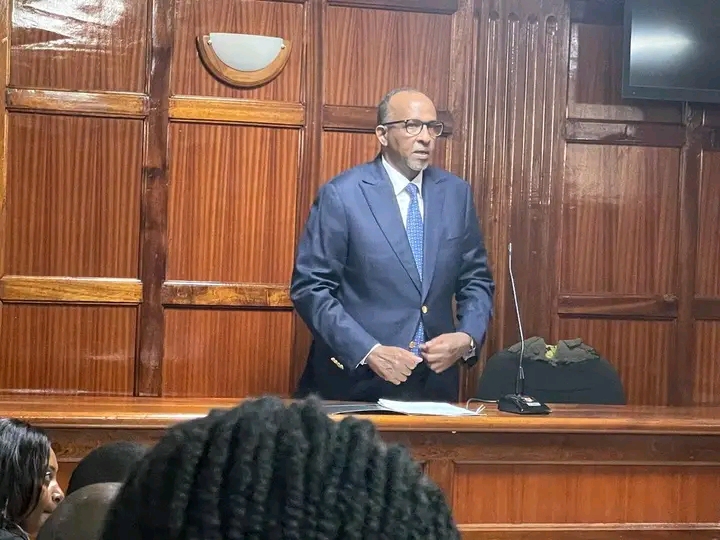
Health Cabinet Secretary Aden Duale has been pardoned by the High Court after apologising for disobeying court orders related to the construction of a controversial U.S.-funded Ebola isolation facility at Laikipia Air Base.
Justice Patricia Nyaundi declined to impose a custodial sentence on the Cabinet Secretary despite finding him guilty of contempt of court, instead accepting his apology and mitigation presented before the Milimani High Court.
Duale had appeared in person before the court following a strict summons issued by Justice Nyaundi, requiring him to attend the proceedings and explain his conduct after being found in contempt over the implementation of the Ebola facility project.
The contempt proceedings arose from a legal challenge filed by Katiba Institute, which had successfully obtained conservatory orders halting the construction of the Ebola quarantine facility pending the hearing and determination of the case.
The court orders were intended to stop activities associated with the project while the issues raised in the petition were being considered by the High Court. However, despite the conservatory orders being in force, activities linked to the facility allegedly continued, leading to accusations that the directives had been ignored.
The Ministry of Health had maintained that the activities undertaken after the issuance of the court orders were part of routine domestic public health preparedness measures and not connected to the suspended bilateral project involving the United States government.
According to the ministry, the work being carried out was separate from the U.S.-funded arrangement and therefore did not amount to a violation of the conservatory orders.
However, the High Court rejected that argument and found that the continued activities amounted to non-compliance with its directives.Justice Nyaundi ruled that the conservatory orders were clear and binding and that compliance was expected from all parties regardless of their interpretation of the project activities.
The finding paved the way for contempt proceedings against the Health Cabinet Secretary, who was subsequently required to appear before the court for mitigation.
Appearing before the court, Duale expressed regret over the circumstances that led to the contempt finding and insisted that he had no intention of undermining the authority of the judiciary.
“I would be the last person to disregard or violate a court order. I sincerely regret any action, omission, misunderstanding, or misinterpretation that may have resulted in non-compliance or created the perception thereof,” Duale told the court.
The Cabinet Secretary further assured the court of his commitment to respecting judicial decisions and complying with all directives issued in the matter.
As part of his mitigation, Duale informed the court that he had already taken steps to ensure full compliance with the conservatory orders.
He stated that he had directed the immediate and complete suspension of any planned construction, site preparation, or related activities connected to the Ebola isolation facility at Laikipia Air Base.
According to Duale, the suspension would remain in effect pending the hearing and determination of the ongoing case before the High Court.The apology and commitment to halt all activities related to the project formed a key part of the mitigation presented before the court.
After considering the Cabinet Secretary’s submissions, Justice Nyaundi accepted his apology and declined to impose a jail sentence, effectively pardoning him in the contempt proceedings.
The ruling spared Duale from possible imprisonment and brought to a close the contempt phase of the case, although the substantive legal challenge regarding the Ebola facility remains before the court.
The project at the center of the dispute was designed as an Ebola isolation and quarantine facility aimed at strengthening Kenya’s preparedness for potential outbreaks of highly infectious diseases.
Supporters of the initiative have argued that the country requires enhanced disease surveillance and response infrastructure to effectively manage public health emergencies, particularly given Kenya’s position as a major regional transport and economic hub.
However, concerns raised over the project’s implementation and legal procedures prompted Katiba Institute to move to court, leading to the issuance of conservatory orders that temporarily halted its construction.
The dispute has since attracted national attention due to its public health implications and the involvement of senior government officials.With Duale now pardoned after tendering an apology, attention is expected to remain on the broader case challenging the legality and implementation of the Laikipia Ebola isolation facility.
For now, all construction and related activities connected to the project remain suspended following the directive issued by the Health Cabinet Secretary, pending the court’s determination of the main petition.