

For much of the past three decades, Somalia’s security challenges have largely been viewed through the lenses of terrorism, piracy, state-building and humanitarian crises. International military engagement in the country focused primarily on stabilisation, counterterrorism operations and supporting the reconstruction of state institutions.
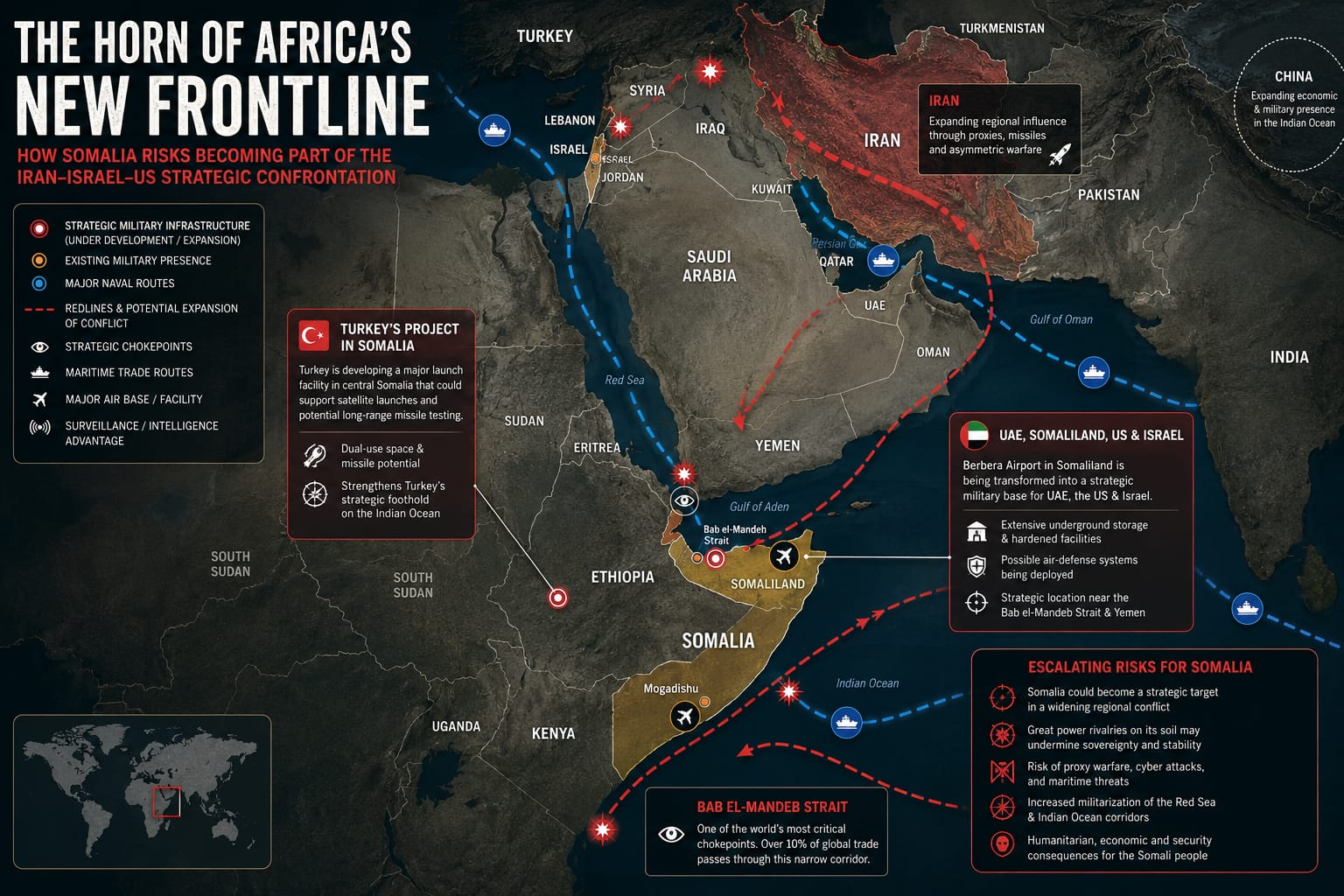
Today, however, a different strategic picture is beginning to emerge.Recent reporting by Le Monde Afrique suggests that Somalia and the wider Horn of Africa are increasingly attracting the attention of major global and regional powers for reasons extending far beyond counterterrorism. According to the publication, Turkey is pursuing plans to develop a major launch facility on Somalia’s central coast capable of supporting satellite launches and potentially other advanced aerospace activities.
In a separate investigation, Le Monde also reported that Berbera Airport in Somaliland is undergoing significant military-related expansion led by the United Arab Emirates, with facilities reportedly intended to support the UAE, the United States and Israel.Whether viewed independently or together, these developments point toward a broader strategic transformation across the Horn of Africa.
The region is no longer merely a gateway between continents. It is increasingly becoming an arena where military power, technological capability, intelligence collection, maritime security and geopolitical influence converge.At the same time, tensions across the Middle East have intensified dramatically.
The confrontation involving Iran, Israel and the United States has expanded beyond direct military exchanges into a wider contest stretching across multiple theatres from the Persian Gulf and Iraq to Syria, Lebanon and the Red Sea.
Against this backdrop, an important strategic question emerges:Could Somalia become one of the next indirect arenas in this expanding regional rivalry?No evidence currently suggests Somalia is directly involved in the conflict.
However, history demonstrates that strategically important states often find themselves drawn into wider geopolitical competition not because they seek confrontation, but because of their geography and the interests of external powers.
From Counterterrorism to Strategic Competition
For years, Turkey’s engagement with Somalia has centred on humanitarian assistance, infrastructure development, military training and security cooperation.
Ankara operates one of its largest overseas military training facilities in Mogadishu and has steadily expanded defence partnerships with the Somali government.Le Monde Afrique now reports that Turkey is exploring construction of a launch facility on Somalia’s coastline capable of supporting satellite launches.While satellite programmes are legitimate civilian and scientific ventures pursued by many countries, aerospace infrastructure often carries what defence analysts describe as “dual-use” characteristics.
Technologies used to place satellites into orbit share engineering foundations with long-range rocket systems, although their purposes, legal frameworks and operational requirements differ significantly.If such infrastructure materialises, Somalia’s strategic profile would change considerably.Instead of hosting only traditional military cooperation, the country would become associated with advanced aerospace capability an area closely monitored by competing global powers.Meanwhile, Le Monde’s investigation into Berbera presents another significant development.
According to the newspaper, satellite imagery reveals extensive excavation south of Berbera Airport, with European security sources suggesting the underground structures resemble hardened ammunition or fuel storage protected from aerial attack. The report further describes preparations consistent with enhanced defensive infrastructure.Le Monde links these developments to the UAE while reporting that the facilities are intended to support the United States and Israel.
Although Somaliland remains internationally unrecognised as an independent state, Berbera’s geographical importance is undisputed.Located near the Bab el-Mandeb Strait, it overlooks one of the world’s busiest maritime corridors through which enormous volumes of global trade and energy supplies transit annually.Control, surveillance and rapid military access to this corridor have become increasingly valuable following repeated attacks on commercial shipping in the Red Sea.Viewed together, the reported Turkish project in Somalia and the reported expansion around Berbera suggest that different strategic partnerships are simultaneously reshaping the Horn of Africa.
When Great-Power Rivalries Expand, Geography Becomes a Strategic Asset and a Strategic Risk
The timing of these developments is particularly significant.The conflict involving Iran, Israel and the United States has increasingly extended beyond conventional battlefields.Rather than relying solely on direct military confrontation, regional competition now involves maritime security, intelligence operations, proxy networks, missile defence, cyber capabilities and strategic infrastructure.
The Red Sea has become one of the most militarised waterways in the world following attacks on international shipping and repeated military responses aimed at protecting freedom of navigation.Any infrastructure overlooking this corridor inevitably attracts greater strategic attention.If Le Monde’s reporting proves accurate, Berbera would provide the UAE, the United States and Israel with another strategic observation point near the Bab el-Mandeb Strait.
At the same time, a future Turkish aerospace facility in Somalia would represent another strategically significant installation only a relatively short distance from one of the world’s most contested maritime regions.Neither project necessarily implies offensive military intentions.However, strategic planners often evaluate infrastructure according to its potential capabilities rather than its declared purposes.
This distinction matters because, during periods of heightened international tension, infrastructure perceived as strategically valuable can become part of wider military calculations.History repeatedly demonstrates this pattern.Ports, airports, communication facilities and logistics hubs constructed for one purpose frequently assume entirely different strategic significance during periods of regional conflict.
The Middle East offers numerous examples where countries initially uninvolved in conflicts later found themselves affected because foreign military assets on their territory became strategically important.Somalia therefore faces a delicate balancing act.Its partnerships with external powers can strengthen national security, improve infrastructure and stimulate economic development.Yet those same partnerships may also increase international attention during periods of geopolitical confrontation.
The challenge is not necessarily the infrastructure itself.Rather, it is the changing strategic environment surrounding it.Military planners assess geography through capability, access and proximity.Political leaders often evaluate it through diplomacy.Unfortunately, conflicts tend to follow the logic of military geography rather than diplomatic intention.This creates potential risks that Somalia cannot ignore.
One possibility is increased intelligence activity as rival states seek greater visibility over foreign military installations and maritime movements.Another involves heightened cyber activity targeting strategic infrastructure linked to international defence cooperation.Diplomatic pressure could also intensify as competing powers encourage Somalia to align more closely with one strategic bloc over another.
Perhaps most importantly, perceptions themselves become influential.If regional actors increasingly view Somalia as hosting strategically valuable facilities connected to competing alliances, Somalia’s international position may evolve regardless of its own intentions.That is not an inevitable outcome.It is, however, a strategic possibility deserving careful consideration.The Horn of Africa has entered an era in which geography is no longer merely an advantage.It is becoming a source of geopolitical leverage and geopolitical vulnerability.
For Somali policymakers, this reality demands a sophisticated foreign policy capable of preserving beneficial partnerships while avoiding unnecessary entanglement in rivalries that originate far beyond the country’s borders.Ultimately, Somalia’s greatest strategic asset should remain its sovereignty.Foreign investment, defence cooperation and infrastructure development can all contribute to national progress when managed transparently and in accordance with national interests.
The country benefits from constructive relations with multiple international partners, and maintaining a balanced, independent foreign policy will be increasingly important as regional competition intensifies.The reports published by Le Monde Afrique should therefore be understood not simply as stories about military construction or aerospace projects. They illustrate a broader geopolitical shift taking place across the Horn of Africa.
As competition over the Red Sea, the Gulf of Aden and the Indian Ocean grows, Somalia’s location ensures it will attract increasing international interest.Whether that interest translates into long-term economic opportunity or heightened strategic pressure will depend largely on how regional governments manage partnerships, uphold sovereignty and navigate the competing ambitions of global powers.
The Iran–Israel–United States confrontation has already demonstrated that modern geopolitical competition rarely remains confined to a single battlefield. It spreads through maritime routes, technology, intelligence networks and strategic infrastructure.The Horn of Africa now lies along many of those same strategic fault lines.For Somalia, the coming decade may therefore represent both its greatest opportunity for international relevance and one of its most complex diplomatic tests.
The country is no longer on the periphery of global strategy.It is steadily moving toward its centre.Whether that transformation enhances Somalia’s security or exposes it to greater geopolitical risks will depend not only on decisions made in Mogadishu, but also on the choices of powerful states whose competition increasingly extends to the shores of the Horn of Africa.As global rivalries continue to evolve, one lesson from history remains clear: nations situated at the crossroads of great-power competition rarely have the luxury of remaining untouched by events unfolding beyond their borders.
For Somalia, preserving strategic neutrality where possible, strengthening national institutions and ensuring that foreign partnerships serve long-term national interests may prove just as important as any military or economic investment. The Horn of Africa’s future is no longer only a regional question it has become an increasingly important chapter in the wider story of global geopolitics.