

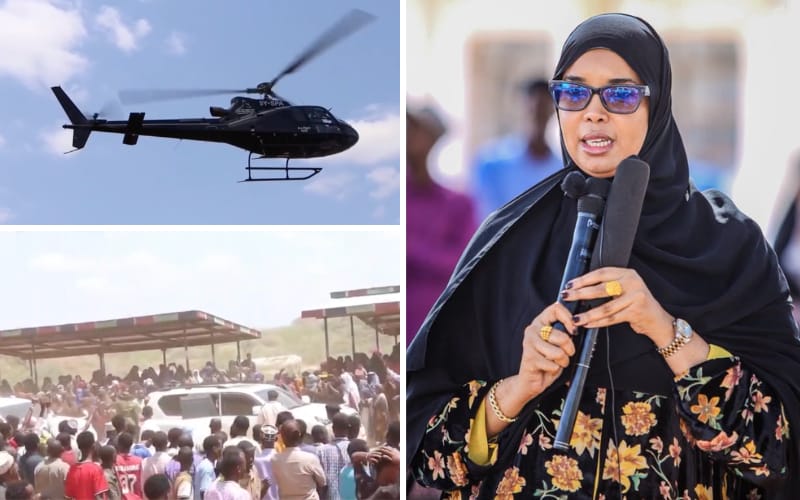
The political landscape of Wajir County was rocked to its core when County Woman Representative Fatuma Abdi Jehow touched down in the strategic northern outpost of Bute, only to be met by an unrelenting wall of hostile protests, echoing chants of “One Term,” and visible public anger.
What was intended to be a triumphant return and service delivery tour to Wajir North Constituency rapidly unraveled into a political firestorm that exposes the fragile foundation of her re-election ambitions and highlights deep-seated structural grievances across Northern Kenya.
At the center of this storm lies an explosive financial discrepancy that has ignited fierce outrage among pastoral communities, local elders, and disenfranchised youth.
Since taking office following the 2022 General Election, the Office of the Wajir County Woman Representative has received an aggregate budget allocation estimated between KSh 180 million and KSh 250 million from the National Government Affirmative Action Fund (NGAAF).
Yet, during what local residents reported as her first official ground visit to Wajir North in nearly three years, Jehow handed over a solitary cheque of KSh 1 million to the local community.
To a sub-county severely battered by catastrophic livestock losses, unrelenting climate shocks, acute water scarcity, and soaring school dropout rates, this distribution represented less than 1% of the total affirmative action resource pool managed by her office over her tenure.
Rather than being welcomed as a gesture of development, the paltry KSh 1 million disbursement was widely interpreted as a profound insult to vulnerable communities, triggering immediate backlash and exposing a breakdown in public participation, equitable resource distribution, and legislative accountability.
The fierce resistance encountered in Bute is not an isolated incident of local posturing; it is the culmination of years of mounting frustration over perceived political absenteeism.
In vast, geographically expansive frontier counties like Wajir, where terrain is harsh and communities rely heavily on visible, tangible leadership, prolonged absence from key constituencies creates deep political wounds.
For Wajir North, a region that has historically felt marginalized within county-wide decision-making matrices, being visited only when electoral timelines begin to condense sends a damaging signal.
The sight of local youth and community members boldly chanting “One Term” as the lawmaker’s entourage arrived demonstrated that the era of tokenism and superficial campaign gestures is facing unprecedented resistance from a politically awakened electorate demanding audited financial transparency and genuine grass-roots engagement.
From a strategic perspective, Jehow’s current dilemma illustrates the high-risk gamble of voter concentration. Political observers note that her administration appears to have prioritized high-density urban centers and traditional strongholds, effectively treating remote sub-counties like Wajir North as secondary voting blocs.
In county-wide affirmative action seats, however, treating any constituency as non-essential can prove fatal to re-election ambitions. While consolidating core strongholds in central or southern regions is necessary to build a baseline vote, it is rarely sufficient to cross the winning threshold in a competitive contest.
Wajir North represents a highly organized, cohesive, and decisive swing region whose cumulative turnout has historically tipped the scale in close elections.
By allowing local rivals to weaponize the narrative of total neglect, Jehow has effectively gifted her political opponents a powerful platform, transforming Bute into a nationwide focal point for anti-incumbent sentiment.
Compounding this hostility is the formidable specter of Wajir County’s political history, famously defined by the strict “Single-Term Curse” for the Woman Representative seat. Since the inception of devolved governance under the 2010 Constitution, Wajir County has never re-elected an incumbent Woman Representative to a second consecutive term.
The position has operated as a revolving door, ruthlessly cycling through occupants every five years regardless of their national profile or financial backing. In the inaugural post-devolution election of 2013, Fatuma Ibrahim Ali secured the historic seat, only to be ousted in 2017 amid shifting regional alignments and community demands for political rotation.
Her successor, Fatuma Gedi, rose to prominent national stature as a key parliamentary voice and secured significant endorsements heading into the 2022 contest, yet she too fell victim to the trend, losing the seat to Fatuma Abdi Jehow by a decisive margin.
This high turnover rate is directly tied to the intricate institution of negotiated democracy, overseen by traditional councils of elders including the Sultans and Ugaases who represent the major clan federations of Wajir, such as the Degodia, Ogaden, and Ajuran.
To maintain political stability and ensure equitable distribution of executive power across the expansive county, these traditional institutions enforce strict rotational leadership across key county-wide offices, including the Governor, Senator, and Woman Representative.
Under this unwritten social contract, any incumbent attempting to secure a second consecutive term faces an uphill battle against the entrenched norm that major county seats must rotate among sub-clans and regions to preserve communal equilibrium.
By coupling a multi-million-shilling NGAAF resource disparity with years of physical absence from Wajir North, Jehow has severely weakened her standing in the delicate matrix of negotiated democracy.
Clan elders and community influencers who monitor resource distribution across the sub-counties now possess concrete evidence of fiscal imbalance to present during upcoming consultative caucuses.
When local leaders observe that hundreds of millions in public funds yield only a fraction of investment in their backyards, their willingness to back an incumbent against traditional rotational norms evaporates.
Instead, regional rivals in Northern Wajir now hold a compelling justification to demand leadership change, framing her tenure as a failure of equitable stewardship.
Ultimately, the events in Bute represent a major turning point in the trajectory toward the 2027 General Elections in Wajir County.
To break a decade-long historical precedent and overcome the single-term barrier, an incumbent requires an exceptionally pristine record of balanced development, constant presence across all six sub-counties, and deep goodwill among traditional elders and youth movements alike.
Instead, the hostile chants in Bute signal that the fundamental vulnerabilities of absenteeism and skewed resource distribution have caught up with her administration.
As political activity accelerates across Northern Kenya, the confrontation in Wajir North stands as a stark warning: in an era of heightened public scrutiny, no constituency can be sidelined without catastrophic political consequences at the ballot box.