

For more than two decades, the United States’ policy toward Somalia followed a relatively predictable course. Washington invested heavily in Somalia’s internationally recognized Federal Government, financed African Union peace operations, trained elite Somali security forces, and coordinated counterterrorism operations primarily aimed at weakening Al-Shabaab. The overarching objective was clear: rebuild Somalia as a unified state capable of securing its own territory while preventing extremist organizations from threatening regional and international security.
Today, however, a series of diplomatic engagements and security developments suggest that this long-standing approach may be evolving.
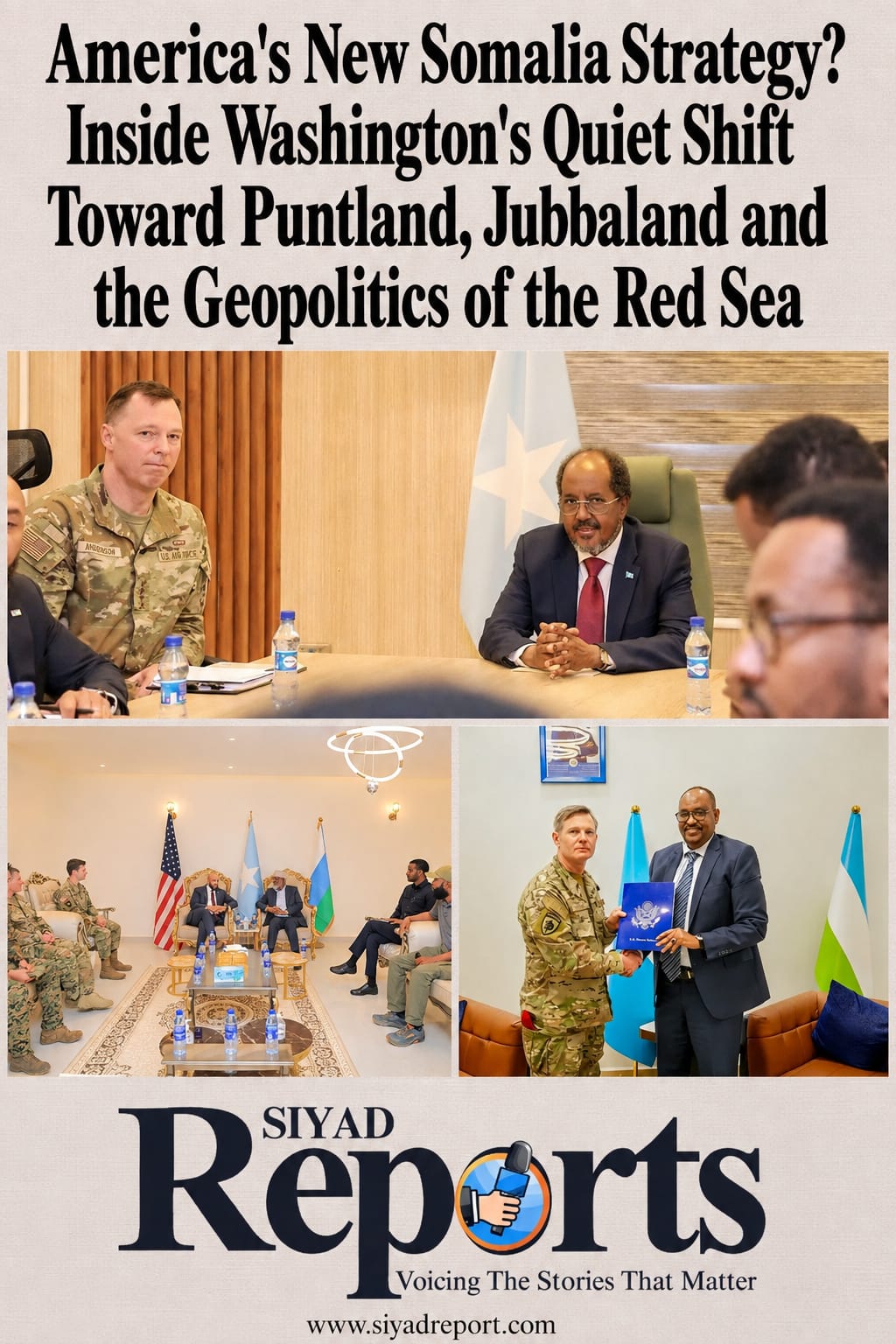
Within a matter of weeks, senior American military and diplomatic officials have engaged leaders in Mogadishu, Kismayo and Bosaso. While each meeting focused on security cooperation, the significance lies not merely in the visits themselves but in where they occurred and what they collectively signal. The latest development a security cooperation agreement between the United States and Puntland signed by Puntland President Said Abdullahi Deni and AFRICOM Special Operations Commander Maj. Gen. Claude Tudor has intensified debate over whether Washington is quietly redefining its priorities inside Somalia.
Although U.S. officials have not announced a formal policy change, the pattern of engagement points toward a more pragmatic strategy centered on strategic geography rather than solely on centralized state-building. Rather than relying exclusively on federal institutions in Mogadishu, Washington increasingly appears willing to deepen partnerships with federal member states that occupy locations of exceptional military and geopolitical value.
If this interpretation proves accurate, Somalia could be witnessing one of the most significant shifts in American policy since the fight against terrorism intensified following the September 11 attacks.
The timing of this apparent recalibration is particularly significant.
Across the wider Middle East, tensions remain high following recent confrontations involving Iran and its regional allies. The Red Sea has become one of the world’s most contested maritime corridors due to attacks on commercial shipping, while competition among global powers has intensified throughout the Horn of Africa. Against this backdrop, Somalia’s northern coastline has become increasingly valuable not simply because of Somalia itself, but because of its location overlooking some of the world’s busiest sea lanes.
From Washington’s perspective, geography matters as much as politics.
Bosaso sits near the Gulf of Aden, a maritime gateway connecting the Indian Ocean with the Red Sea through the Bab el-Mandeb Strait before vessels continue toward the Suez Canal and Europe. A substantial portion of global trade passes through this corridor every year. Any disruption whether caused by armed groups, piracy or interstate conflict can have immediate consequences for international shipping, energy markets and global supply chains.
This explains why Bosaso has steadily attracted the attention of international security planners.
The reported expansion of U.S.-Puntland security cooperation therefore extends beyond counterterrorism. While combating extremist groups remains an important objective, military planners also view the region as strategically positioned for intelligence collection, maritime surveillance, logistical support and rapid deployment across East Africa, the Red Sea and parts of the Middle East.
In military planning, location often determines strategic value more than political boundaries.
A security presence in Bosaso offers observation over maritime traffic moving through one of the world’s most important waterways while simultaneously allowing quicker responses to emerging threats throughout the Horn of Africa.
This broader strategic calculation mirrors American defense policy elsewhere.
For decades, Washington has maintained military facilities in Djibouti because of the country’s proximity to the Bab el-Mandeb Strait. Camp Lemonnier has served as the primary American base for operations across East Africa, Yemen and the wider region. Yet changing regional dynamics—including growing Chinese influence in Djibouti, increasing instability in the Red Sea and evolving security challenges—have encouraged American planners to diversify strategic partnerships throughout the Horn rather than relying on a single location.
Somalia now appears increasingly relevant within that wider regional equation.
From State-Building to Strategic Partnerships
For years, American engagement in Somalia was built around strengthening national institutions. Financial support flowed toward the Federal Government, assistance was directed through internationally recognized frameworks, and African Union peace operations formed the backbone of stabilization efforts.
The United States invested considerable resources in training Somali special forces, supporting governance reforms and enabling multinational military operations against Al-Shabaab.
However, recent developments suggest that Washington may now be balancing those objectives with another priority: ensuring that strategically located regions remain stable enough to protect American security interests regardless of broader political disagreements within Somalia.
This represents an important distinction.
Rather than replacing support for Mogadishu, Washington may be supplementing it with deeper, more direct relationships in areas considered indispensable for regional security.
Puntland and Jubbaland both fit that description.
Puntland provides access to the Gulf of Aden and overlooks vital maritime routes connecting Africa, the Arabian Peninsula and Asia.
Jubbaland, meanwhile, borders Kenya and remains one of the most active operational theatres against Al-Shabaab. Its location also makes it central to cross-border intelligence sharing, counterterrorism coordination and regional security cooperation involving Kenya and other international partners.
Recent American delegations to Kismayo focusing on security and legislative affairs reinforce the perception that Washington increasingly views these federal member states as critical components of its broader regional strategy.
This does not necessarily diminish the Federal Government’s importance.
President Hassan Sheikh Mohamud’s recent meeting with AFRICOM Commander Gen. Dagvin Anderson reaffirmed ongoing cooperation between Washington and Mogadishu. During the discussions, Somalia reiterated its commitment to achieving greater self-reliance in national security.
Yet observers noted what was absent.
There were no announcements indicating a major expansion of U.S. financial support for the African Union Support and Stabilization Mission in Somalia (AUSSOM), nor any indication that Washington intends to restore previous levels of funding for multinational peace operations.
That silence has become part of the wider debate.
American policymakers increasingly emphasize burden-sharing and sustainable partnerships rather than indefinite financial commitments abroad. This philosophy aligns closely with the broader foreign policy thinking associated with President Donald Trump’s “America First” doctrine, which argues that American overseas engagements should directly advance U.S. national interests.
Viewed through that lens, supporting strategically located partners may be seen in Washington as a more efficient use of resources than maintaining broad stabilization commitments with uncertain long-term outcomes.
The implications extend well beyond Somalia.
The Horn of Africa has become one of the world’s most competitive geopolitical arenas. China has expanded its economic and military footprint throughout East Africa. Gulf states continue investing heavily in ports and logistics infrastructure. Turkey has deepened defense cooperation with Somalia, while the United Arab Emirates maintains substantial commercial and security interests across the region.
Against this increasingly crowded strategic landscape, American policymakers face growing pressure to preserve influence without significantly expanding military expenditures.
Partnerships with strategically positioned regional authorities could therefore offer Washington greater operational flexibility while reducing political and financial costs.
At the same time, such an approach carries risks.
Somalia’s federal system remains politically sensitive, with recurring tensions between the Federal Government and some federal member states over constitutional powers, resource sharing and security responsibilities. Expanding direct international engagement with regional administrations could generate perceptions that external partners are bypassing national institutions, potentially complicating Somalia’s already delicate federal balance.
These political dynamics are likely to become increasingly important if security cooperation expands further.
Another question concerns the long-term military implications of Bosaso.
Speculation has grown over whether the United States intends to establish a larger or more permanent military presence there. While no official announcement has confirmed such plans, analysts note that an expanded security footprint would significantly improve America’s surveillance, intelligence, logistics and rapid-response capabilities across the Gulf of Aden and the Red Sea.
Such capabilities would be particularly valuable if regional instability were to intensify.
Nevertheless, linking Bosaso directly to any future confrontation involving Iran or other regional powers remains speculative. While Somalia’s strategic geography inevitably places it within broader regional security calculations, no evidence currently indicates that the country is being positioned as a launch point for future military operations related to wider Middle Eastern conflicts.
What is clear, however, is that Somalia’s geopolitical value has risen considerably.
Its coastline stretches thousands of kilometers along waters that connect Africa, the Middle East and Asia. Its proximity to global shipping lanes gives it strategic significance extending far beyond its domestic politics.
For international powers, Somalia is increasingly viewed not only through the lens of counterterrorism but also through maritime security, regional competition, trade protection and geopolitical influence.
For Somalia itself, this renewed international attention presents both opportunity and responsibility.
Closer partnerships with major powers can strengthen security capabilities, improve maritime surveillance and attract investment in defense infrastructure. At the same time, Somali leaders must carefully balance those relationships to ensure that external cooperation strengthens national sovereignty rather than creating new political divisions or exposing the country to rivalries among global powers.
Whether Washington’s recent engagements represent a temporary tactical adjustment or the beginning of a lasting strategic realignment remains to be seen.
What is beyond dispute is that American attention is increasingly focusing on Somalia’s strategic geography as much as its domestic politics. In today’s rapidly changing geopolitical environment, ports, coastlines and maritime corridors have become as important as capitals and government institutions.
If the pattern witnessed in Mogadishu, Kismayo and Bosaso continues, historians may eventually view this period as the moment when U.S. policy toward Somalia evolved from a strategy centered primarily on state-building into one equally driven by geopolitical competition, maritime security and strategic regional partnerships.
Such a transformation would not only redefine America’s role in Somalia but could also reshape the balance of power across the Horn of Africa for years to come.