

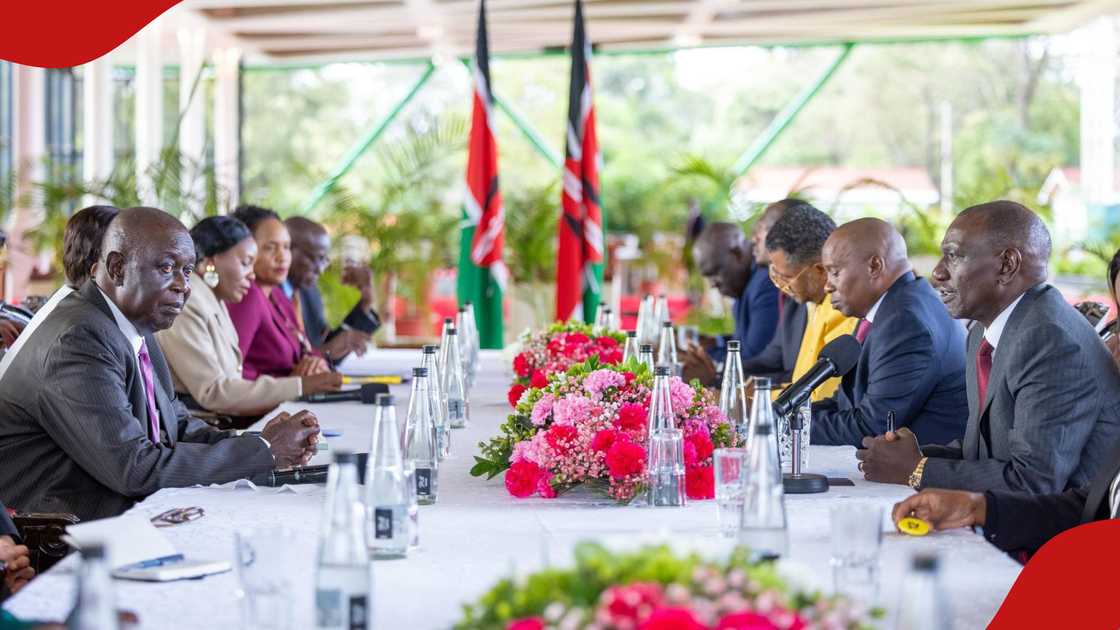
President William Ruto and senior leaders from the United Democratic Alliance (UDA) and the Orange Democratic Movement (ODM) are meeting in Naivasha as the broad-based government enters a more politically sensitive phase, with the two parties beginning to confront the difficult question of how their cooperation in government can be transformed into an electoral partnership for the 2027 General Election.
The two-day retreat at Lake Naivasha Resort brings together governors, deputy governors, Members of Parliament and senior political figures from the two parties at a moment when the political calculations surrounding the next election are becoming increasingly clear.
What began as a broad-based arrangement designed to bring political rivals together in government is now moving towards a much more complicated conversation about power, positions, nominations and the distribution of political influence.
The timing of the retreat is significant. With the 2027 election approaching, UDA and ODM can no longer concentrate solely on running the government together. They must also determine whether they can remain partners when their politicians begin competing for the same parliamentary, gubernatorial and senatorial seats across the country.
That tension is likely to define the political discussions in Naivasha.
The broad-based government was built around cooperation between President Ruto and the late former Prime Minister Raila Odinga, with ODM leaders subsequently taking positions within the administration. Raila’s death and the emergence of Oburu Oginga as ODM’s acting party leader have altered the political equation, while the emergence of the Linda Mwananchi faction has added another layer of uncertainty to ODM’s internal politics.
The question now is whether the political understanding established between Ruto and Raila can survive the transition and become a formal electoral arrangement capable of carrying both UDA and ODM into the 2027 election.
For President Ruto, the challenge is to preserve the strength of the UDA political machine while accommodating ODM without allowing the demands of its leaders to weaken his control over the presidential ticket.
For ODM, the challenge is different. Having entered government as part of the broad-based arrangement, the party now wants its participation translated into a clearly defined political stake in the next administration.
That is where the question of the Deputy President becomes particularly important.
ODM leaders have already indicated that they expect the position to form part of negotiations for a possible 2027 coalition. Senate Minority Leader Stewart Madzayo has argued that the President and Deputy President should not come from the same party, opening the door for ODM to demand the position if it formally supports Ruto’s re-election.
The demand immediately places Deputy President Kithure Kindiki at the centre of the emerging political negotiations.
Kindiki’s supporters are expected to resist any attempt to remove him from the ticket, while ODM politicians have begun positioning their preferred candidates. Cooperatives Cabinet Secretary Wycliffe Oparanya has emerged among the names being associated with a possible running-mate arrangement.
The debate, however, is much bigger than the personalities being mentioned.
The Deputy President position would represent ODM’s influence within a potential Ruto-led 2027 coalition and would determine how much political power the party could expect to wield in a second Ruto administration.
The negotiations could therefore become a test of how far Ruto is prepared to go to secure ODM’s political support without compromising the interests of his existing political allies.
Another potentially explosive issue is political zoning.
ODM has been pushing for an arrangement in which coalition partners respect one another’s traditional political strongholds. Such an arrangement would allow parties to avoid direct competition in areas where one coalition partner has traditionally enjoyed significant support.
UDA, however, has maintained that political parties should retain the freedom to field candidates across the country.
That difference could become one of the biggest obstacles to a formal coalition agreement.
The presidential contest may unite the parties, but elections are ultimately fought at constituency, county and senatorial levels as well. Politicians seeking parliamentary and county positions will not necessarily be willing to withdraw their ambitions simply because their parties have reached an agreement at the national level.
A UDA politician in an ODM-leaning constituency may want to contest regardless of the coalition agreement. An ODM aspirant in a traditionally UDA area may make the same calculation.
This means that any agreement between the two parties will have to answer a difficult question: can UDA and ODM campaign together for the presidency while competing against each other for other elective positions?
The Naivasha retreat is therefore not simply a meeting to discuss the performance of the broad-based government. It is the beginning of a much larger political negotiation.
National Assembly Majority Leader Kimani Ichung’wah has indicated that leaders will discuss the political direction of the partnership and work towards establishing a team that will handle coalition negotiations.
Such a team could eventually be tasked with addressing some of the most politically sensitive questions ahead of 2027, including the presidential ticket, the Deputy President position, parliamentary seats, county positions, regional representation and the terms of a formal coalition agreement.
The National Dialogue Committee, commonly known as NADCO, also remains part of the political background to the arrangement.
NADCO helped establish the framework for political cooperation between Ruto and Raila and proposed institutional changes, including the creation of an Office of the Prime Minister and an Office of the Official Leader of the Opposition.
Those proposals could acquire renewed political significance if the two sides seek to build a broader framework for cooperation ahead of 2027.
At the same time, the government will want to place its development record at the centre of the political conversation. President Ruto’s Beyond Vision 2030 agenda is expected to provide part of the policy framework through which the administration presents its plans for the country.
But policy alone may not be enough to hold the emerging alliance together.
Kenyan coalition politics has historically been shaped as much by questions of power-sharing and political survival as by policy. Parties can agree on development priorities while disagreeing sharply over who gets the presidential ticket, which region receives the running-mate position and who contests parliamentary seats.
That is the political reality facing UDA and ODM.
The Naivasha retreat therefore marks an important transition. The broad-based government was initially about bringing political opponents into one administration. The next stage is about determining whether those partners can become electoral allies.
For Ruto, the objective will be to maintain control of the presidential contest while keeping the coalition broad enough to secure support across different regions.
For ODM, the opportunity is to turn its government participation into concrete political influence and negotiate a stronger position ahead of the election.
But both sides face the same danger.
The closer the 2027 election gets, the harder it will become to separate government cooperation from electoral competition.
The Deputy President debate has already exposed the fault lines. The disagreement over zoning could deepen them. Questions over parliamentary and county contests could make the negotiations even more complicated.
The real test of the Naivasha retreat will therefore not be whether the leaders leave with another declaration of unity.
It will be whether UDA and ODM can establish a political formula that allows them to share power, protect their respective political interests and still present themselves to Kenyans as a credible coalition capable of governing together after 2027.
The election may still be a year away, but the negotiations that could determine its political architecture have already begun.