

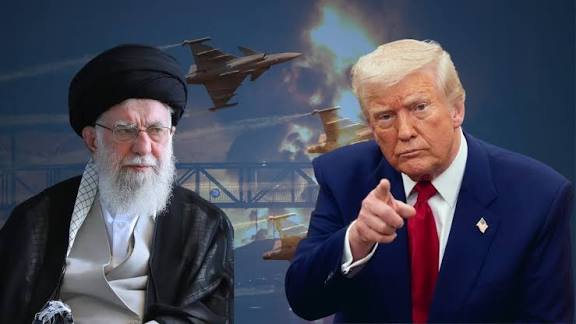
On January 28, 2026, former U.S. President Donald J. Trump reignited global anxiety with a dramatic and highly provocative public message directed at Iran. Posted on his X (formerly Twitter) account, Trump announced that a “massive Armada” led by the aircraft carrier Abraham Lincoln was heading toward Iran, warning that it was ready to carry out its mission “with speed and violence, if necessary.” He framed the deployment as a final warning, urging Iran to “come to the table” and negotiate what he described as a “fair and equitable deal” focused on one central demand: no nuclear weapons.
The language was unmistakably confrontational. Trump referenced a previous military action which he called “Operation Midnight Hammer” claiming it caused major destruction in Iran after Tehran failed to heed earlier warnings. This time, he cautioned, the consequences would be “far worse” if Iran refused to negotiate. The message ended with a familiar Trump-style ultimatum: “MAKE A DEAL! Time is running out.”
This was not merely political rhetoric. It was a calculated signal part deterrence, part coercion delivered at a moment when U.S.–Iran relations are already strained by years of mistrust, broken agreements, military encounters, and regional instability. The post immediately sent shockwaves through diplomatic circles, markets, and regional capitals, raising one unavoidable question: is the United States edging closer to a direct military confrontation with Iran?
Iran’s response was swift and defiant. Tehran rejected Trump’s claims outright. Senior Iranian officials, including the foreign minister, stated clearly that Iran had not requested talks with the United States and had not received any formal proposal. More importantly, they warned that Trump’s aggressive messaging made negotiations increasingly unlikely. Iran insisted that diplomacy cannot take place under threats, stressing that continued provocation would close not open the door to dialogue.
This exchange highlights the deep strategic disconnect between Washington and Tehran. While Trump presents military pressure as a tool to force negotiations, Iran interprets the same pressure as intimidation and a violation of sovereignty. That fundamental mismatch in perception is what makes the current moment especially dangerous.
The context surrounding this escalation cannot be ignored. Iran is facing internal pressures, including economic hardship and social unrest, while still dealing with the aftermath of earlier military strikes that damaged parts of its nuclear infrastructure. The Iranian leadership views any new U.S. military movement in the region not as routine deterrence, but as preparation for potential aggression. Against that backdrop, Trump’s words were seen less as diplomacy and more as an open threat.
At the same time, the deployment of a large U.S. naval force is not, by itself, an automatic precursor to war. Historically, Washington has used aircraft carriers and armadas to project power, reassure allies, and strengthen its hand in negotiations. The United States often signals readiness without necessarily intending immediate conflict. However, when such deployments are accompanied by explicit threats of “violence” and references to past attacks, the margin for miscalculation narrows significantly.
Iran, for its part, has made it clear that it would treat any direct attack as an act of war. Iranian officials have warned that retaliation would be swift and decisive, and that the consequences would not be limited to Iran alone but would affect the entire region. Tehran’s military doctrine relies heavily on deterrence, asymmetric capabilities, and regional influence tools it would almost certainly activate if conflict erupts.
What makes this standoff particularly risky is the apparent lack of functioning diplomatic channels. Public statements suggest that formal communication between Washington and Tehran is minimal, if not nonexistent. Without reliable back-channel dialogue or trusted intermediaries, the chances of misunderstanding intentions increase. In such an environment, a naval maneuver, an intercepted signal, or a regional incident could rapidly spiral out of control.
Regional and global actors are watching closely. A direct U.S.–Iran conflict would have profound consequences from destabilizing the Middle East to disrupting global energy markets. That is why several countries, including regional powers, have urged restraint and incremental diplomacy, arguing that disputes should be addressed issue by issue rather than through sweeping ultimatums. So far, however, those calls have not softened the rhetoric coming from either side.
Trump’s approach reflects a familiar strategy from his previous presidency: apply maximum pressure, create a sense of urgency, and force the opponent into a deal from a position of perceived weakness. While this method has worked in certain contexts, it carries enormous risks when applied to a state like Iran, which sees resistance as central to its national identity and political survival.

Is War Inevitable or Still Avoidable?
Despite the alarming tone, war is not inevitable at least not yet. Both Washington and Tehran have strong reasons to avoid a full-scale confrontation. The United States would face enormous military, political, and economic costs, as well as potential backlash from allies and the international community. Iran, meanwhile, understands that a direct conflict with the U.S. would be devastating, even if it could inflict damage in return.
Yet acknowledging that war is undesirable does not mean it cannot happen. History shows that conflicts often begin not by deliberate choice, but through escalation, miscalculation, or the collapse of diplomacy. The current situation contains all the ingredients for such a scenario: aggressive rhetoric, military movements, mutual distrust, and a lack of clear communication.
Trump’s public warning places Iran in a difficult position. If Tehran engages in talks after such threats, it risks appearing to submit to coercion something its leadership is unlikely to accept. If it refuses, it risks further escalation and possibly military action. This is the classic dilemma of coercive diplomacy, where pressure intended to force compromise instead hardens resistance.
Iran’s insistence that it did not request talks and will not negotiate under threats signals a firm stance, but it also narrows the path to de-escalation. Without indirect negotiations, third-party mediation, or a cooling of rhetoric, both sides may continue edging closer to confrontation even if neither truly wants war.
For now, the crisis remains at a critical but fluid stage. The U.S. armada is a signal, not a strike. Iran’s response is defiant, not mobilization for immediate war. Between these two positions lies a shrinking space for diplomacy one that can only be preserved through restraint, quieter channels of communication, and a willingness to step back from public ultimatums.
The world has seen similar moments before moments when war seemed imminent, only to be avoided at the last minute through diplomacy. Whether this will be one of those moments remains uncertain. What is clear is that Trump’s message has raised the stakes dramatically, placing U.S.–Iran relations at one of their most dangerous points in years.
Until cooler heads prevail or credible negotiations begin, the spectre of conflict will continue to hang over the region. And as history has shown time and again, when great powers trade threats instead of trust, the cost is rarely paid by leaders alone but by entire nations and regions caught in between.