

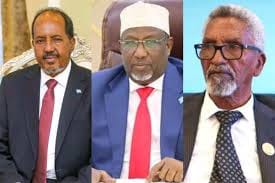
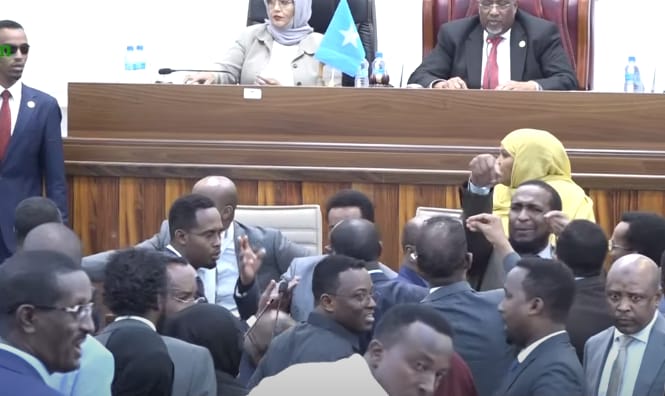
The dramatic scenes that unfolded inside Somalia’s Federal Parliament today were not merely an episode of legislative disorder, they were a loud political verdict. When lawmakers ripped apart the parliamentary agenda, traded blows on the floor, and forced the Speaker to abruptly adjourn the sitting, the institution of parliament itself sent a signal that the constitutional process under President Hassan Sheikh Mohamud has reached a dangerous breaking point.
What played out was not spontaneous chaos. It was the eruption of long-simmering political resentment, mistrust, and unresolved federal tensions that have been building since the president pushed through earlier constitutional amendments without broad-based consensus. The attempt to introduce additional amendments particularly as his term edges closer to its conclusion acted as the final trigger.
For President Hassan Sheikh, the crisis now transcends constitutional reform. It has become a test of political survival, state cohesion, and legitimacy. With parliament fractured, federal member states openly defiant, and former allies shifting camps, the president’s room for maneuver has narrowed considerably. Yet, despite the severity of the moment, several strategic paths remain each with profound consequences for Somalia’s fragile political equilibrium.
At the heart of the current standoff is not simply the content of the proposed amendments but the manner in which power is being exercised. Opposition lawmakers, backed by the leadership of Puntland and Jubbaland, argue that the president has adopted a unilateral approach to constitutional change, sidelining consensus in favor of speed and control. In a federal system still struggling to define the boundaries between Mogadishu and the regions, such an approach was bound to provoke resistance.
The events inside parliament symbolized this breakdown. The tearing of agenda papers was a symbolic rejection of process, not just policy. It reflected a legislature that no longer feels bound by institutional discipline because it believes the rules themselves have been violated. When security minister exchange punches with fellow MPs, it underscores a deeper institutional collapse where executive power, legislative authority, and political accountability have blurred into confrontation.
One of the most consequential developments is the reported shift of Somaliland MPs in the Federal Parliament toward the opposition. These lawmakers were previously instrumental in passing the first four constitutional amendments, often siding with Villa Somalia. Their defection now is not ideological it is geopolitical. As tensions between Somaliland’s leadership and the Federal Government intensify, northern MPs have recalibrated their loyalties accordingly. This realignment significantly weakens the president’s numerical and political leverage inside parliament, making any future amendment push far more difficult, if not impossible.
Against this backdrop, President Hassan Sheikh faces several possible paths none of them easy.
The first option is political de-escalation through dialogue and compromise. This would require the president to pause the constitutional amendment process entirely and initiate an inclusive national dialogue involving opposition leaders, federal member state presidents, civil society actors, and traditional elders. Such a move would signal acknowledgment that the current trajectory is unsustainable. It would also restore some legitimacy to the constitutional process, which is increasingly viewed as executive-driven rather than nationally owned. However, this path demands political humility and a willingness to surrender short-term control traits that incumbents nearing the end of their terms often struggle to embrace.
A second option is strategic retreat: shelving the remaining amendments altogether and focusing on stabilizing governance until the next electoral cycle. This would be a tacit admission that the constitutional project has failed to gain national buy-in. While this might preserve institutional calm and prevent further parliamentary breakdowns, it would also leave the president vulnerable to criticism from supporters who view constitutional reform as his legacy project. More importantly, it would shift the reform debate into the next administration, potentially weakening Hassan Sheikh’s historical standing.
The third, and most risky, path is confrontation attempting to push forward regardless of parliamentary resistance. This could involve leveraging executive authority, security influence, and loyal blocs within parliament to reintroduce the amendments in a different form or forum. Such a strategy, however, carries severe consequences. Puntland and Jubbaland have already signaled that they do not recognize amendments passed without consensus. Forcing the issue could deepen federal fragmentation, encourage regional non-compliance, and further delegitimize Mogadishu’s authority. In a country still battling Al-Shabaab and dependent on international support, such internal disunity would be catastrophic.
There is also a fourth, quieter option: political reconfiguration. The president may attempt to rebuild a working majority by negotiating new alliances within parliament offering political concessions, appointments, or policy trade-offs. Somali politics has long operated on negotiated loyalties rather than fixed ideological lines. Yet the scale of the current revolt suggests that transactional politics alone may not be enough this time. When opposition hardens around process legitimacy rather than personal grievances, inducements lose their effectiveness.
Beyond the immediate choices facing President Hassan Sheikh, the parliamentary chaos exposes a deeper structural problem within Somalia’s governance framework. Constitutional reform in post-conflict societies requires patience, trust, and inclusivity. Rushing amendments especially those perceived to consolidate executive power inevitably provokes resistance. Somalia’s federal experiment remains unfinished, and any attempt to redefine power relations without federal consensus risks unraveling what little cohesion exists.
The role of the Speaker and parliamentary leadership will also be critical in the days ahead. Their walkout effectively suspended institutional function, but it also protected the parliament from further degeneration. Whether the Speaker can now act as a neutral broker or is perceived as aligned with Villa Somalia will influence whether parliament regains authority or becomes a battleground for executive-legislative warfare.
International actors are watching closely. Somalia’s donors and partners have consistently emphasized consensus-driven governance as a condition for continued support. A prolonged constitutional crisis, marked by violence inside parliament, will raise alarms about political stability, reform credibility, and electoral preparedness. This external pressure may ultimately push the president toward compromise, even if reluctantly.
In the end, the chaos in parliament may prove to be a political inflection point rather than merely a setback. For President Hassan Sheikh Mohamud, it is a moment that forces a choice between legacy and longevity. Whether he emerges as a statesman who recalibrated in the face of resistance or as a leader whose constitutional ambitions fractured parliament will depend on what he does next.
What is clear is this: the era of uncontested constitutional engineering is over. Parliament has revolted, federal states have drawn red lines, and former allies have crossed the aisle. Somalia’s political future now hinges not on how fast reforms are passed, but on whether legitimacy can be rebuilt before institutions collapse under the weight of unresolved power struggles.