

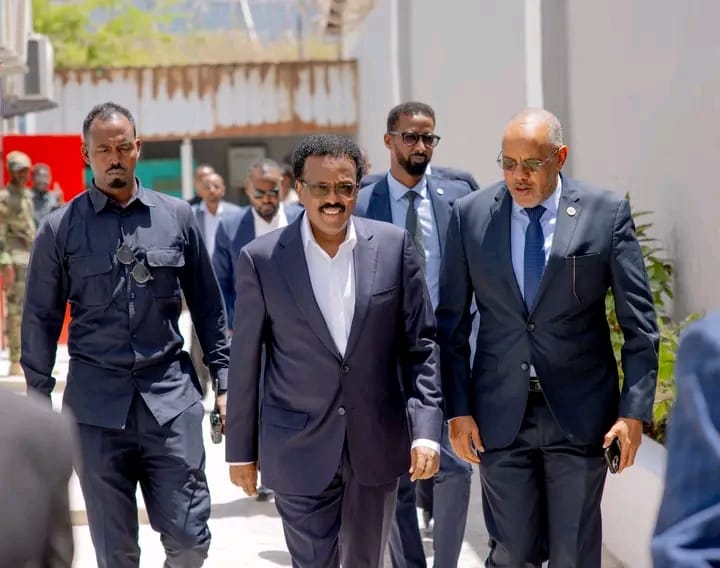
Former Somali President Mohamed Abdullahi Farmaajo has met Puntland President Said Abdullahi Deni and Jubbaland President Ahmed Mohamed Islam Madobe in Mogadishu, in what observers see as a significant political moment amid growing tensions over Somalia’s constitutional direction and electoral future.
Deni and Madobe are currently in the capital for consultations with President Hassan Sheikh Mohamud, as disagreements intensify between the Federal Government and some Federal Member States over constitutional amendments, the structure of elections, and the balance of power within the federal system. Their visit comes at a time when opposition figures and regional leaders have raised concerns about what they describe as shrinking political space and limited consensus-building on critical national decisions.
Following his meeting with the two regional presidents, Farmaajo issued a brief but pointed message calling for compromise at the highest level of leadership.
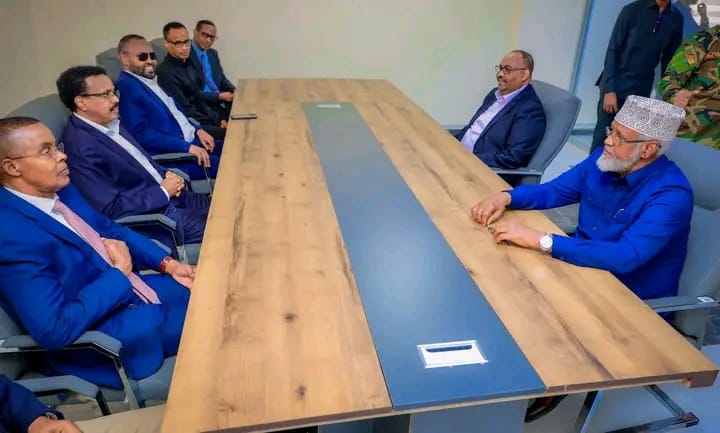
“I urge President Hassan Sheikh to show compromise and leadership to overcome the current deadlock and protect the country from constitutional uncertainty,” he said.
The statement places Farmaajo squarely within the broader political conversation, signaling alignment with calls for inclusive dialogue rather than unilateral reforms. His remarks also reflect a growing narrative among opposition-leaning figures that Somalia risks entering a period of constitutional ambiguity if disputes over electoral models and amendments are not resolved through consensus.
At the center of the current political debate is the federal government’s push to advance constitutional changes and reshape the electoral framework. While the administration argues that reforms are necessary to stabilize governance and transition toward a more democratic system, critics in Puntland and Jubbaland insist that such changes must be anchored in broad-based agreement among federal stakeholders.
The presence of Deni and Madobe in Mogadishu in what political pundits describes carries symbolic and strategic weight. It represents both resistance to perceived centralization and a willingness to negotiate within institutional channels rather than escalate tensions publicly. Political analysts note that Somalia’s federal experiment remains delicate, with trust deficits between Mogadishu and some regional capitals frequently resurfacing during moments of constitutional transition.
Beyond the legal and procedural arguments lies a deeper political contest over influence, legitimacy, and the future architecture of power in Somalia. The outcome of these discussions could redefine not only the electoral process but also the political space available to opposition actors and regional administrations ahead of the next political cycle.
As negotiations continue, the country watches closely. Whether these engagements produce compromise or entrench divisions will determine if Somalia moves toward inclusive political settlement or deeper polarization at a time when unity remains critical for both governance and national stability.