

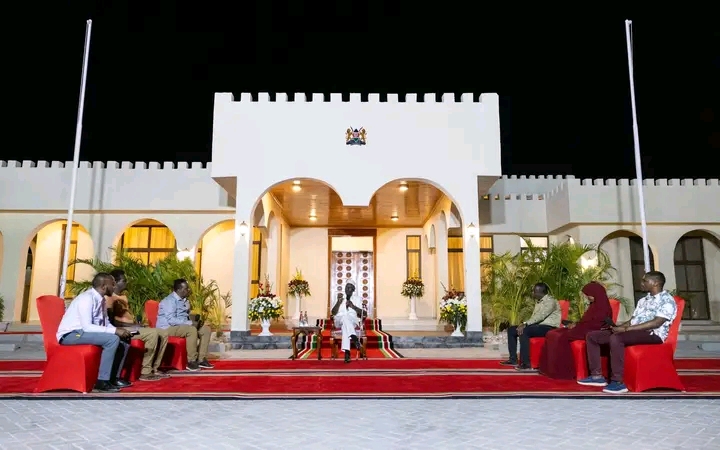
“I am not doing things for people to vote for me. I am doing them because I am the President of Kenya. They do not have another president and I am doing them because it is the right thing to do.” Those were the words of President William Ruto during an extensive engagement with North Eastern media practitioners at the Wajir State Lounge following the historic Madaraka Day celebrations in Wajir County.
The media roundtable provided President Ruto with an opportunity to reflect on his administration’s development agenda, address concerns affecting Northern Kenya, discuss relations with neighbouring Somalia, and defend what he described as difficult but necessary decisions aimed at transforming the country.
At the heart of the President’s message was his insistence that development should never be determined by political calculations, ethnicity, regional affiliations, or voting patterns. According to Ruto, every Kenyan deserves equal attention and service from the national government regardless of where they live or how they vote.
“I am not undertaking development projects to win votes. I do so because I am the President of Kenya, and every Kenyan deserves equal service from their government. They have no other president, and it is my responsibility to serve them because it is the right thing to do. Some of the decisions I make may not be popular, but I remain committed to doing what is right for the country,” he said.
The President described the decision to hold this year’s Madaraka Day celebrations in Wajir as a historic milestone not only for the county but for the entire Northern Kenya region. He said the occasion symbolized the government’s determination to end decades of exclusion and ensure the region receives its fair share of national development.
According to Ruto, Northern Kenya is now entering a new chapter after years of neglect, with significant investments being directed toward infrastructure, education, water, electricity, housing, irrigation and economic development projects.
“The journey towards correcting the wrongs of the past has begun. Northern Kenya is getting what is due to them in terms of the education of their children. The development of this region, whether it is in roads, whether it is in electricity, we are working on water and all the other things that this region deserves,” the President stated.
He noted that the government is actively investing in roads, electricity connectivity, housing projects, markets, hostels, water infrastructure and irrigation schemes to accelerate economic growth and improve living standards across the region.
Ruto framed the investments as part of a broader national vision of inclusivity, arguing that leadership requires ensuring every Kenyan feels represented and valued within the republic.
“It was the right thing to do. I believe in inclusivity. I have been given the responsibility of being the father of this nation, and just as a father thinks about all his children, I have a duty to ensure that no part of Kenya feels like it does not belong,” he said.
The President further emphasized that his political philosophy is built around national unity and inclusiveness. He pointed to the broad-based government arrangement as evidence of his commitment to bringing together leaders and communities from different political backgrounds.
“I am very proud that today we have a broad-based government, one that creates the opportunity for more people to work together, to create a sense of belonging to different parts of Kenya, different communities, different people from different political positions,” he said.
Ruto also used the engagement to highlight what he considers achievements of his administration in stabilizing the country’s economy. Responding to critics who have questioned his economic promises, the President argued that his government has delivered measurable results since taking office.
“Today, I can face the people of Kenya and tell them that when I spoke to you about the economy, I meant it. I have sorted out inflation, dealt with exchange rates, and addressed interest rates. Today, we have saved more money than ever before,” he stated.
While defending his economic record, the President acknowledged that Kenya still faces significant challenges that require continued investment and long-term planning. He particularly pointed to infrastructure and food security as key areas requiring urgent attention.
“We need to develop more infrastructure, especially transport and logistics, roads, tolls, highways, airports and seaports. We need to put in money there and we are still a country that is food deficient,” he said.
The remarks underscored his administration’s focus on expanding critical infrastructure networks as a foundation for economic growth, trade and regional integration.
On governance and service delivery, Ruto announced that the Cabinet has approved funding to expand judicial infrastructure across the country. Wajir is among the counties expected to benefit from the initiative.
The President expressed confidence that the allocation of resources would facilitate the establishment and full operationalization of a High Court in Wajir, a move expected to improve access to justice for residents who have long faced challenges in obtaining judicial services.
The discussion also touched on Kenya’s relationship with neighbouring Somalia and the ongoing challenges affecting cross-border trade. While acknowledging existing border-related concerns, Ruto maintained that economic exchanges between the two countries remain active.
According to the President, traders have continued moving goods through alternative routes, including maritime transport, ensuring that commercial ties between the two nations remain intact despite the challenges.
He revealed that ongoing diplomatic engagements could eventually help resolve the issues affecting cross-border movement and cooperation. Ruto also disclosed that Somali President Hassan Sheikh Mohamud is expected in Kenya for the upcoming Ocean Summit, where the two leaders are expected to discuss matters of mutual interest, including trade, security and regional cooperation.
At the same time, the President confirmed that Kenya has put plans to reopen the Kenya-Somalia border on hold. He cited the absence of a coherent strategy to address Somalia’s internal challenges, unpredictable funding arrangements and the country’s ongoing political stalemate as key factors behind the decision.
Even as he defended government policy on regional matters, Ruto dismissed criticism from opposition leaders, arguing that political slogans and demonstrations cannot substitute for tangible development.
Speaking candidly, he challenged his critics to account for their own records and achievements, insisting that his administration’s performance can be measured through completed projects and economic reforms rather than political rhetoric.
“The ultimate decision-makers are the people of Kenya,” he said, maintaining that leadership should be judged on results rather than political theatrics.
The President also reflected on his role as a national leader, arguing that he enjoys relationships across different regions of the country because he has chosen to lead inclusively.
“I think I am one of the politicians in Kenya that can go to Nyanza and there is a relationship between me and them. Western the same, Central the same, Northern Kenya the same, Coast the same. In my place as the leader of this nation, I have a unique responsibility to be the father of the nation,” he said.
As the curtains closed on the historic Madaraka Day celebrations in Wajir, President Ruto’s message remained consistent throughout the engagement: that national development must be inclusive, difficult decisions must sometimes be made for the greater good, and no region of Kenya should feel forgotten. Whether discussing roads and electricity in Northern Kenya, economic reforms, judicial expansion, food security, or relations with Somalia, the President sought to project an image of a government focused on long-term transformation rather than short-term political gain.
For a region that has often felt marginalized, the symbolism of hosting Madaraka Day and the promises made during the Wajir media roundtable may ultimately be remembered as a defining moment in Northern Kenya’s place within the national development agenda.