

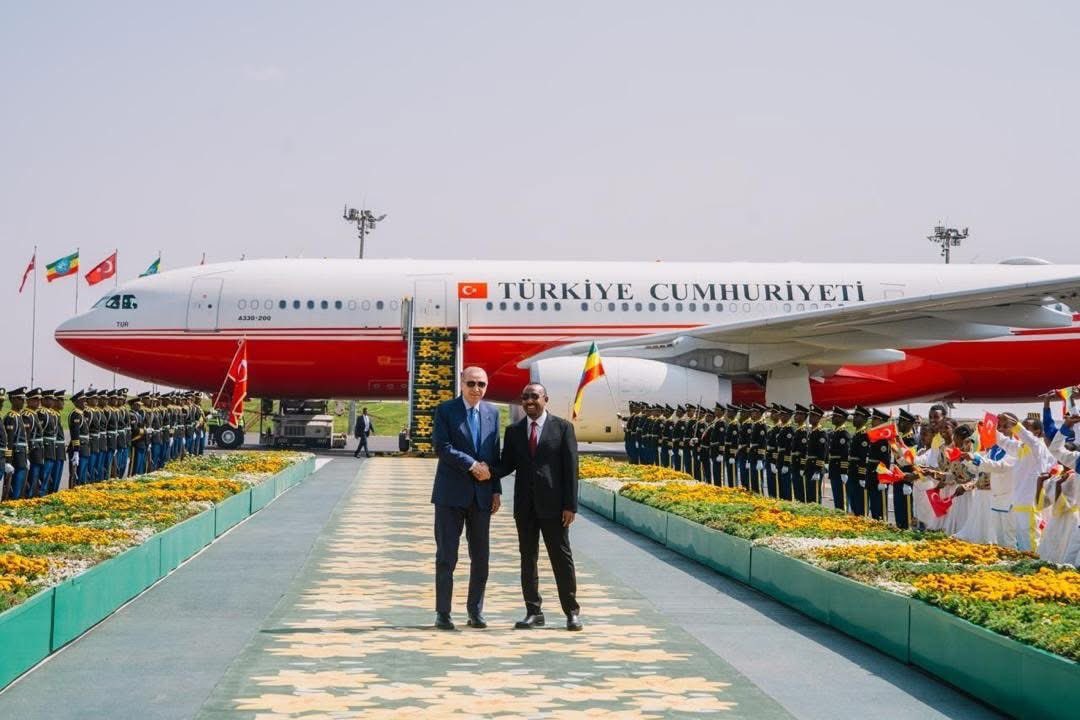
Turkish President Recep Tayyip Erdoğan’s official visit to Ethiopia on Tuesday marked more than a routine diplomatic engagement. It unfolded at a time of shifting alliances, rising geopolitical competition in the Red Sea, and heightened tensions over Somaliland’s international recognition. Welcomed warmly in Addis Ababa by Prime Minister Abiy Ahmed, Erdoğan’s trip symbolized the steady consolidation of Turkey–Ethiopia relations while placing Somalia and the future of the Horn of Africa at the core of strategic discussions.
Though the two leaders signed agreements focusing on economic cooperation including the 9th Turkey–Ethiopia Joint Economic Commission and a Memorandum of Understanding on energy collaboration the political undertones of the visit were unmistakable. Somalia’s territorial integrity, Ethiopia’s search for sustainable maritime access, and the broader implications of Israel’s reported recognition of Somaliland were central to the regional context shaping the talks.
Deepening Turkey–Ethiopia Ties Amid Red Sea Geopolitics
Turkey’s engagement in Ethiopia reflects Ankara’s broader Africa strategy, which has accelerated over the past decade. Turkey has significantly expanded diplomatic missions across the continent, increased trade volumes, and strengthened defense and development cooperation. Ethiopia, with its large population, strategic location, and growing industrial base, represents a crucial partner in East Africa.
The agreements signed during the visit aim to deepen economic integration, boost trade, and encourage Turkish investment in Ethiopian energy and infrastructure projects. Ethiopia’s ambition to become a manufacturing hub aligns with Turkey’s expertise in construction, logistics, and industrial development. For Ankara, Ethiopia provides not only economic opportunity but also geopolitical relevance in the Horn of Africa a region bordering one of the world’s most vital maritime routes.
The Red Sea corridor carries a significant portion of global trade. Control and influence over ports and logistics hubs in the Horn have attracted attention from Gulf states, Western powers, and Asian economies. Turkey’s presence in the region including its longstanding cooperation with Somalia places it in a unique position to engage multiple actors while projecting itself as a stabilizing force.
However, economic cooperation cannot be separated from security considerations.
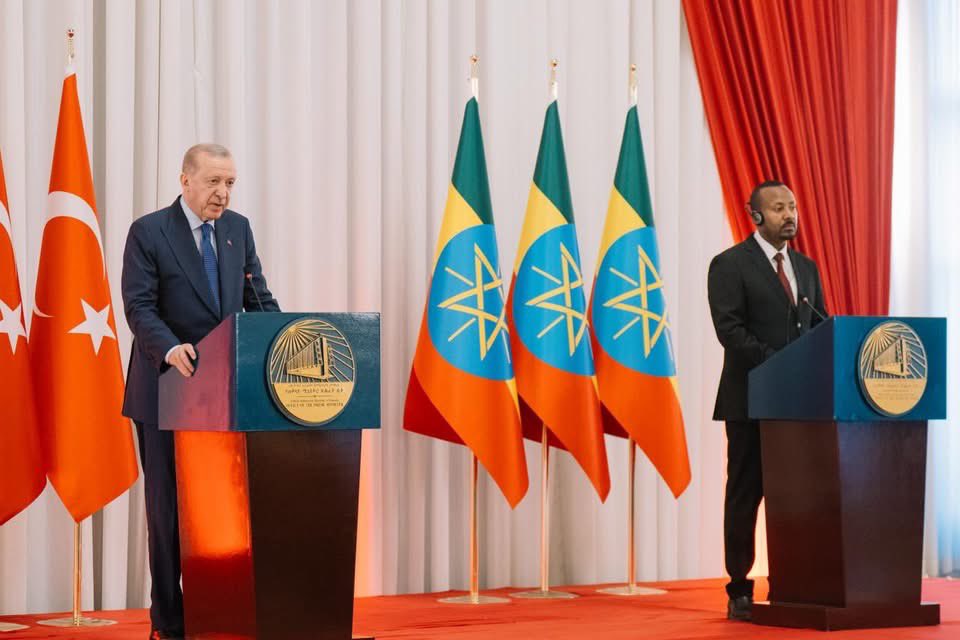
The Horn of Africa has experienced recurring tensions involving maritime access, sovereignty disputes, and shifting diplomatic recognitions. In this context, Erdoğan’s remarks during the joint press conference were particularly significant.
Addressing Israel’s recognition of Somaliland, Erdoğan stated that such a move would bring no benefit to Somaliland or the wider Horn of Africa. The statement was widely interpreted as reaffirming Turkey’s consistent support for Somalia’s territorial unity. Turkey has long maintained that Somalia’s sovereignty must be respected, and it has invested heavily in Mogadishu through infrastructure, humanitarian assistance, and security training.
For Ethiopia, this diplomatic landscape presents both opportunity and complexity.
Somalia, Somaliland Recognition, and Ethiopia’s Maritime Calculus
Somalia’s territorial integrity remains one of the most sensitive issues in the Horn of Africa. Since declaring independence in 1991, Somaliland has operated with de facto autonomy, yet it lacks broad international recognition. Any move by external actors to formally recognize Somaliland has immediate regional consequences, particularly for Mogadishu.
Ethiopia’s interest in sea access adds another layer to this dynamic. Since becoming landlocked in 1993 following Eritrea’s independence, Ethiopia has relied heavily on Djibouti for maritime trade. Prime Minister Abiy Ahmed has repeatedly emphasized the economic necessity of securing reliable and diversified sea access for Ethiopia’s long-term growth. For a country of over 120 million people with expanding industrial ambitions, maritime dependency represents both a strategic vulnerability and a financial burden.
Earlier debates in the region raised concerns about how Ethiopia might pursue sea access. Some proposals involving port agreements triggered diplomatic friction with Somalia. The Somali federal government firmly insists that any arrangement affecting its coastline must respect national sovereignty and constitutional processes.
Against this backdrop, Erdoğan’s visit to Addis Ababa carried deeper strategic weight. Turkey is uniquely positioned in this equation. It enjoys strong relations with Somalia, having built significant trust with the Somali leadership and public over the years. At the same time, Turkey maintains robust diplomatic and economic ties with Ethiopia.
This dual engagement enables Ankara to act as a bridge potentially facilitating dialogue that balances Ethiopia’s economic needs with Somalia’s territorial integrity. If Ethiopia secures maritime access through a mutually agreed framework with Somalia, it could ease tensions and strengthen regional integration rather than exacerbate fragmentation.
The reported Israeli recognition of Somaliland further complicates matters. Such recognition could embolden separatist aspirations while heightening fears in Mogadishu of incremental erosion of sovereignty. Erdoğan’s public dismissal of the move signals Turkey’s unwillingness to support unilateral steps that might destabilize the Horn.
For Ethiopia, aligning with a framework that preserves Somalia’s unity while negotiating economic arrangements would minimize diplomatic backlash. It would also reinforce Addis Ababa’s image as a responsible regional actor seeking cooperation rather than confrontation.
The broader geopolitical contest in the Red Sea amplifies the stakes. Ports are no longer merely commercial gateways; they are strategic assets tied to security partnerships, military access, and global supply chains. External powers seek influence through port investments and maritime agreements. In such an environment, miscalculations can quickly escalate tensions.
Turkey’s approach appears to emphasize negotiated solutions and multilateral engagement. By strengthening ties with Ethiopia while reiterating support for Somalia’s sovereignty, Ankara signals that economic cooperation and political stability must advance together.
For Somalia, the Addis Ababa meeting is closely watched. Mogadishu seeks reassurance that regional negotiations will not undermine its constitutional authority.
If Turkey successfully encourages dialogue that integrates Ethiopia’s maritime ambitions within Somalia’s legal framework, it could mark a turning point in Horn diplomacy.
For Ethiopia, diversification of port access whether through Djibouti, Somalia, or other neighbors remains essential for reducing dependency risks. However, any pathway must avoid fueling perceptions of territorial encroachment. Diplomacy, rather than unilateral action, will determine whether Ethiopia’s maritime aspirations become a source of regional integration or renewed friction.
For Turkey, the strategic calculus extends beyond immediate agreements. Anchoring itself as a trusted partner capable of navigating complex disputes enhances its standing not only in Africa but also in broader Middle Eastern and global geopolitics. The Horn of Africa offers Ankara both economic opportunity and strategic leverage.
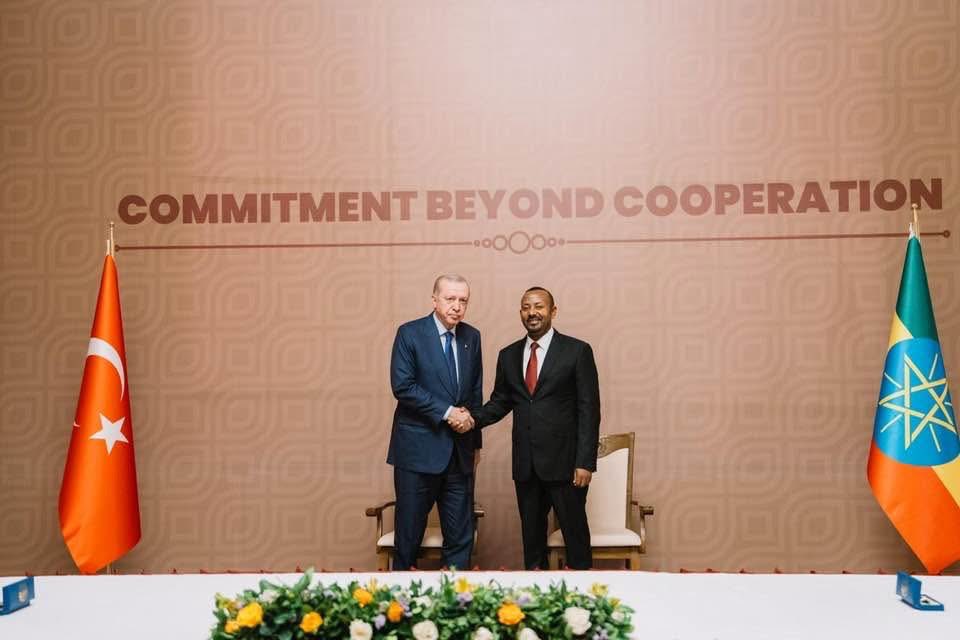
Ultimately, Erdoğan’s visit to Ethiopia illustrates the interconnected nature of Horn politics. Economic commissions and energy MoUs cannot be separated from sovereignty debates and maritime ambitions. The discussions between Erdoğan and Abiy Ahmed reflect an understanding that stability in the Horn depends on balancing national interests with regional cooperation.
If Addis Ababa and Ankara have indeed aligned on supporting Somalia’s territorial integrity while exploring lawful avenues for Ethiopia’s sea access, the outcome could reshape the diplomatic landscape. A cooperative framework would reduce tensions linked to recognition disputes, counterbalance external geopolitical pressures, and foster sustainable development across the region.
The Horn of Africa stands at a crossroads. Choices made today regarding recognition, maritime access, and strategic partnerships will define its trajectory for decades. The Erdoğan–Abiy meeting, therefore, was not merely ceremonial; it was a moment embedded in the wider contest over sovereignty, economic survival, and geopolitical influence.
Whether these discussions translate into tangible diplomatic breakthroughs remains to be seen. But the signals emerging from Addis Ababa suggest an effort to prioritize dialogue over division an approach that, if sustained, could help stabilize one of the world’s most strategically sensitive regions.