

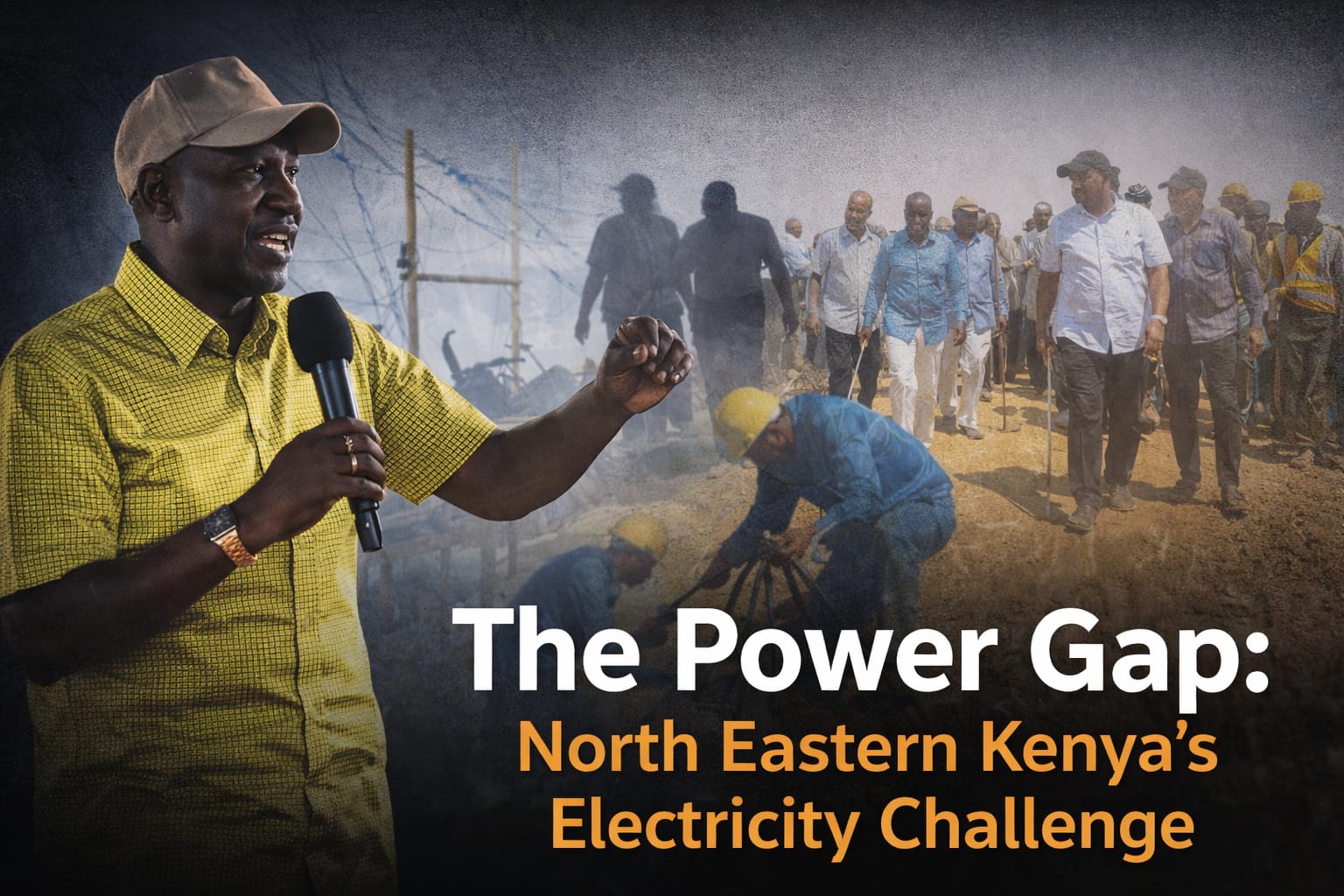
North Eastern Kenya stands at the center of a critical development debate as questions over energy access, economic inclusion and infrastructure equity continue to dominate public discussion.
For decades, the region has struggled with limited integration into the national electricity network, raising concerns about whether development policies have adequately addressed historical marginalization.
The electricity challenge is not merely about lighting homes or powering businesses; it is a deeper reflection of economic opportunity, social transformation and regional equality. In modern development, access to reliable energy determines the pace at which communities participate in digital economies, education advancement, healthcare delivery and industrial investment.
Among the counties in the region, Garissa County remains the only one relatively connected to the national electricity grid through expansion efforts linked to Kenya Power and Lighting Company. However, even in Garissa, supply stability and coverage depth continue to raise questions, especially in rural settlements where transmission infrastructure has not fully penetrated.
The situation becomes more complex in Mandera County, which sits at the frontier bordering Ethiopia. The geographical positioning of Mandera has opened a new diplomatic and infrastructure conversation as the Kenyan government explores cross-border energy transmission possibilities.
During a recent visit to the region, William Ruto signaled government intention to explore connecting Mandera to the national grid through electricity infrastructure partnerships involving Ethiopia. The proposal reflects a strategic shift from purely domestic transmission expansion toward regional energy cooperation.
Similarly, residents of Wajir County continue to live under what many describe as an infrastructure uncertainty. The county has been repeatedly mentioned in political speeches promising future grid connection, yet large sections of the population still depend on costly and less reliable alternative energy sources.
For a region with a growing population, expanding urban centers and increasing youth unemployment pressure, electricity access is no longer just a technical issue but a development survival question.
The Development Promise Versus Ground Reality
North Eastern Kenya’s energy dilemma reflects a broader national development paradox where economic growth indicators coexist with regional inequality. Successive governments have promised infrastructure transformation, yet implementation has often lagged behind political declarations.
The electricity challenge affects small-scale traders who rely on generators or solar installations that may not sustain heavy commercial use. Shop owners in major towns often close earlier than their counterparts in other Kenyan regions because of operational cost pressure.
Education systems have also felt the impact. Many learning institutions face difficulties maintaining digital learning environments due to unstable power supply. In an era where education is increasingly technology-driven, lack of electricity risks widening the knowledge gap between North Eastern Kenya and more connected parts of the country.
Healthcare delivery is another area deeply affected. Hospitals require reliable electricity for refrigeration of medical supplies, diagnostic equipment and emergency procedures. Power interruptions can create life-threatening risks in facilities serving large pastoralist populations who already travel long distances to access medical care.
The business investment climate in the region remains cautious. Private investors often evaluate infrastructure readiness before committing capital. Without dependable power, industrialization efforts remain limited to small and medium enterprises that can survive with alternative energy solutions.
Youth unemployment continues to intersect with the electricity debate. Many young people in the region are educated but lack platforms to convert skills into economic production. Digital entrepreneurship, which is rapidly growing in urban Kenya, struggles to expand in areas where internet infrastructure and stable electricity are not guaranteed.
The energy gap also reinforces historical narratives of marginalization that have shaped political discourse in North Eastern Kenya. Residents frequently argue that development distribution has not matched national integration expectations since independence.
The Ethiopia Connection: Strategic Opportunity or Political Promise?
The proposal to explore cross-border power transmission from Ethiopia introduces a new dimension to the conversation. The idea reflects the reality that infrastructure development in border regions may sometimes be more practical through regional cooperation than purely domestic expansion.
Ethiopia’s growing energy generation capacity, largely driven by hydroelectric projects, positions it as a potential electricity exporter in the Horn of Africa. Cross-border transmission could theoretically provide cheaper and more stable electricity supply to Mandera and surrounding areas.
However, the success of such a plan will depend on diplomatic, technical and financial arrangements between Kenya and Ethiopia. Energy interdependence requires long-term policy commitment beyond political administration cycles.
Critics of the cross-border strategy argue that regional connectivity should not replace internal grid expansion but rather complement it. They warn that overreliance on external energy sources could expose the region to geopolitical and supply negotiation risks.
Supporters, on the other hand, see the proposal as a pragmatic solution to geographical challenges. The distance from central Kenyan generation hubs to northern frontier counties makes transmission line construction expensive and technically demanding.
The government’s vision of regional energy cooperation aligns with broader African integration ambitions, where infrastructure networks transcend national boundaries.
Political Expectations and the Future of Infrastructure Delivery
The energy question in North Eastern Kenya is increasingly becoming a political performance test. Development promises made during campaign seasons are now being measured against tangible ground implementation.
The repeated presidential assurance regarding electricity expansion has generated cautious optimism among residents of the region. Many community leaders argue that infrastructure transformation should move from announcement stage to construction stage.
Economic transformation of pastoralist regions depends heavily on modernization of production systems. Electricity enables water pumping technology for livestock management, cold storage for agricultural products and digital market access for traders.
Without such transformation, North Eastern Kenya risks remaining trapped in climate vulnerability cycles where drought shocks repeatedly disrupt economic stability.
Drought conditions have historically affected the region’s livelihood systems. Energy access could support climate adaptation technologies such as solar-powered water systems and resilient agricultural practices.
The development debate is also shaping regional political mobilization ahead of future electoral cycles. Young voters are increasingly demanding policy-driven leadership rather than identity-based political messaging.
Whether the region will experience continuity of current political arrangements or move toward new leadership dynamics remains an open question.
Some analysts believe that infrastructure delivery will play a major role in shaping voter sentiment. If electricity expansion projects begin visible implementation across Mandera, Wajir and surrounding areas, it could reshape political narratives in the region.
However, if promises remain unfulfilled, public trust in development commitments may continue to decline.
The region’s future also depends on how national economic planning integrates frontier counties into Kenya’s
industrialization vision. Sustainable development cannot be achieved if certain regions remain peripheral to the country’s energy backbone.
North Eastern Kenya represents both a challenge and an opportunity. The region’s young population, strategic geographic location and cross-border economic potential could transform it into a regional trade and logistics hub if infrastructure investment accelerates.
Electricity is not merely a utility in this conversation; it is the foundation upon which modern economic society is built.
The power gap therefore symbolizes a larger question facing the region whether North Eastern Kenya will remain on the margins of national development or finally enter a new era of economic integration.
As political leaders continue making development assurances, residents are waiting to see whether the next phase will be defined by words or by construction sites, transmission towers and illuminated towns across the northern frontier.
The future of North Eastern Kenya may ultimately depend on whether the power gap will be closed or whether it will remain one of the region’s most enduring development symbols.