

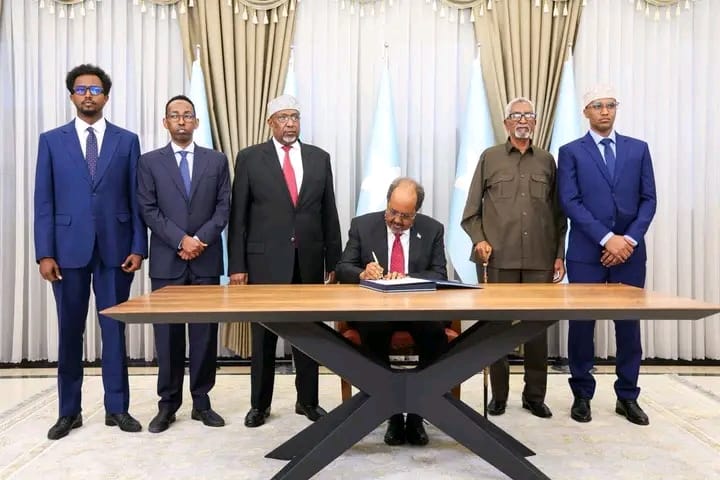
Somalia has taken what its leadership describes as one of the most significant political steps since the country began rebuilding its state institutions after decades of conflict. On Sunday, Somali President Hassan Sheikh Mohamud formally signed the country’s newly approved constitution into law following its ratification by both chambers of the Federal Parliament.
The signing ceremony took place at the presidential palace in Mogadishu and was attended by the speakers of the two parliamentary houses as well as senior government officials. With the president’s signature, Somalia officially moves beyond the long-standing provisional constitutional framework that has guided the country since 2012.
In remarks delivered during the ceremony, President Hassan Sheikh Mohamud described the moment as the culmination of a long and difficult national process aimed at completing the constitutional review and providing Somalia with a definitive legal and political foundation.
“Today I signed the new Constitution of the Federal Republic of Somalia after it was approved on Wednesday by the members of both Houses of the Federal Parliament.
Today marks the conclusion of the long journey of reviewing the constitution, which for many years had remained provisional. God willing, from today onward, the process of implementing it will begin.”
The president emphasized that the completion of the constitution represents more than a legal milestone. According to him, it is a necessary step toward strengthening state institutions, preserving national unity, and advancing democratic governance in the country.
Yet even as the government celebrates what it calls a historic breakthrough, the move has already triggered sharp political reactions. Several opposition figures and regional administrations particularly the leadership of Jubaland and Puntland have rejected the process and questioned the legitimacy of the constitutional changes.
Their opposition signals that Somalia may now be entering a new phase of political contestation, where the meaning and implementation of the constitution will be fiercely debated.
The signing therefore raises a deeper national question: Is this the final step toward stabilizing Somalia’s political system, or the beginning of another constitutional struggle?
The Meaning of Somalia’s New Constitution: A Turning Point for Governance
To understand the significance of this development, it is important to examine the historical and political context behind Somalia’s constitutional journey.
For more than a decade, Somalia has operated under a provisional constitution adopted in 2012. That document served as a temporary framework designed to guide the country through a transitional period as it rebuilt federal institutions following the collapse of the central government in 1991.
However, because the constitution was provisional, many critical issues remained unresolved. These included questions about the division of power between the federal government and regional states, the structure of the political system, the electoral framework, and the overall architecture of governance.
The review process that culminated in the newly signed constitution was therefore intended to address these unresolved issues and transform the provisional framework into a permanent national charter.
In principle, a finalized constitution is essential for several reasons.
First, it establishes legal certainty for the political system. A permanent constitution defines the powers of government institutions, clarifies the relationship between the federal government and member states, and provides a stable legal framework for policymaking.
Second, it strengthens the legitimacy of the state. For countries emerging from prolonged instability, a clearly defined constitutional order often serves as the backbone of national governance. It signals that political authority is grounded in law rather than temporary arrangements.
Third, the new constitution is closely linked to Somalia’s long-discussed transition toward universal suffrage commonly described as the “one-person, one-vote” system.
For decades, Somalia’s elections have relied on indirect voting mechanisms in which clan representatives select members of parliament, who then elect the president. The federal government argues that the completion of the constitution is necessary to enable a shift toward a direct electoral system that would allow ordinary citizens to vote for their leaders.
If implemented successfully, such a transition could transform Somalia’s political landscape by expanding political participation and strengthening democratic legitimacy.
However, constitutional reform in Somalia is not simply a legal process. It is deeply intertwined with the country’s federal structure and complex political balances.
Regional administrations have long been sensitive to any constitutional changes that could alter the distribution of power between the federal government and federal member states. This sensitivity helps explain why the newly signed constitution has generated strong reactions in some regions.
For leaders in these regions, the central concern is not only the content of the constitution but also the process through which it was adopted.
In their view, any permanent national charter must be built on broad political consensus that includes the federal government, regional administrations, opposition parties, and civil society groups.
Without that consensus, they argue, constitutional reform risks deepening political divisions rather than resolving them.
Opposition and state Resistance: What Comes Next for Somalia’s Political Landscape
The immediate challenge facing Somalia after the signing of the constitution is political acceptance.
While the federal government sees the document as the completion of a long national project, several opposition figures and regional authorities view it differently.
Leaders in Puntland and Jubaland have voiced objections to the process and have questioned whether the constitutional changes reflect genuine national agreement.
Their position reflects broader tensions that have existed in Somali politics for years.
One of the central debates in Somalia’s federal system concerns the balance of authority between Mogadishu and regional states. Some regional leaders fear that constitutional revisions could strengthen the federal government at the expense of regional autonomy.
Others argue that the process should have involved deeper consultation with federal member states before the final vote in parliament.
These disagreements create several possible political scenarios in the months ahead.
One possibility is continued negotiation. Somalia’s political history shows that major institutional changes often involve prolonged dialogue between the federal government and regional leaders.
Negotiations could focus on clarifying specific constitutional provisions or establishing implementation mechanisms that address regional concerns.
Another scenario is political mobilization by opposition groups. Opposition leaders could use the issue of constitutional legitimacy to rally public support and challenge the government’s narrative about the reform process.
This could manifest in political campaigns, parliamentary disputes, or calls for broader national dialogue on constitutional implementation.
A third possibility involves legal and institutional contestation. Political actors may seek to challenge aspects of the constitution through parliamentary mechanisms or through broader political pressure aimed at delaying its implementation.
The outcome of these dynamics will shape Somalia’s political trajectory over the coming years.
If the government succeeds in building broader political consensus around the constitution, the document could become the cornerstone of Somalia’s next phase of state-building. It would provide the legal foundation for electoral reforms, institutional development, and long-term governance stability.
However, if political divisions deepen, the constitution could become another arena of national contestation reflecting the unresolved tensions that have long characterized Somali politics.
Ultimately, the success of the new constitution will depend not only on the text of the document itself but also on the willingness of Somalia’s political actors to engage in compromise and dialogue.
For President Hassan Sheikh Mohamud, the signing represents a declaration that Somalia has moved beyond the provisional constitutional era.
For opposition leaders and some regional administrations, however, the debate is far from over.
What happens next will determine whether Somalia’s new constitution becomes a unifying national framework or the starting point of another chapter in the country’s complex political evolution.