

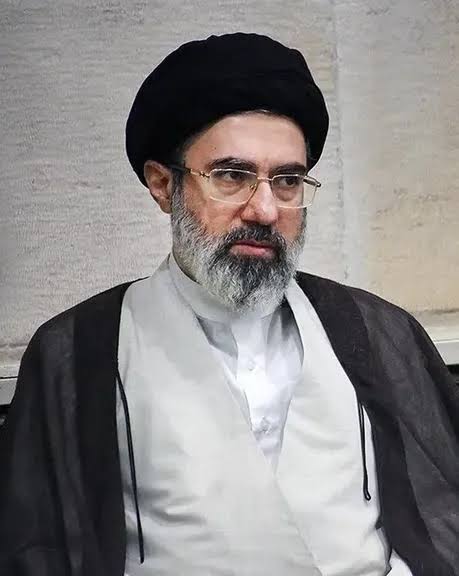
Iran has entered a historic and highly significant chapter after the reported selection of Mojtaba Khamenei as the country’s new Supreme Leader, replacing his father Ali Khamenei.
The leadership transition represents one of the most consequential moments in Iran’s modern political history since the death of the Islamic Republic’s founding leader Ruhollah Khomeini in 1989. For more than thirty years, Ali Khamenei stood at the center of Iran’s political, military, and ideological leadership, shaping the direction of the Islamic Republic both domestically and internationally.
Reports emerging from Tehran indicate that senior military commanders, influential political figures, and members of Iran’s powerful religious establishment have pledged allegiance to Mojtaba Khamenei. Their pledge signals the beginning of a new phase in Iranian leadership and suggests that key pillars of the state have aligned behind the new Supreme Leader.
The development has already drawn attention across the world. Governments, diplomats, and geopolitical analysts are closely watching how the leadership transition will influence Iran’s domestic governance, regional policies, and global relations.
The change in leadership also triggered an immediate reaction from the President of the United States Donald Trump, who commented on Iran’s new leader in a strongly worded statement.
“He’s going to have to get approval from us. If he doesn’t get approval from us, he’s not going to last long. We want to make sure that we don’t have to go back every 10 years when you don’t have a president like me.”
Trump’s remarks reflect the continuing tensions between Washington and Tehran and highlight the geopolitical importance of Iran’s leadership transition.
Background and Rise of Mojtaba Khamenei
Mojtaba Khamenei has long been one of the most mysterious yet influential figures inside the Iranian political establishment.
Born in 1969 in the city of Mashhad, Mojtaba grew up during a transformative period in Iran’s history. His childhood coincided with the aftermath of the Iranian Revolution, which overthrew the monarchy and established the Islamic Republic.
As the son of Ali Khamenei, Mojtaba was raised within the inner circle of Iran’s revolutionary leadership. This environment exposed him to the complex political, religious, and ideological debates that shaped the country during its formative years after the revolution.
Like many members of Iran’s clerical elite, Mojtaba pursued religious education in the seminaries of Qom, the most important center of Shiite scholarship in the country.
The seminaries of Qom are where Iran’s religious scholars receive their training and where many of the country’s leading clerics develop their influence within the religious establishment.
Despite being the son of one of the most powerful leaders in the Middle East, Mojtaba maintained a relatively low public profile for much of his life. Unlike many political figures who frequently appear in media or public events, Mojtaba was rarely seen in public and seldom gave interviews or speeches.
However, his absence from the public spotlight did not mean he lacked influence.
Over the years, numerous analysts and observers of Iranian politics suggested that Mojtaba played an important role behind the scenes in coordinating relationships between Iran’s political leadership and the country’s security institutions.
Among the most important of these institutions is the Islamic Revolutionary Guard Corps, widely known as the IRGC.
The IRGC is not only a military force but also a powerful political and economic institution inside Iran. It oversees strategic military programs, participates in regional security operations, and manages significant economic sectors inside the country.
Strong relationships between the Supreme Leader and the Revolutionary Guard are considered essential for maintaining stability within the Iranian political system. Many observers believe Mojtaba Khamenei developed close working relationships with influential figures inside the IRGC, which may have strengthened his position within Iran’s power structure.
Another important institution involved in selecting Iran’s Supreme Leader is the Assembly of Experts.
This body consists of senior Islamic scholars who are responsible for appointing and supervising the Supreme Leader. Although the Assembly formally makes the decision, the process often involves extensive consultations among religious authorities, political elites, and security institutions.
The selection of Mojtaba Khamenei therefore reflects the convergence of multiple centers of power within the Iranian system religious scholars, military leadership, and political institutions.
What Mojtaba Khamenei’s Leadership Means for Iran and the World
The role of Supreme Leader is the most powerful position in the Iranian political system.
Unlike the president, who is elected by citizens and manages day-to-day government affairs, the Supreme Leader holds ultimate authority over the strategic direction of the state.
The Supreme Leader serves as the commander-in-chief of the armed forces, oversees the judiciary, appoints key military commanders, influences foreign policy decisions, and maintains authority over many of the country’s most important political institutions.
Because of these powers, the Supreme Leader plays a decisive role in shaping Iran’s long-term strategy.
Under Ali Khamenei’s leadership, Iran developed a strong regional influence across the Middle East. Through political alliances and strategic partnerships, Tehran established relationships with actors in Syria, Lebanon, Iraq, and Yemen.
These relationships have shaped the geopolitical landscape of the region and made Iran one of the most influential powers in Middle Eastern politics.
Mojtaba Khamenei now inherits this complex network of alliances, responsibilities, and strategic challenges.
One of the most significant issues he will face involves Iran’s nuclear program and its relations with Western powers.
The international community has long been concerned about Iran’s nuclear activities, leading to years of negotiations and diplomatic agreements.
One of the most notable agreements was the Joint Comprehensive Plan of Action, which sought to limit Iran’s nuclear activities in exchange for sanctions relief and economic cooperation.
However, geopolitical tensions and shifting political priorities have repeatedly disrupted these agreements, leaving the future of Iran’s nuclear program uncertain.
As the new Supreme Leader, Mojtaba Khamenei will play a critical role in determining whether Iran pursues renewed diplomacy or continues a strategy focused on strategic deterrence and national security independence.
Beyond nuclear diplomacy, Iran faces a number of important domestic challenges.
Economic pressures caused by international sanctions, inflation, and unemployment have affected many Iranian citizens. Managing these economic realities while maintaining political stability will be one of the central tasks of the new leadership.
At the same time, Iran’s regional influence means that its decisions will continue to affect conflicts and political developments across the Middle East.
Observers around the world are therefore watching carefully to see how Mojtaba Khamenei will approach leadership during the early years of his tenure.
Some analysts believe his initial focus will likely be on consolidating stability within Iran’s political system and maintaining strong relationships with the country’s military and religious institutions.
Others suggest that his leadership could gradually introduce strategic adjustments in how Iran engages with international powers and regional partners.
Regardless of the direction he ultimately takes, Mojtaba Khamenei’s leadership marks the beginning of a new era for the Islamic Republic.
The transition from Ali Khamenei’s long rule to a new generation of leadership represents not only a change of personalities but also a moment that could redefine Iran’s political trajectory for decades to come.
As Iran moves forward under its new Supreme Leader, the world will be closely observing how the country balances continuity, stability, and evolving geopolitical realities.
The decisions made in Tehran in the coming months and years will shape not only Iran’s future but also the broader political landscape of the Middle East and international diplomacy.