

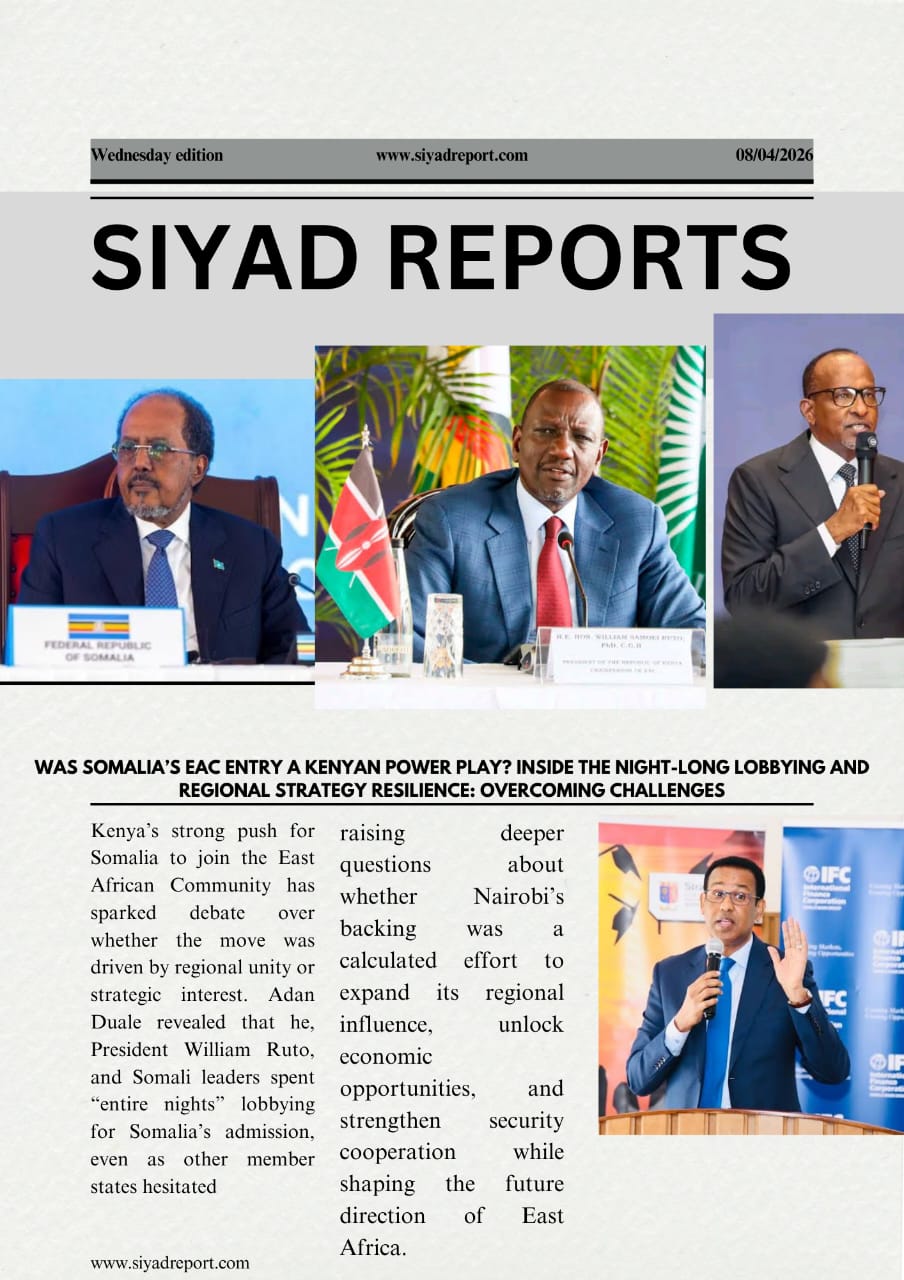
The admission of Somalia into the East African Community has often been framed as a historic milestone for regional integration, peacebuilding, and economic expansion.
However, recent remarks by senior Kenyan officials have reopened a deeper and more politically sensitive question: was Somalia’s entry purely a gesture of regional solidarity or a calculated geopolitical move led by Kenya to expand its influence within East Africa?
The controversy intensified after Adan Duale revealed that he, alongside President William Ruto and Somali leadership, spent “entire nights” lobbying for Somalia’s admission into the bloc. His comments not only confirmed intense behind the scenes diplomacy but also suggested that Kenya had taken a uniquely assertive role compared to other member states.
This raises a central analytical question: Was Somalia’s admission a Kenyan power play disguised as regional integration diplomacy?
Kenya’s Strategic Motives Behind Somalia’s Entry into the EAC
At the center of this debate lies a complex web of geography, security concerns, economic ambition, and regional influence.
Kenya and Somalia share a long, porous border marked by both opportunity and vulnerability. For Kenya, the stability of Somalia is not a distant foreign policy issue it is a direct national interest.
When Adan Duale stated:
“We spent entire nights lobbying for Somalia’s admission into the East African Community. Kenya believed in Somalia’s potential when others did not and we stood firm in supporting their inclusion.”
he was not simply describing diplomacy.
He was revealing the intensity of high-level negotiations that positioned Kenya as one of the strongest advocates for Somalia’s entry.
This lobbying effort, led alongside President William Ruto, suggests a deliberate foreign policy direction where Kenya sought to shape the future structure of the East African Community.
From a geopolitical perspective, Kenya’s motivation can be broken into three major layers: security, economics, and regional leadership.
Security remains the most immediate concern. The threat of cross-border militancy, particularly from groups such as Al-Shabaab, has historically affected Kenya’s northern regions. By integrating Somalia into a formal regional bloc, Kenya helps institutionalize security cooperation, intelligence sharing, and coordinated border management. This transforms an informal and reactive security relationship into a structured regional system.
Economically, Somalia represents both a challenge and a major opportunity. Years of instability have left its markets underdeveloped but highly attractive for expansion.
Kenyan financial institutions, logistics companies, and telecommunications firms stand to benefit significantly from Somalia’s integration into a common regional market. This creates pathways for regulated investment, cross-border trade, and infrastructure development.
At the same time, other member states of the East African Community approached Somalia’s entry with caution. Concerns about governance, institutional readiness, and long-term stability shaped hesitation in some capitals. This divergence allowed Kenya to step forward as the most vocal supporter, effectively positioning itself as a regional agenda-setter.
The involvement of senior leadership, including President Ruto, reinforces the idea that Somalia’s admission was not a routine diplomatic expansion but a strategically coordinated initiative at the highest level of Kenyan foreign policy.
Kenya’s geographic position gives it a unique stake in Somalia’s trajectory. The shared border means that instability in Somalia often translates into direct security and humanitarian pressures within Kenya.
This makes Kenya’s foreign policy toward Somalia fundamentally different from that of more distant EAC member states.
By pushing for Somalia’s inclusion, Kenya also strengthens its maritime and Indian Ocean economic interests. Access to expanded coastal trade routes and regional port collaboration enhances Kenya’s long-term economic outlook. In this sense, Somalia becomes not just a neighbor but a strategic extension of East Africa’s economic corridor.
The economic dimension of this decision is further reinforced by the potential for private sector expansion. Kenyan banks, insurers, construction firms, and transport companies all gain access to a new frontier market. Formal integration reduces risk and increases predictability for investment flows, making Somalia a high-value addition to the regional bloc.
However, this raises an important question, does economic opportunity automatically equal regional altruism? Or does it reflect a calculated effort to secure early-mover advantage in a recovering economy?
The answer likely lies somewhere in between. International relations rarely operate on a single motive. Instead, states pursue layered interests that combine national benefit with regional justification.
Somalia’s perspective adds another dimension to this debate.
For Somalia, membership in the East African Community represents a major diplomatic achievement. It provides access to a larger economic system, greater investment potential, and stronger regional legitimacy. It also signals Somalia’s gradual reintegration into structured international frameworks after decades of instability.
Yet integration also brings pressure.
Somalia must align its institutions, regulations, and economic systems with regional standards. This can be both stabilizing and challenging, depending on domestic capacity and political consensus.
The contrast between Kenya’s enthusiasm and other states’ caution highlights a broader truth about regional blocs: expansion is never purely technical. It is always political.
Kenya’s active lobbying can therefore be interpreted in two ways. On one hand, it reflects leadership and commitment to regional integration. On the other hand, it reflects strategic positioning to shape the balance of influence within the East African Community.
Both interpretations are valid, and both may be simultaneously true.
Ultimately, Somalia’s entry into the EAC is not just a diplomatic event. It is a geopolitical recalibration of East Africa’s future. Kenya’s role in that process ensures that it remains central to the region’s evolving architecture whether as a stabilizing force, a strategic investor, or a regional power shaping integration from within.
The question of whether this was a “power play” therefore depends on definition. If power play means domination or manipulation, the evidence is mixed. But if it means strategic influence within a regional system, then Kenya’s role is undeniable.
What is clear is this, Somalia’s admission was not passive. It was actively shaped, strongly advocated for, and strategically supported particularly by Kenya’s top leadership.
And in regional politics, those who shape entry often shape the rules that follow.