

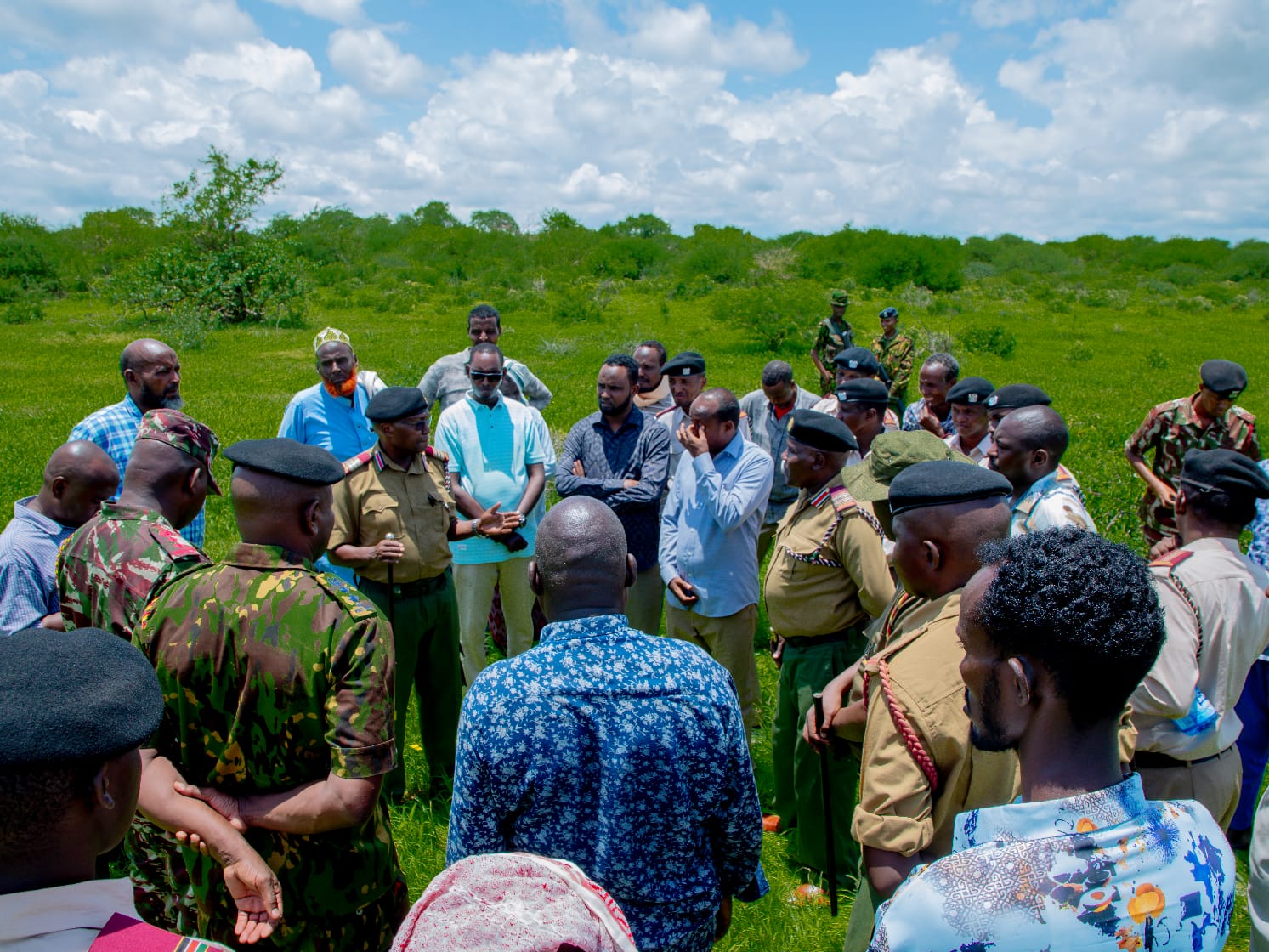
The National Government has officially launched the construction of a multi-agency command centre in Basir area of Eldas North Sub-County, in Wajir County, in a move aimed at strengthening security operations in a region long associated with drug trafficking and human smuggling.
The launch event marks a significant administrative and operational step by the government in responding to security concerns that have persisted over time in northern Kenya. While the announcement itself focuses on the construction of a physical facility, the broader implication lies in how the state is positioning its security structures to respond to patterns of crime that are both local and transnational.
The reference to Basir, a specific locality within Eldas, signals a deliberate decision to situate the command centre within an area that has been directly linked, through intelligence and reporting, to the movement of illegal goods and people.
The project was unveiled during a groundbreaking ceremony led by Wajir County Commissioner Karuku Ngumo, who outlined the government’s intention to improve coordination among security agencies and enhance monitoring along key transit routes.
A groundbreaking ceremony in this context is not merely symbolic. It marks the official start of implementation and reflects that planning processes including identification of need, allocation of resources, and inter-agency consultations have already taken place.
The presence of the County Commissioner underscores the administrative weight of the project. As the national government’s representative at the county level, Ngumo’s involvement indicates that the initiative is anchored within the national security framework rather than being a purely local or isolated intervention.
Speaking at the event, Ngumo said the facility is expected to address persistent security challenges linked to the area’s location and terrain. “For a number of years, this area has been used as a major route for trafficking of drugs and illegal immigrants from neighbouring countries through Marsabit, Wajir, Isiolo and onward to other parts of the country,” he said.
This statement provides a direct explanation of why Eldas has been prioritised. The mention of “a number of years” points to a long-standing pattern rather than a recent surge, suggesting that the issue has been monitored over time and is supported by consistent data or intelligence reports.
By identifying the movement through Marsabit County, Wajir County, and Isiolo County, the commissioner outlines a geographical corridor that links northern Kenya to central regions. This corridor is significant because it illustrates how criminal activities are not confined to one location but operate across multiple administrative boundaries.
The use of the term “transit route” is particularly important. It indicates that Eldas is not necessarily the origin or final destination of these activities but serves as a passage point. This distinction matters in understanding the operational nature of trafficking networks, which often rely on multiple staging points to move goods or people while avoiding detection. By placing a command centre within such a route, the government is effectively targeting the movement phase of these operations.
He noted that Eldas, located more than 200 kilometres from the county headquarters, has remained difficult to police effectively due to its remoteness. According to the commissioner, the distance has contributed to delays in response and limited surveillance, factors that have been exploited by criminal networks operating across the region.
Distance in security operations is a critical factor. A location that is over 200 kilometres away from the administrative centre presents logistical challenges, including delayed deployment of personnel, limited patrol frequency, and slower communication. In such contexts, response times can significantly affect the outcome of operations. Criminal networks often exploit these gaps by operating in areas where the presence of law enforcement is less immediate.
The description of “limited surveillance” suggests that existing monitoring mechanisms whether through patrols, checkpoints, or intelligence gathering have not been sufficient to fully cover the area.
This does not necessarily indicate absence, but rather insufficiency relative to the scale and complexity of the activities taking place. The establishment of a command centre within Eldas can therefore be interpreted as an effort to decentralize security operations, bringing decision-making and response capabilities closer to the ground.
The command centre is designed to bring together various security agencies under one operational unit. Officials say the multi-agency setup will allow for improved information sharing, joint planning, and faster response to incidents. “The command centre will enhance coordination among security agencies and improve our response to crime,” Ngumo added.
The concept of a “multi-agency” command centre reflects a specific model of security management. In many cases, different agencies such as police, intelligence services, and administrative units operate independently, each with its own mandate and information systems. While this structure allows for specialization, it can also lead to fragmentation, where critical information is not shared in time or operations are not fully synchronized.
By bringing these agencies into a single operational space, the government is attempting to reduce such fragmentation. Improved information sharing means that intelligence collected by one unit can be quickly accessed and acted upon by others. Joint planning allows for coordinated strategies rather than parallel efforts, while faster response times are expected to result from the proximity of decision-makers and operational teams.
The initiative is being implemented through a collaboration between the County Security and Intelligence Committee (CSIC) and the National Government Constituency Development Fund (NG-CDF), with support from Eldas Member of Parliament Adan Keynan.
This institutional arrangement highlights how the project is being financed and governed. The involvement of the CSIC indicates that the initiative is rooted in the county’s security architecture, which brings together various heads of security agencies to coordinate policy and operations.
The inclusion of the NG-CDF, a fund typically associated with development projects at the constituency level, shows that financial resources are being drawn from multiple channels.
Ngumo used the occasion to issue a warning to those involved in illegal activities, stating that the government intends to intensify operations in the area. “We will do whatever it takes to curb drug trafficking and human smuggling, which is already affecting our youth,” he said.
This statement reflects the enforcement aspect of the initiative. The phrase “whatever it takes” indicates a strong commitment to addressing the issue, while the reference to youth highlights the social dimension of the problem.
Drug trafficking is often linked to local consumption, distribution networks, and recruitment of young people into illegal activities. Human smuggling, on the other hand, involves individuals who may be seeking migration opportunities but end up being part of illegal and often dangerous processes.
By linking these crimes to their impact on youth, the statement broadens the narrative beyond law enforcement to include social consequences. However, within the context of this report, it primarily signals the government’s intention to increase surveillance, enforcement, and legal action against those involved.
Security officials indicated that the location of the facility in Basir is intended to place enforcement efforts closer to routes that have been identified as commonly used for illicit movement. These routes connect parts of Marsabit County, Wajir County, and Isiolo County, forming a corridor that has been cited by authorities as a pathway for illegal cross-border activities.
The identification of specific routes suggests that the decision to build the command centre is informed by intelligence and operational data. Security agencies typically map patterns of movement, identifying areas where illegal activities are concentrated or frequently pass through. By placing the facility within proximity to these routes, the government is aligning its infrastructure with its intelligence.
The reference to a “corridor” emphasizes the interconnected nature of these routes. Rather than isolated paths, they form a network that spans multiple counties. This has implications for coordination, as operations in one area may affect or depend on actions in another. The command centre, therefore, may serve not only as a local hub but also as part of a broader regional security system.
Wajir County Administration Police Commander David Nyadera also addressed the gathering, acknowledging the role of local residents in supporting security efforts. He said community policing structures in the area have contributed to ongoing operations and will continue to play a role once the command centre becomes operational.
The mention of community policing introduces another layer to the security framework. Community policing involves collaboration between residents and law enforcement, often through information sharing, reporting of suspicious activities, and participation in local security initiatives. In areas where formal security presence may be limited, such structures can provide valuable insights and early warnings.
Nyadera’s acknowledgment suggests that these systems are already in place and functioning to some extent. The integration of the command centre with existing community structures may enhance the flow of information and improve the effectiveness of operations.
“We have seen cooperation from the community, and this has supported our work. The new command centre will strengthen these efforts,” Nyadera said.
He added that law enforcement agencies will continue to take action against individuals involved in criminal activities. “We will ensure that those involved in illegal activities are arrested and prosecuted in accordance with the law,” he said.
This highlights the legal framework within which the operations will be conducted.
Arrest and prosecution are key components of the justice system, and their mention underscores the intention to follow due process. It also signals that the command centre will be part of a broader system that includes investigation, arrest, and judicial proceedings.
Officials present at the event described the command centre as part of a broader approach to improving security coordination in remote areas. By housing multiple agencies in one location, the facility is expected to serve as a central point for planning and executing operations within Eldas and surrounding areas.
This description aligns with the earlier emphasis on coordination. Remote areas often face challenges related to communication and resource allocation. A central point of operation can help address these issues by consolidating functions and providing a base for coordinated action.
The project also reflects an effort to position security services closer to regions identified as operational hotspots. Authorities say this approach is intended to reduce response times and improve oversight along routes that have been difficult to monitor due to distance and limited infrastructure.
Positioning services closer to hotspots is a strategic decision that reflects an understanding of spatial dynamics in security. Rather than relying solely on centralised control, the government is decentralising certain functions to improve efficiency.
Residents who attended the ceremony were urged to continue working with security agencies, particularly through existing community policing frameworks.
Leaders emphasized that information sharing between the public and law enforcement remains an important component of ongoing operations.
This reinforces the role of the community as part of the security ecosystem. While the article reports the launch of a government facility, it also captures how authorities are framing public participation as essential to the initiative.
The launch of the command centre marks the beginning of construction, with officials indicating that once completed, the facility will support coordinated action against drug trafficking and human smuggling in Eldas and neighboring regions.
The development comes amid continued focus by the government on strengthening internal security systems, particularly in areas that serve as transit points for cross-county and cross-border movement.