

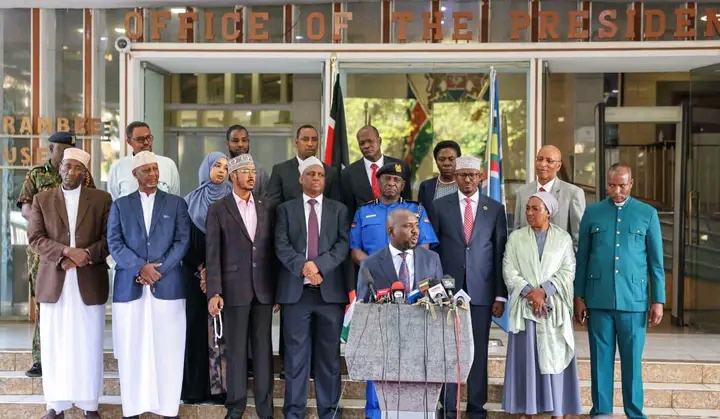
Kenya’s Interior Cabinet Secretary Kipchumba Murkomen has suspended the construction of a controversial multi-agency security installation along the Moyale–Marsabit–Isiolo road corridor following rising tensions, violent clashes, and demonstrations linked to a long-running boundary dispute between Wajir County and Marsabit County.
In a strongly worded statement issued after a high-level security and political meeting, Murkomen announced that the government had resolved to discontinue construction at the disputed site and abandon the location entirely until a new area is identified by national security authorities.
The decision comes after days of political friction and public anger surrounding plans to establish a multi-agency security facility in an area claimed by both counties. What initially appeared to be a security project aimed at combating transnational crime has now evolved into a politically sensitive territorial dispute threatening stability in northern Kenya.
According to the Interior Ministry, the Moyale–Marsabit–Isiolo corridor has increasingly become “a major conduit for arms, narcotics, human trafficking, and other transnational crimes,” prompting security agencies to push for a stronger state presence in the region.
Murkomen said the plan emerged after several security deliberations and submissions made during the Jukwaa la Usalama forums, where leaders and residents raised concerns over insecurity along the corridor.
“The construction of the facility be discontinued and the site abandoned,” Murkomen declared after the meeting involving political leaders from both counties.
The Cabinet Secretary further announced that the North Eastern and Eastern regional security teams led by Regional Commissioners John Otieno and Jacob Muganda would now identify an alternative site for the security installation “in consultation with the National Security Council.”
The government also clarified that the proposed facility would remain “national in nature,” an apparent attempt to ease fears that one county could gain administrative or territorial advantage over the other through the project.
The crisis surrounding the proposed security camp reflects the fragile nature of boundary politics in northern Kenya, where county borders remain disputed more than a decade after devolution was introduced under the 2010 Constitution.
For residents in the affected areas, boundaries are not merely lines on a map. They determine access to resources, political influence, grazing land, representation, security deployment, and development funding. As a result, any state project introduced in contested territory often immediately becomes politically explosive.
The Eldas NG-CDF had reportedly agreed to finance construction of the facility after being approached by the Wajir County Security and Intelligence Committee. However, the project quickly sparked anger from leaders and communities in Marsabit who viewed the move as an encroachment into disputed territory.
Demonstrations and tensions soon followed, forcing the national government to intervene before the situation deteriorated further.
Murkomen acknowledged the seriousness of the standoff, warning indirectly that unresolved territorial disputes continue to threaten peace and coexistence between neighboring communities.
“That the determination of the boundary dispute between Wajir and Marsabit counties, alongside other similar disputes nationwide, be handled by the relevant government institutions, including IEBC,” the statement read.
The inclusion of the Independent Electoral and Boundaries Commission signals the government’s recognition that the matter extends beyond security and touches on constitutional and administrative boundaries that require formal legal determination.
The meeting brought together an unusually large delegation of leaders from both counties, highlighting the political weight of the crisis.
Among the Marsabit leaders present were Governor Mohamud Mohamed Ali, Senator Mohamed Chute, County MP Naomi Waqo, Saku MP Dido Raso and Moyale MP Prof Jaldesa Guyo.
Representing Wajir County were Governor Ahmed Abdullahi, Senator Abass Mohamed, County MP Fatuma Jehow, Eldas MP Adan Keynan, Wajir North MP Abdi Saney, Wajir East MP Aden Daudi, Tarbaj MP Hussein Barre and Wajir West MP Yusuf Farah.
Their joint appearance was viewed as a deliberate effort to calm tensions after inflammatory rhetoric and demonstrations threatened to deepen divisions between communities living along the disputed border.
One of the most significant resolutions from the meeting was the agreement for leaders and National Government Administrative Officers to hold public barazas aimed at diffusing tensions and promoting coexistence between communities.
This is particularly important because northern Kenya has historically experienced cycles of conflict fueled by competition over territory, water, pasture, and political representation. Security experts fear that without immediate intervention, local grievances can quickly evolve into ethnic and inter-county confrontations.
The government now faces the difficult task of balancing two competing realities: the urgent need to strengthen security along a corridor increasingly associated with trafficking and organized crime, and the equally sensitive need to avoid appearing biased in unresolved territorial disputes.
For many observers, the suspension of the project may calm tensions temporarily, but it does not solve the underlying dispute. The border question between Wajir and Marsabit remains unresolved, and unless national institutions move decisively, similar confrontations could emerge again whenever new projects or administrative decisions are introduced in contested areas.
Murkomen attempted to reassure residents that the government remains committed to establishing the facility once consensus is achieved.
“We wish to assure the residents of the two counties that we shall expedite the establishment of the security facility once a new site has been identified,” he said, while calling for “patience and understanding.”
But beyond the official statements and political diplomacy lies a deeper national question: whether Kenya’s devolved system has adequately addressed historical border grievances or merely shifted old disputes into new political battlegrounds.
As tensions simmer in northern Kenya, the abandoned security project has now become more than a halted construction plan. It is a symbol of how fragile governance, security, and identity politics remain in some of Kenya’s most strategic yet historically marginalized regions.