

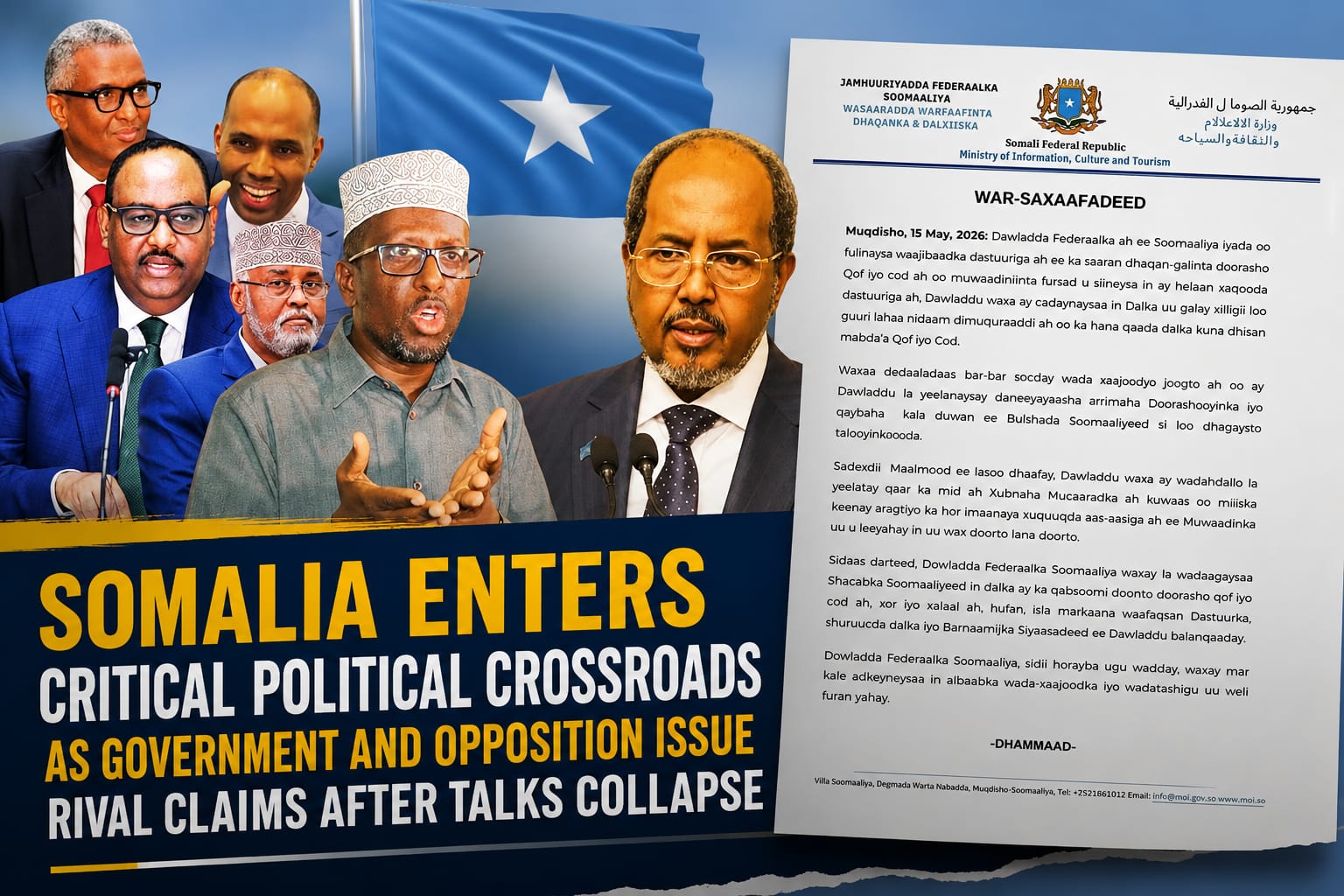
Somalia moved deeper into political uncertainty on Friday after mediated talks between the federal government and opposition leaders collapsed without agreement, leaving the country sharply divided over the legitimacy of President Hassan Sheikh Mohamud’s mandate and the future of the country’s electoral system.
In a strongly worded statement issued in Mogadishu on May 15, the Federal Government of Somalia declared that it would proceed with plans to hold a one-person, one-vote election, rejecting opposition proposals presented during three days of negotiations facilitated by members of the international community.
The government said Somalia had already entered a new democratic phase based on direct voting and insisted that Somali citizens must be allowed to exercise what it described as their constitutional right to vote and contest for office.
“Therefore, the Federal Government of Somalia shares with the Somali people that the country will hold a one-person, one-vote election that is free, fair, transparent and in accordance with the constitution, the laws of the country and the political programme promised by the government,” the statement said.
The announcement came amid escalating tensions over whether President Hassan Sheikh Mohamud’s constitutional mandate expired on May 15, 2026 — exactly four years after he was elected by parliament in 2022.
Opposition leaders argue that both the president’s mandate and that of the federal parliament legally came to an end on Friday under Articles 60 and 91 of Somalia’s Provisional Constitution. However, government allies maintain that recent constitutional amendments extended federal mandates from four years to five years, allowing the current administration to remain in office until 2027.
The collapse of the talks has now pushed Somalia into what opposition groups are calling a constitutional and political crisis, while the government insists the country is merely transitioning toward a democratic electoral model after decades of indirect voting systems dominated by clan-based power-sharing.
The Somali Future Council, a coalition bringing together opposition figures and political stakeholders, accused the government of refusing to accept what it described as an inclusive transitional political framework meant to address the country’s disputed constitutional situation.
In a statement released shortly after the negotiations collapsed, the opposition coalition said the talks had failed because of disagreements over constitutional legitimacy, political power-sharing, and the management of Somalia’s transition period.
The council argued that President Hassan Sheikh Mohamud should now be regarded as a former president following what it called the expiration of his constitutional term.
“The Federal Government should operate with limited executive authority during the transitional period,” the coalition said, adding that the administration should restrict itself to routine governmental functions and avoid taking unilateral decisions on elections, constitutional matters, national security, and political arrangements.
The opposition also warned that any unilateral political steps by Villa Somalia could deepen tensions and threaten national stability at a time when the country continues to battle the militant groups al Shabaab and Islamic State-linked fighters.
The government, however, dismissed the opposition’s demands and accused some opposition representatives of presenting proposals that contradicted the democratic rights of Somali citizens.
According to the government statement, extensive consultations had already been held with various sections of Somali society and election stakeholders regarding the planned electoral process.
The administration maintained that despite the collapse of the talks, the door for dialogue remained open.
Still, Friday’s developments exposed how deeply Somalia’s political elite remains divided over the future direction of the country, particularly on the question of direct elections.
For years, Somalia has operated under an indirect electoral model where clan elders and delegates select lawmakers, who in turn elect the president. President Hassan Sheikh Mohamud has repeatedly argued that Somalia must transition toward universal suffrage to strengthen democratic legitimacy and move away from clan-based politics.
But critics say the country lacks the security, institutional capacity, and political consensus necessary to implement a nationwide direct election at this stage.
Among the most significant reactions came from former Somali president Mohamed Abdullahi Mohamed, commonly known as Farmaajo, who issued a lengthy statement warning that Somalia was entering a dangerous constitutional vacuum.
Farmaajo said the country was facing a “serious political and constitutional phase” following what he described as the end of the constitutional mandates of both the president and parliament.
Citing Article 103 of the Provisional Constitution, Farmaajo argued that the current government had effectively become a caretaker administration with no authority to make major decisions affecting the country’s political future.
He called for broad national consultations involving political leaders, intellectuals, and different sectors of Somali society in order to rescue the country from what he described as constitutional uncertainty.
Farmaajo also urged the Somali National Armed Forces to remain neutral and avoid being drawn into political disputes.
“We call on the security forces to completely avoid involvement in political affairs or being used for power retention and the suppression of citizens,” his statement said.
The former president emphasized that Somalia’s security institutions should instead focus on defending the country, maintaining stability, and protecting national unity during the tense political period.
The opposition coalition similarly appealed to security forces to uphold their constitutional responsibilities and avoid partisan involvement as the crisis intensifies.
The failed negotiations were reportedly facilitated by members of the international community, although no official statement had yet been issued by key international partners by Friday evening.
That silence is now being closely watched across Mogadishu and beyond.
Diplomatic actors including the United Nations, the African Union, the European Union, the United States, Türkiye, the United Kingdom, and regional stakeholders have historically played significant roles in Somalia’s political processes, especially during periods of electoral disagreement and constitutional disputes.
Whether the international community ultimately sides with the federal government’s push for direct elections, supports calls for a transitional framework, or pushes both sides back to the negotiating table could significantly shape the next phase of Somalia’s political trajectory.
For now, Somalia appears to stand at one of its most sensitive political crossroads in recent years with competing claims over constitutional legitimacy, deepening mistrust among political actors, and uncertainty over how the country will navigate its next electoral chapter.