

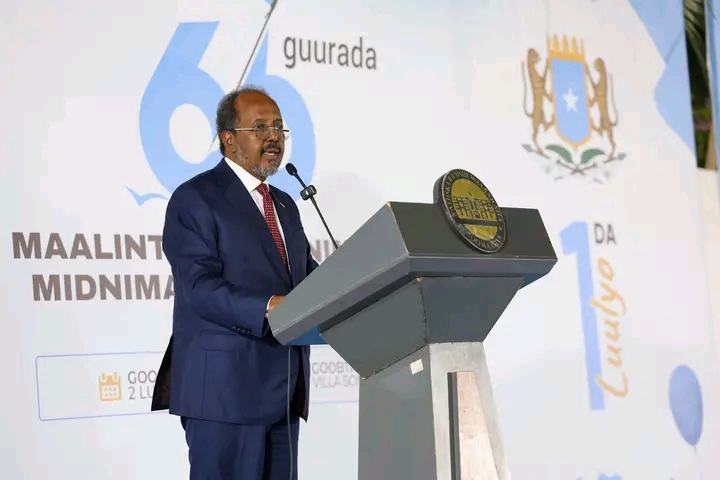
President Hassan Sheikh Mohamud used the closing ceremony of Somalia’s Independence Week celebrations to deliver one of his most comprehensive national addresses in recent years, outlining an ambitious vision centered on security, democratic transformation, national reconciliation, education and Somalia’s sovereignty.
Speaking before thousands of Somalis gathered at Taleh Junction in Mogadishu, the President declared that the country stands at a historic turning point, insisting that Somalia has moved beyond the politics of division and is entering a new era built on democratic governance, institutional politics and national unity.
At the heart of his speech was a renewed commitment to eliminating the militant group Al-Shabaab, which has remained Somalia’s greatest security challenge for more than a decade.
President Hassan Sheikh announced that his government has finalized a clear strategy aimed at bringing the conflict to an end and permanently removing the group from Somalia.He said the detailed plan would be presented to the Somali public once all preparations are complete, describing it as the country’s final push against the extremist group.
At the same time, he renewed his government’s standing offer of amnesty, urging Al-Shabaab fighters to abandon violence and return to their communities.
“The door remains open for anyone who lays down their arms and returns to their people and their government,” the President said, emphasizing that reconciliation remains an essential part of achieving lasting peace.
The President also devoted a significant portion of his address to the longstanding political dispute with Somaliland, reiterating that dialogue remains the Federal Government’s preferred path toward resolving differences.
Addressing residents of the Northern Regions directly, President Hassan Sheikh appealed for unity instead of separation, arguing that Somalis share a common history and future that cannot be divided by political disagreements.
“By God, my brothers and sisters in the Northern Regions, Israel does not have your best interests at heart. There is something far better that binds us together. For generations, we have protected one another. So let us put aside our anger and engage in dialogue. Know this: wherever Somalis are, Israel has no place there.”
His remarks came amid growing regional debate surrounding reported Israeli efforts to strengthen relations in parts of the Horn of Africa.
The Somali President firmly rejected any possibility of Israeli influence or presence in Somali territories, maintaining that Somalia cannot establish any form of diplomatic relations with Israel.
He stated that Israel offers no benefit to Somalia and accused it of leaving “only a trail of destruction behind it,” reaffirming Somalia’s longstanding foreign policy position in support of the Palestinian people.
Turning to domestic politics, President Hassan Sheikh announced what he described as one of the defining democratic milestones in Somalia’s modern history.He pledged that never again would Somalis be governed by leaders whom they had not directly elected.
According to the President, after 58 years Somalia is preparing for genuine democratic participation in which ordinary citizens not clan elders or indirect electoral delegates will choose their leaders through the ballot box.
He declared that the age of personality-driven politics has ended, insisting that future political leadership must be based on organized political parties with clear ideologies, policies and manifestos.
“To those who call themselves the opposition: we have moved beyond the era of political warlords. We want organized, institutional politics,” he said in one of the strongest political messages directed at government critics during the celebrations.
The statement appeared to underline the Federal Government’s determination to push ahead with electoral reforms despite continued disagreements with sections of the opposition and some federal member states over the country’s electoral model.
President Hassan Sheikh also praised the success of the Independence Week celebrations, thanking organizers and citizens who participated in events held throughout the week.
He said the large crowds that filled Taleh Junction represented every corner of Somalia, describing the turnout as evidence of growing national unity and patriotism.
The President used the occasion to endorse commitments previously announced by Prime Minister Hamza Abdi Barre, particularly regarding education reforms.He revealed that a substantial portion of the government’s promised recruitment of 10,000 teachers has already been achieved, describing education as a central pillar of Somalia’s long-term development strategy.
President Hassan Sheikh also accused the Puntland administration of obstructing federal education initiatives, saying authorities had blocked the recruitment of an initial group of 700 teachers as well as plans to establish a federal teacher training college within the region.
The comments highlighted continuing tensions between Mogadishu and Puntland over constitutional authority and the implementation of federal government programs.
Addressing another contentious issue, the President dismissed reports claiming that Mogadishu had recently deployed new federal troops into Puntland.He described those reports as entirely false, explaining that the soldiers in question are nationally recognized federal forces who have been stationed in the region for approximately seven months.
According to the President, the troops are officially registered members of Somalia’s national security institutions and have continued receiving their salaries from the Federal Government throughout their deployment.
His remarks come amid heightened political tensions between the Federal Government and Puntland, particularly over questions surrounding federal authority, security responsibilities and constitutional interpretation.
Throughout the speech, President Hassan Sheikh repeatedly emphasized the importance of national unity, urging Somalis to reject political divisions rooted in clan identity and instead embrace institutions capable of strengthening the country’s future.
He argued that Somalia’s progress depends on dialogue rather than confrontation, democratic participation rather than exclusion, and national solidarity rather than fragmentation.
The address brought together nearly every major issue currently shaping Somalia’s political landscape from counterterrorism and constitutional reform to education, federal relations, diplomacy and electoral transformation.
As Independence Week concluded, the President sought to project confidence that Somalia is entering a decisive chapter in its history, one defined by stronger institutions, expanded democratic participation and renewed efforts to secure lasting peace.
Whether these ambitious pledges translate into tangible progress will depend on implementation in the months ahead.
However, the closing address left little doubt about the Federal Government’s priorities: defeating Al-Shabaab, advancing direct elections, preserving Somalia’s territorial unity, expanding public services and pursuing what President Hassan Sheikh described as a future built on organized politics rather than division.