

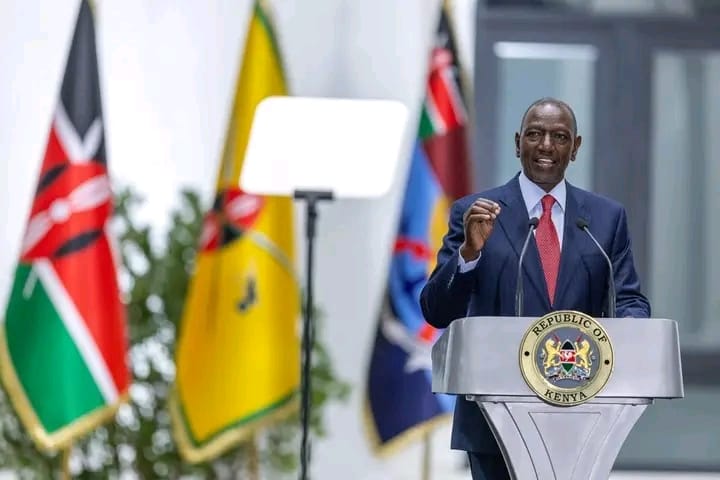
President William Ruto’s special address to the nation was more than a routine government speech. It was an attempt to shift Kenya’s national conversation away from day-to-day politics and towards a long-term vision for the country’s future. At the heart of his message was a simple but ambitious argument: Kenya’s development should no longer depend on changing political administrations or election cycles but should instead be guided by a shared national vision created and owned by all Kenyans.
Throughout the address, President Ruto repeatedly returned to one central theme that national development cannot be left to chance. “National development must never be left to chance or short-term politics. It must be guided by a shared national vision that endures beyond administrations and election cycles,” he declared.
His statement reflects a growing concern that while governments introduce development programmes, many of them fail to continue once political leadership changes. The President argued that Kenya requires a development blueprint capable of surviving political transitions, ensuring that national priorities remain consistent regardless of who occupies State House.
The President framed development not merely as an economic objective but as a constitutional responsibility. Referring to the 2010 Constitution, he argued that Kenyans deliberately chose not only democracy but also prosperity as a national aspiration.
“The Constitution envisages both a democratic and a wealthy and prosperous nation,” he said. “Democracy allows us to organize power, protect liberties, and govern ourselves. The provisions of our Constitution affirm that the purpose of state power is not simply to administer the affairs of state but to expand opportunity, promote human dignity, create wealth, and improve the lives of citizens.”
By linking development directly to constitutional principles, President Ruto sought to elevate economic transformation beyond ordinary government policy. His message suggested that improving livelihoods, creating wealth and expanding opportunities are constitutional obligations rather than optional political promises.
One of the most significant moments of the speech was his assessment of Kenya’s long-term development blueprint, Vision 2030. Launched in 2008, Vision 2030 aimed to transform Kenya into an upper-middle-income economy by the year 2030 through sustained economic growth, industrialization and improved public services.
President Ruto acknowledged both its achievements and shortcomings.
“Vision 2030 set a target of Kenya becoming an upper-middle-income country by 2030. So far, we are off target.”
However, he was careful not to dismiss the strategy altogether.
“This is not a criticism of Vision 2030, nor is it a reason for disappointment; rather, it is an opportunity to proudly learn from our successes, reflect with honesty on where we have fallen short, and define together Kenya’s next long-term vision.”
This balanced assessment marked an important aspect of the address. Rather than abandoning Vision 2030, the President argued that Kenya should build upon its achievements while designing a new roadmap capable of guiding the country for decades beyond 2030.
Another major theme was the economy. President Ruto painted a picture of an economy that, according to his administration, has recovered from instability and is now positioned for sustained growth.
“We have stabilised our currency, inflation has fallen, borrowing costs have declined and investor confidence has returned.”
He further noted that Kenya attracted a record USD 3.2 billion in foreign direct investment last year more than double the amount recorded in 2022 presenting this as evidence that international investors are regaining confidence in Kenya’s economy.
The President also cited international competitiveness rankings to support his argument.
“The 2025 IMD World Competitiveness Ranking placed Kenya as the most competitive economy in Africa, reflecting the confidence our reforms have restored.”
To reinforce the sustainability of future development, he highlighted the establishment of the National Infrastructure Fund, intended to finance major infrastructure projects, and the Sovereign Wealth Fund, designed to preserve and invest national wealth for future generations.
Together, these institutions, he argued, represent long-term financial mechanisms that can help Kenya finance development beyond annual government budgets.
Perhaps the most reflective section of the speech came when President Ruto challenged Kenyans to examine why the country has repeatedly struggled to fulfil its potential despite possessing abundant natural resources, entrepreneurial talent and democratic institutions.
“The question we must ask ourselves candidly and honestly is why other nations have fulfilled so much of their potential while we have repeatedly fallen short. What must we now do differently to ensure that the next chapter of Kenya’s development story is fundamentally different from the last?”
Rather than assigning blame, he framed the issue as a national moment of self-reflection. His appeal suggested that understanding past shortcomings is essential if Kenya is to chart a more successful future.
President Ruto’s solution is what he described as the most consequential national conversation since the promulgation of the Constitution in 2010.
“Tonight I invite every Kenyan to what I believe will become the most consequential national conversation since the adoption of our Constitution in 2010.”
He emphasised that the process must rise above politics, transcend electoral cycles and unite the country around a shared national destiny.
Importantly, he stressed that this initiative is not intended to produce yet another government policy document.
“It is not a conversation about producing another government document. It is about forging a new national consensus on the country we intend to become and the standards by which we shall measure our progress.”
The President repeatedly insisted that politicians alone cannot design Kenya’s future.
“A national development charter for the attainment of these noble constitutional imperatives can’t be designed by politicians alone, nor by any single institution, profession or interest group. It must be shaped by Kenyans themselves through an open, inclusive national conversation.”
This emphasis on citizen participation formed one of the strongest messages of the address. According to the President, Kenya’s future should be determined through broad public engagement involving citizens, professionals, faith communities, young people, county governments and institutions across society.
He disclosed that he has already consulted current and former national leaders alongside young Kenyans from across the country.
“Those interactions reinforced one conviction above all: a vision worthy of guiding Kenya for the next generation cannot be written by the government or a handful of experts. It must be forged through a genuinely people-driven, citizens-centred and future-focused national process.”
The President also revealed that he had commissioned renowned scholars, including Professor Hiroyuki Hino and Professor Anyang’ Nyong’o, to begin examining Kenya’s future beyond Vision 2030.
According to him, the team has already submitted strategic proposals outlining how Kenya can become “a prosperous high-income, industrialised and globally competitive nation within one generation,” provided the country remains united and committed to long-term transformation.
President Ruto announced that the formal national conversation will begin on Wednesday, August 12, 2026, bringing together every county, institution, generation, faith community and, most importantly, young people.
He repeatedly described young Kenyans as central participants in shaping the country’s future rather than passive observers.
The speech concluded with an appeal that combined constitutional ideals with economic aspirations.
“In 2010, we gave ourselves a Constitution worthy of our dreams. The task before our generation is to build a nation worthy of that Constitution.”
He argued that while Kenya has laid strong democratic foundations over the past decade and a half, the country’s next challenge is building equally strong foundations for prosperity.
“We have secured the foundations of our democracy. Let us now secure the foundations of our prosperity.”
Ultimately, President Ruto’s address sought to reposition Kenya’s national debate from immediate political contests to long-term nation-building. Whether Kenyans embrace the proposed national conversation and whether it results in a development charter capable of enduring beyond governments will likely determine whether this speech becomes simply another presidential address or a defining moment in Kenya’s development journey.
As the country approaches the end of the Vision 2030 era, President Ruto is asking Kenyans to imagine what comes next. His message was clear: the future of Kenya is “too important to be left to politicians alone.” It must be imagined, shaped and built collectively by all citizens, with a shared vision that outlives elections and serves generations to come.