

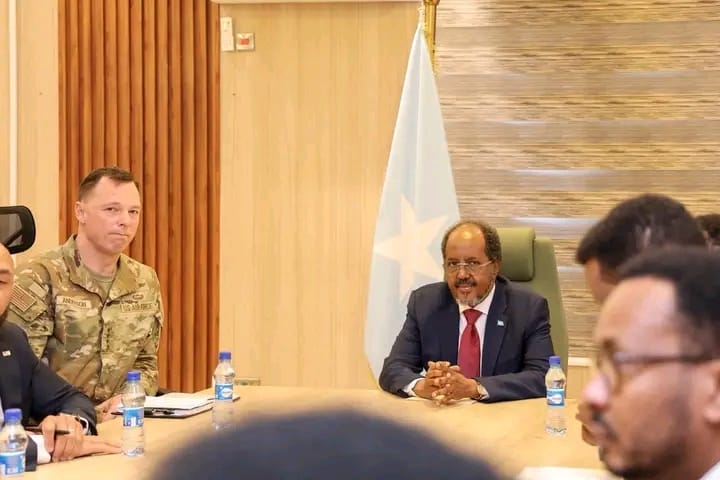
President Hassan Sheikh Mohamud’s meeting with the Commander of the United States Africa Command (AFRICOM), General Dagvin R. M. Anderson, on Thursday comes at one of the most consequential moments in Somalia’s security and political landscape in recent years. While the official statement from Villa Somalia emphasized discussions on counterterrorism, regional security, defense cooperation and continued American support, the timing of the meeting suggests it carries far greater strategic significance than a routine diplomatic engagement.
The talks took place as Somalia continues an intensified military campaign against Al-Shabaab across several regions, amid renewed offensives involving the Somali National Army and local forces. In recent weeks, the federal government has repeatedly declared that military pressure on the militant group will continue despite setbacks experienced earlier this year. Against this backdrop, Washington’s decision to send the head of AFRICOM for high-level discussions with President Hassan Sheikh underscores the importance the United States continues to attach to Somalia’s security.
For Mogadishu, maintaining close military cooperation with Washington remains indispensable. The United States has for years been Somalia’s most significant security partner, providing intelligence, training, logistical support and precision air operations against Al-Shabaab. Although Somali authorities have consistently stated that their long-term objective is to build a self-reliant national army capable of independently securing the country, international support remains a critical component of that strategy.
President Hassan Sheikh’s expression of gratitude for continued U.S. assistance reflects an understanding that Somalia’s campaign against Al-Shabaab cannot succeed through domestic efforts alone. American support has played an important role in strengthening the operational capabilities of the Somali National Armed Forces, particularly in intelligence sharing, special operations training and air support targeting senior Al-Shabaab commanders.
General Anderson’s reaffirmation of Washington’s commitment to supporting Somalia therefore sends a strong political and military message. It demonstrates that despite shifting global priorities and competing international crises, the United States continues to view stability in Somalia as an important strategic interest in the Horn of Africa.
The meeting also comes at a time when Somalia’s political environment has become increasingly contentious. Disagreements between the federal government and sections of the political opposition over constitutional reforms, governance issues and the country’s electoral direction have heightened political tensions in Mogadishu. Critics have repeatedly argued that prolonged political disputes risk diverting attention from the fight against Al-Shabaab, while the government has maintained that national security and state-building efforts remain firmly on course.
Against this backdrop, visible engagement between President Hassan Sheikh and AFRICOM carries symbolic importance. It projects continuity in Somalia’s international security partnerships despite domestic political disagreements and reassures external partners that cooperation against terrorism remains a shared priority.
The discussions also coincide with growing uncertainty surrounding the future of the African Union Support and Stabilization Mission in Somalia (AUSSOM). The mission, which succeeded ATMIS, continues to face serious financial challenges as international donors reassess long-term funding commitments for peace operations across Africa.
Recent decisions by the United States to reduce financial support for certain United Nations-backed peacekeeping mechanisms have intensified debate over how AUSSOM will sustain its operations in Somalia. Funding uncertainties have prompted concern among regional governments contributing troops, particularly as the mission remains central to supporting Somali security institutions during ongoing counterterrorism operations.
At the same time, senior military and political leaders from troop-contributing countries are meeting in Kampala to discuss AUSSOM’s future, force generation, financing and operational priorities. Those discussions have become increasingly urgent as questions persist over who will finance the mission if existing donor arrangements become insufficient.
In that context, President Hassan Sheikh’s meeting with General Anderson may also be interpreted as part of broader diplomatic efforts to ensure Somalia continues receiving robust international security support, even as traditional peacekeeping financing models evolve. While the official readout did not mention AUSSOM directly, security cooperation between Somalia and the United States cannot easily be separated from wider discussions about regional stabilization efforts.
Another important dimension of the meeting concerns the regional security environment in the Horn of Africa. The region continues to experience complex geopolitical competition involving multiple international and regional actors. Instability in Sudan, tensions surrounding the Red Sea, maritime security concerns and rivalries among regional powers have elevated the Horn’s strategic importance for global security.
For Washington, maintaining strong relations with Somalia contributes to broader objectives that include counterterrorism, maritime security in the Gulf of Aden and the Indian Ocean, and preventing extremist organizations from exploiting fragile governance environments. Al-Shabaab remains one of Africa’s most capable militant organizations, retaining the ability to launch sophisticated attacks inside Somalia and occasionally across its borders.
For Somalia, continued American engagement provides both military and diplomatic advantages. Beyond battlefield cooperation, close ties with the United States strengthen Somalia’s standing among international partners and reinforce confidence in the country’s security transition plans.
The meeting also serves as a reminder that Somalia’s counterterrorism campaign is entering a decisive phase. While government forces have reclaimed territory in previous operations, Al-Shabaab has demonstrated resilience through guerrilla tactics, roadside bombings and coordinated assaults. Sustaining military momentum therefore requires not only battlefield successes but also consistent logistical support, intelligence cooperation and institutional strengthening.
The Somali government has repeatedly emphasized that defeating Al-Shabaab will depend on combining military operations with stabilization, governance and service delivery in liberated areas. International partners, including the United States, have consistently echoed that assessment, arguing that lasting security requires both military pressure and stronger state institutions.
Ultimately, Thursday’s meeting between President Hassan Sheikh Mohamud and General Dagvin R. M. Anderson represents more than a diplomatic courtesy. It reflects Somalia’s continued reliance on strategic partnerships as it seeks to overcome one of the continent’s longest-running insurgencies while navigating an increasingly complex political and security environment.
As military operations intensify against Al-Shabaab, political debates continue in Mogadishu, and uncertainty surrounds the future financing of AUSSOM, the message emerging from Villa Somalia is that the partnership between Somalia and the United States remains active and strategically important. Whether that cooperation translates into greater security gains on the ground will depend on the effectiveness of ongoing military operations, the cohesion of Somalia’s political leadership and the willingness of international partners to sustain long-term support during a critical period in the country’s security transition.