

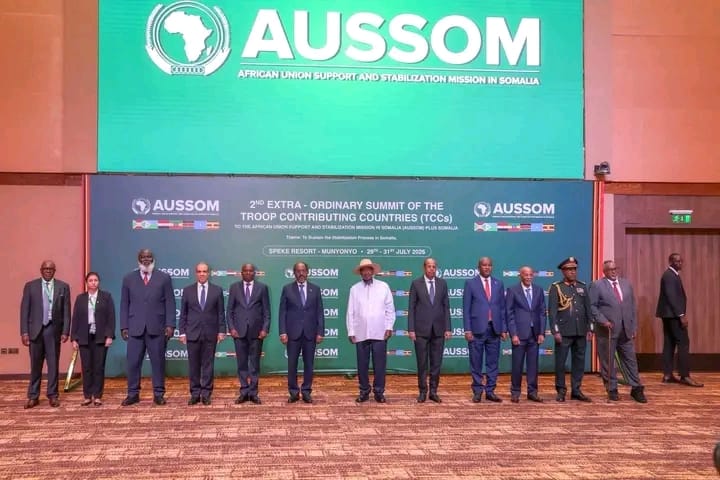
African leaders have reaffirmed their commitment to Somalia’s fight against Al-Shabaab while endorsing a carefully managed transition that would gradually hand over security responsibilities to Somali forces, following the Second Extraordinary Summit of Heads of State and Government of African Union troop-contributing countries (TCCs) to the African Union Support and Stabilization Mission in Somalia (AUSSOM).
The summit, hosted by Ugandan President Yoweri Kaguta Museveni in Kampala on July 31, brought together leaders and senior representatives from Somalia, Uganda, Kenya, Burundi, Egypt, Djibouti and Ethiopia, alongside officials from the African Union, the United Nations and IGAD.
The communiqué issued after the meeting presents one of the clearest roadmaps yet for Somalia’s security transition. While reaffirming confidence in Somalia’s progress, the leaders also acknowledged that the country is not yet ready to fully shoulder national security responsibilities without continued international backing.
Rather than advocating for an abrupt withdrawal of peacekeeping forces, the summit endorsed what it described as an “orderly, coordinated and phased exit” of AUSSOM. The leaders recommended that a United Nations Security Council-mandated mission continue providing essential operational and logistical support for an additional 18 to 24 months, giving Somalia time to strengthen its security institutions and complete agreed transition milestones.
The recommendation reflects growing recognition among regional leaders that a rushed exit could jeopardize hard-won security gains against Al-Shabaab. It also underscores the belief that Somalia’s transition should be measured by institutional readiness rather than predetermined political timelines.
A dominant theme throughout the communiqué is the gradual transfer of security responsibilities from international forces to the Somali National Armed Forces (SNAF).
The summit stressed that Somali forces must continue receiving sustained training, mentorship and institutional support until they are capable of independently protecting the country’s territorial integrity and maintaining internal security.
Leaders called for seamless military training and the development of an integrated military doctrine to improve coordination across Somalia’s security institutions. Such reforms are considered essential for creating a professional national army capable of responding to evolving security threats.
The communiqué also directed the Chiefs of Defence Forces to accelerate implementation of decisions reached during the first extraordinary summit in April 2025. Those decisions include developing a comprehensive military strategy aimed at deterring, degrading and ultimately defeating Al-Shabaab while consolidating government authority in liberated areas.
The Federal Government of Somalia was further encouraged to continue recruiting Local Defence Forces and mobile units to secure newly recovered territories after military offensives.
One of the strongest messages emerging from Kampala concerns military capability gaps.
Regional leaders stressed the urgent need for increased investment in air assets, intelligence, surveillance and reconnaissance (ISR) capabilities, describing them as force multipliers that could significantly improve ongoing counter-terrorism operations.
Military analysts have long argued that Somalia’s campaign against Al-Shabaab cannot rely solely on ground operations. Better surveillance technology, improved intelligence gathering and enhanced air mobility are viewed as essential for responding quickly to insurgent attacks and protecting liberated communities.
The communiqué signals that future international support should increasingly focus on providing these high-value capabilities while simultaneously strengthening Somalia’s own military institutions.
Although security dominated discussions, the summit also emphasized that military gains alone cannot guarantee lasting peace.
Leaders stressed the importance of a unified Somalia built on strong democratic institutions and national cohesion rather than clan-based politics.
The communiqué urged Somali leaders to prioritize national interests over identity politics, warning that political divisions could undermine security achievements.
It also encouraged the Federal Government to deepen cooperation with Federal Member States, traditional elders and local communities in the campaign against Al-Shabaab.
This reflects an understanding that successful counter-insurgency operations depend not only on military strength but also on political consensus, community trust and effective governance.
Beyond military operations, the summit acknowledged the growing importance of information warfare.
The communiqué reaffirmed the need to strengthen efforts to counter extremist propaganda by promoting national unity and shared interests instead of divisive identity politics.
Al-Shabaab has increasingly relied on propaganda and online messaging to recruit supporters and intimidate communities. Regional leaders therefore argued that defeating the group requires both military pressure and stronger strategic communication capable of undermining extremist narratives.
Perhaps the most urgent issue discussed was the financing of AUSSOM.
The communiqué acknowledged significant financial shortfalls affecting the mission and warned that predictable funding will be essential if Somalia’s transition is to succeed.
To address the challenge, the summit mandated the foreign ministers of troop-contributing countries, working alongside Somalia and the African Union, to establish a joint diplomatic task force tasked with mobilizing international political and financial support.
The leaders also called for the organization of a major donors’ conference aimed at securing sustainable financing throughout the transition period.
Partners were urged to provide additional resources to prevent funding gaps from disrupting ongoing security operations.
The emphasis on financing highlights a broader concern among African leaders that security gains could be reversed if international financial support declines before Somali institutions become fully self-sustaining.
The summit opened by paying tribute to the thousands of soldiers from troop-contributing countries who have lost their lives or sustained injuries during nearly two decades of peace support operations in Somalia.
Leaders praised the commitment and sacrifices made by African forces in helping stabilize Somalia while reaffirming their collective determination to eliminate Al-Shabaab.
At the same time, they made clear that the ultimate objective remains a Somalia capable of independently guaranteeing its own security.
The Kampala communiqué sends a balanced political message.
On one hand, it recognizes the considerable progress Somalia has made in rebuilding its security institutions and expanding the capabilities of the Somali National Armed Forces.
On the other, it acknowledges that Somalia’s transition remains incomplete and that international support cannot disappear overnight without risking instability.
Rather than delaying Somali ownership of security responsibilities, the communiqué proposes a structured transition supported by continued international logistical assistance, targeted military capacity-building and sustainable financing.
It also reinforces the view that Somalia’s future security depends not only on defeating Al-Shabaab militarily but also on strengthening democratic governance, national unity and cooperation between the Federal Government, Federal Member States and local communities.
The summit concluded by agreeing to submit its recommendations to the African Union Peace and Security Council for endorsement before forwarding them to the United Nations Security Council as a working document, where they are expected to inform future international decisions on Somalia’s security transition.
If endorsed, the Kampala roadmap could shape the next phase of international engagement in Somalia, balancing the country’s growing responsibility for its own security with continued regional and global support during one of the most critical stages of its state-building journey.