

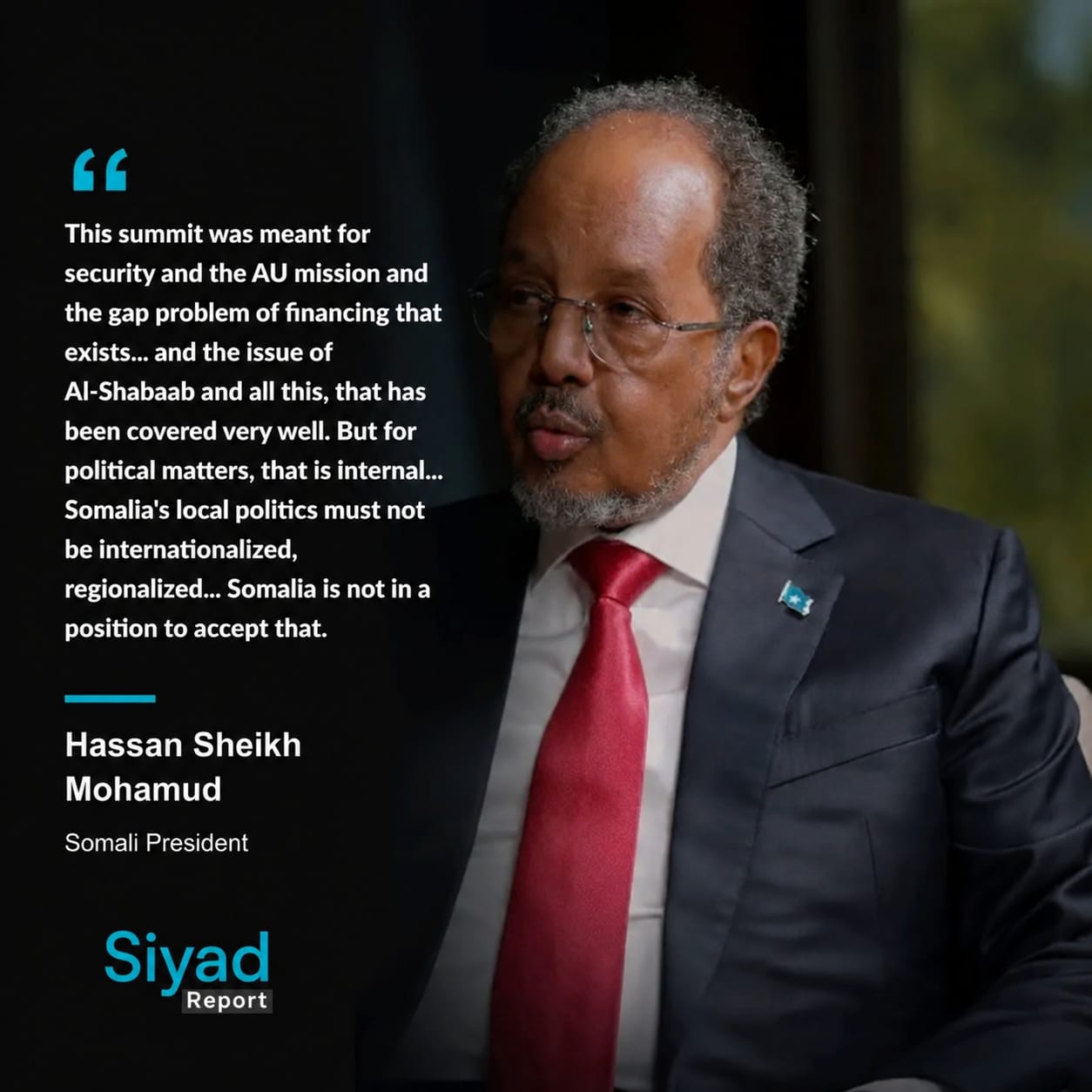
President Hassan Sheikh Mohamud successfully pushed for changes to the Kampala Summit’s final communiqué after objecting to language that called for an “inclusive political agreement” in Somalia, arguing that the country’s internal political affairs should not be subject to regional or international direction.
The diplomatic intervention, made during deliberations on the summit’s final communiqué, became the defining moment of the high-level meeting, underscoring Somalia’s increasingly assertive stance on national sovereignty and its insistence that political decisions affecting the country must remain exclusively in the hands of the Somali people.
According to officials familiar with the discussions, the draft communiqué initially included a provision urging Somalia’s political stakeholders to pursue an inclusive political agreement as part of broader efforts to strengthen stability and national cohesion. The wording was intended to encourage political dialogue, but President Hassan Sheikh immediately objected, arguing that such language crossed a diplomatic line by appearing to invite regional involvement in Somalia’s internal political affairs.
Intervening before the communiqué was formally adopted, the President rejected the provision and insisted that Somalia’s domestic political processes could not be defined or guided by external actors.
“Political matters are internal affairs. They should not be internationalized or regionalized. Somalia does not accept that,” President Hassan Sheikh Mohamud told the summit.
His remarks prompted further consultations among participating delegations, after which the disputed section of the communiqué was revised to reflect Somalia’s position.
The final version affirmed that Somalia’s internal political affairs are the sovereign responsibility of the Somali people and their constitutional institutions. It further acknowledged that decisions concerning the country’s political future must remain Somali-led while recognizing that the Federal Government continues to welcome international partnerships supporting nationally owned priorities in security, stability and state-building.
The revised communiqué stated that Somalia’s internal political affairs are sovereign matters to be determined by the Somali people through their constitutional institutions, without external interference—language that closely reflected the position advanced by President Hassan Sheikh during the discussions.
The episode marked one of the clearest public demonstrations of Somalia’s evolving diplomatic posture. While Mogadishu continues to rely on strong cooperation with regional partners in the fight against Al-Shabaab and in advancing stabilization efforts, the Federal Government has increasingly emphasized that security cooperation should not translate into external influence over domestic political decisions.
For President Hassan Sheikh, the issue extended beyond a single paragraph in a diplomatic document. It represented a fundamental question of sovereignty. Since returning to office, his administration has consistently argued that Somalia has made significant progress in rebuilding its institutions and should now be treated as a sovereign state capable of managing its own constitutional and political affairs.
The Kampala Summit brought together ministers and senior officials from troop-contributing countries to discuss Somalia’s security transition, the future of the African Union stabilization mission, continued military operations against Al-Shabaab, and regional cooperation. However, the debate surrounding the communiqué ultimately overshadowed many of the summit’s security discussions.
Political analysts say the President’s intervention reflects growing confidence within the Federal Government that Somalia’s constitutional institutions are sufficiently established to address domestic political disputes without external mediation. The administration has repeatedly maintained that differences over constitutional reforms, elections and governance should be resolved through Somali institutions rather than through internationally driven political arrangements.
The timing of the dispute is particularly significant as Somalia advances constitutional reforms and preparations for its future electoral process. References to an “inclusive political agreement” carry considerable political sensitivity because they can be interpreted as suggesting that Somalia’s internal political actors require externally facilitated negotiations to reach consensus.
By insisting on changes to the communiqué before its adoption, President Hassan Sheikh ensured that the summit’s final outcome reflected Somalia’s long-standing position on sovereignty. The amendment also demonstrated Mogadishu’s willingness to challenge diplomatic language it considers inconsistent with the country’s constitutional independence, even during high-level regional meetings involving close security partners.
The revised communiqué ultimately preserved the summit’s emphasis on continued regional cooperation in combating terrorism and supporting Somalia’s stabilization efforts while affirming that the country’s political future must remain the exclusive responsibility of the Somali people.
The Kampala meeting therefore concluded with two important messages. First, Somalia reaffirmed its commitment to working closely with regional and international partners on security, stabilization and state-building. Second, and perhaps more significantly, President Hassan Sheikh Mohamud made clear that such partnerships cannot extend to determining Somalia’s internal political direction.
His successful intervention ensured that the summit’s final communiqué reflected that principle, reinforcing Mogadishu’s position that Somalia welcomes international support but will not accept external involvement in decisions concerning its political future.