

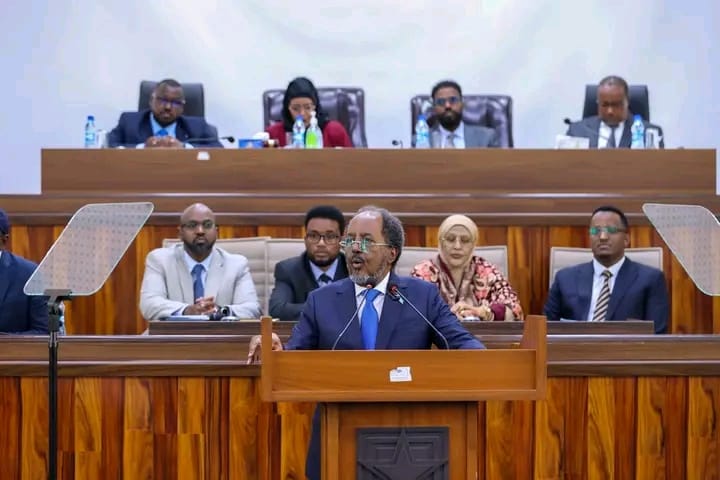
President Hassan Sheikh Mohamud has delivered one of his strongest and most consequential foreign policy messages in recent years, declaring before Somalia’s Federal Parliament that his government will use “all available means” to prevent Israel from establishing any political or security presence in Somalia. His remarks, which also strongly condemned Israel’s reported engagement with Somaliland, represent more than a routine diplomatic statement they signal a hardening of Somalia’s foreign policy at a time when geopolitical competition in the Horn of Africa is intensifying.
Speaking to lawmakers on Thursday, President Hassan Sheikh stated that “Israeli interference in Somalia’s internal affairs is one of the main factors fueling instability in the Horn of Africa and the Red Sea region.” He went further by assuring Parliament that Somalia would rely on “strength, strategy, and diplomacy” to block what he described as any attempt by Israel to establish a presence or foothold inside the country.
The president’s message comes after months of growing speculation over Israel’s interest in expanding its diplomatic reach in the Horn of Africa, particularly through Somaliland. Reports and political discussions surrounding possible Israeli engagement with Somaliland have generated significant debate, with Mogadishu consistently maintaining that any direct relations with Somaliland undermine Somalia’s sovereignty and violate international recognition of the country’s territorial integrity.
The controversy did not emerge overnight. Since Somaliland declared independence from Somalia in 1991, successive governments in Mogadishu have opposed any move by foreign governments to recognize or engage Somaliland as an independent state. While Somaliland has developed its own governing institutions and sought international recognition for decades, no United Nations member state has formally recognized it as a sovereign country.
Recent reports suggesting closer contacts between Israeli officials and Somaliland authorities, alongside discussions about diplomatic cooperation and the possibility of opening representative offices, have heightened concerns within the Somali Federal Government. Although much of the reporting has centered on discussions and political signaling rather than formal recognition, the issue has become increasingly sensitive because it touches directly on Somalia’s longstanding position that Somaliland remains an inseparable part of the Federal Republic of Somalia.
It is against this backdrop that President Hassan Sheikh’s parliamentary address carries significant diplomatic weight. His warning was not limited to rejecting recognition of Somaliland. Instead, he framed the issue as part of a broader regional security challenge.
According to the president, any Israeli political or security presence in Somaliland would amount to direct interference in Somalia’s internal affairs and could drag the Horn of Africa into wider Middle Eastern rivalries.
That assessment reflects Mogadishu’s concern that geopolitical competition is increasingly shifting toward the Red Sea and the Gulf of Aden, where international powers are competing for military access, trade routes, and strategic partnerships. Somalia occupies one of the world’s most strategically important coastlines, making developments involving foreign powers closely watched by both regional governments and international actors.
By stating that Somalia will use “strength, strategy, and diplomacy” to counter Israeli involvement, Hassan Sheikh outlined what appears to be a three-pronged approach. Diplomacy remains the primary instrument, with Somalia expected to continue lobbying allies, regional organizations, and international partners to reaffirm support for its territorial integrity.
Strategy suggests a coordinated political and diplomatic campaign designed to prevent any normalization of relations between Israel and Somaliland. The reference to strength, meanwhile, projects political resolve, although the president did not elaborate on what specific measures that would involve.
Equally notable was the president’s assertion that Somalia will employ “all available means” to prevent Israel from establishing a foothold in the country. While he did not define those means, the statement signals that Mogadishu intends to treat the issue as a major national sovereignty concern rather than merely a diplomatic disagreement.
The remarks also reinforce Somalia’s long-standing foreign policy position on Somaliland. Hassan Sheikh reaffirmed that Somaliland remains an inseparable part of the Federal Republic of Somalia and emphasized that his administration would continue defending the country’s unity, sovereignty, and territorial integrity through lawful international engagement. That language aligns with Somalia’s consistent position before the African Union, the United Nations, and other international forums.
Beyond Somalia’s domestic politics, the speech also sends a broader message to regional and international partners. It demonstrates that Mogadishu intends to resist any foreign engagement with Somaliland that could be interpreted as recognition or as weakening Somalia’s internationally recognized borders. In diplomatic terms, the president’s address raises the political cost for countries considering deeper official ties with Somaliland.
The timing of Hassan Sheikh’s remarks is also significant. The Horn of Africa is experiencing renewed geopolitical competition involving Gulf states, Western powers, Türkiye, China, and other international actors.
Military bases, maritime security partnerships, infrastructure investments, and diplomatic influence have all become central features of regional politics. Within that environment, Somalia appears determined to ensure that the Somaliland question does not become another arena for international rivalry.
Whether the president’s speech translates into concrete diplomatic initiatives remains to be seen. Somalia is likely to intensify engagement with its international partners while continuing to oppose any move that appears to legitimize Somaliland as a separate state. At the same time, countries engaging with Somaliland will face closer scrutiny from Mogadishu, particularly if such engagement extends beyond economic or humanitarian cooperation into political or security matters.
For Israel, Hassan Sheikh’s speech represents one of the clearest public warnings issued by the Somali government in recent years. By explicitly linking Israeli engagement with Somaliland to regional instability, the president elevated the issue from a bilateral disagreement to what Somalia considers a broader threat to peace and security in the Horn of Africa and the Red Sea region.
Ultimately, Hassan Sheikh Mohamud’s parliamentary address was not only about Israel or Somaliland. It was a declaration that Somalia intends to defend its internationally recognized borders with renewed diplomatic determination.
His words “Israeli interference in Somalia’s internal affairs is one of the main factors fueling instability in the Horn of Africa and the Red Sea region” and Somalia will use “strength, strategy, and diplomacy” together with “all available means” to prevent any Israeli foothold are likely to shape political debate in the coming weeks.
They reaffirm Mogadishu’s position that the question of Somaliland is not merely a domestic constitutional issue, but a central pillar of Somalia’s national sovereignty and foreign policy, one that the government says it is prepared to defend on every diplomatic front.