

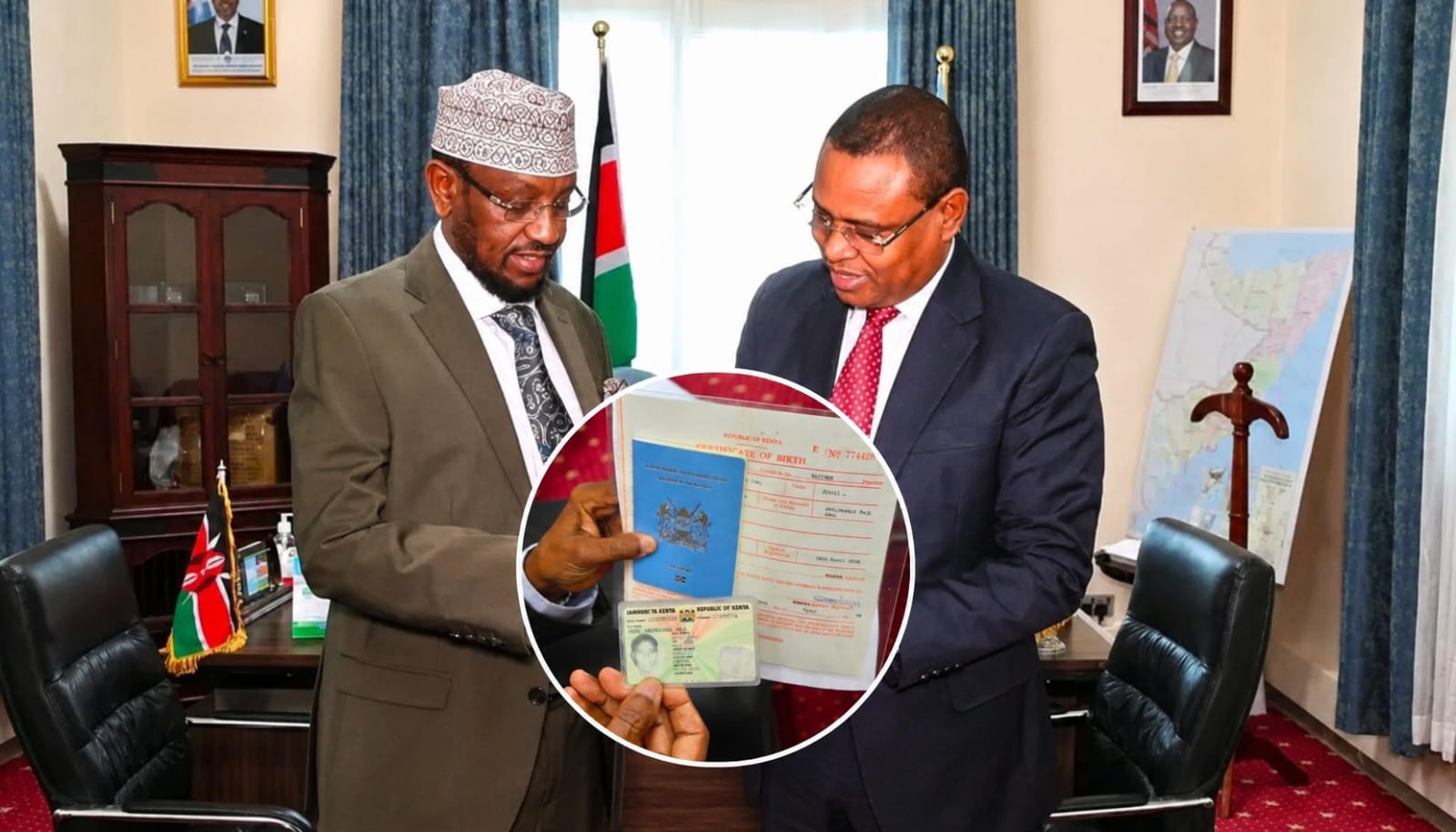
Somalia has entered a new and politically significant chapter after Deputy Prime Minister Jibril Abdirashid officially surrendered his Kenyan citizenship and passport, becoming the first senior government official to publicly comply with President Hassan Sheikh Mohamud’s directive requiring cabinet ministers holding Kenyan passports to renounce their foreign citizenship or leave office.
The move, carried out on Monday, is far more than an administrative exercise. It represents one of the clearest signals yet that Villa Somalia intends to redefine the standards of political loyalty at the highest levels of government, particularly at a time when questions surrounding national sovereignty, immigration, and dual citizenship have become increasingly intertwined with regional diplomacy.
President Hassan Sheikh Mohamud issued the directive during Thursday’s cabinet meeting, ordering all ministers in possession of Kenyan passports to immediately surrender them to the relevant Kenyan authorities. The order came against the backdrop of mounting diplomatic tensions and heightened immigration scrutiny by Kenya, where several Somali government officials have recently been denied entry or deported over what Nairobi described as documentation and immigration irregularities.
Jibril Abdirashid’s decision to relinquish his Kenyan citizenship makes him the highest-ranking Somali official to publicly implement the presidential directive. According to government sources, the Deputy Prime Minister acted in direct compliance with the executive order, choosing to retain his position in government rather than maintain dual nationality.
His decision carries enormous political symbolism.
For decades, Somalia’s political class has included leaders who spent years in exile during the country’s civil conflict. Many acquired citizenship in countries such as Kenya, the United Kingdom, Canada, the United States, Norway and other Western nations while living abroad. As stability gradually returned, numerous members of the diaspora came back to occupy senior government positions, bringing with them international education, professional experience and extensive diplomatic networks.
While this diaspora leadership has often been viewed as an asset in rebuilding state institutions, it has also generated recurring debates over divided loyalties, constitutional obligations and whether senior public officials should owe legal allegiance to another country while serving in Somalia’s highest offices.
The latest directive appears to be the strongest attempt yet by President Hassan Sheikh Mohamud to settle that debate within his administration.
The order also follows weeks of growing friction between Somalia and Kenya after several Somali officials reportedly encountered difficulties at Kenyan border points, particularly at Jomo Kenyatta International Airport in Nairobi. Among those affected was Deputy Prime Minister Jibril Abdirashid, who was previously turned back alongside several other Somali officials.
Those incidents sparked criticism within Somalia, with many officials arguing that senior representatives of a sovereign government should not face such treatment while undertaking official duties. They also renewed domestic discussions about why some top Somali leaders continue to travel using Kenyan passports despite serving in Somalia’s highest offices.
Against this backdrop, the President’s directive can be interpreted as both a political statement and a strategic response.
By insisting that ministers choose between Kenyan citizenship and public office, Villa Somalia is sending a message that service in the federal government requires exclusive national allegiance. It is a move likely intended to reinforce public confidence in state institutions while projecting an image of stronger sovereignty.
Politically, the decision also places considerable pressure on other cabinet members who may possess Kenyan citizenship. They now face a clear choice: surrender their foreign nationality or relinquish their ministerial positions.
How many ministers may ultimately be affected remains unclear, but the directive has the potential to reshape the composition of the federal cabinet if others decide not to comply.
The implications extend beyond Somalia’s internal politics.
Kenya has long served as home to one of the world’s largest Somali diaspora communities, many of whom hold Kenyan citizenship while maintaining deep political, economic and family ties across the border. Successive Somali administrations have relied heavily on expertise drawn from this diaspora.
If the policy is implemented consistently beyond the current cabinet, it could influence future appointments to senior government positions and redefine the relationship between Somalia’s political leadership and its extensive diaspora community.
Supporters of the President’s decision argue that senior public officials should demonstrate undivided loyalty to the Somali state, particularly those entrusted with sensitive responsibilities involving national security, foreign affairs and cabinet-level decision-making. They contend that eliminating questions over dual allegiance strengthens public trust and reinforces the authority of national institutions.
Critics, however, may argue that the directive risks excluding experienced professionals whose international exposure has played a vital role in Somalia’s reconstruction over the past two decades. Many members of the Somali diaspora returned when domestic institutions were still fragile, investing their skills and resources in rebuilding government ministries, financial institutions and public services.
For them, dual citizenship has often reflected the realities of displacement rather than a lack of patriotism.
Whether the directive evolves into a broader legal reform or remains confined to cabinet ministers will likely become one of the next major political questions facing Villa Somalia.
It also comes at a time when Somalia is seeking to strengthen state institutions, prepare for significant political reforms and navigate an increasingly complex regional security environment. Demonstrating a unified national leadership may be viewed by the administration as essential in advancing those objectives.
For Kenya, the development may attract close attention given the longstanding movement of people between the two neighbouring countries. Nairobi has historically hosted Somali refugees, business leaders, students and politicians, making citizenship issues particularly sensitive in bilateral relations.
Although the surrender of a Kenyan passport by a sitting Somali Deputy Prime Minister is unprecedented in recent years, it also reflects the evolving nature of relations between the two governments, where immigration enforcement, diplomatic protocol and national sovereignty are becoming more closely connected.
Ultimately, Jibril Abdirashid’s decision is likely to be remembered not simply as the renunciation of a passport, but as the beginning of a broader political shift within Somalia’s leadership. Whether other ministers follow suit in the coming days will determine whether President Hassan Sheikh Mohamud’s directive becomes a defining governance reform or merely an isolated political gesture.
For now, however, Villa Somalia has drawn a clear line: those entrusted with leading Somalia must demonstrate that their highest legal and political allegiance belongs solely to the Federal Republic of Somalia.