

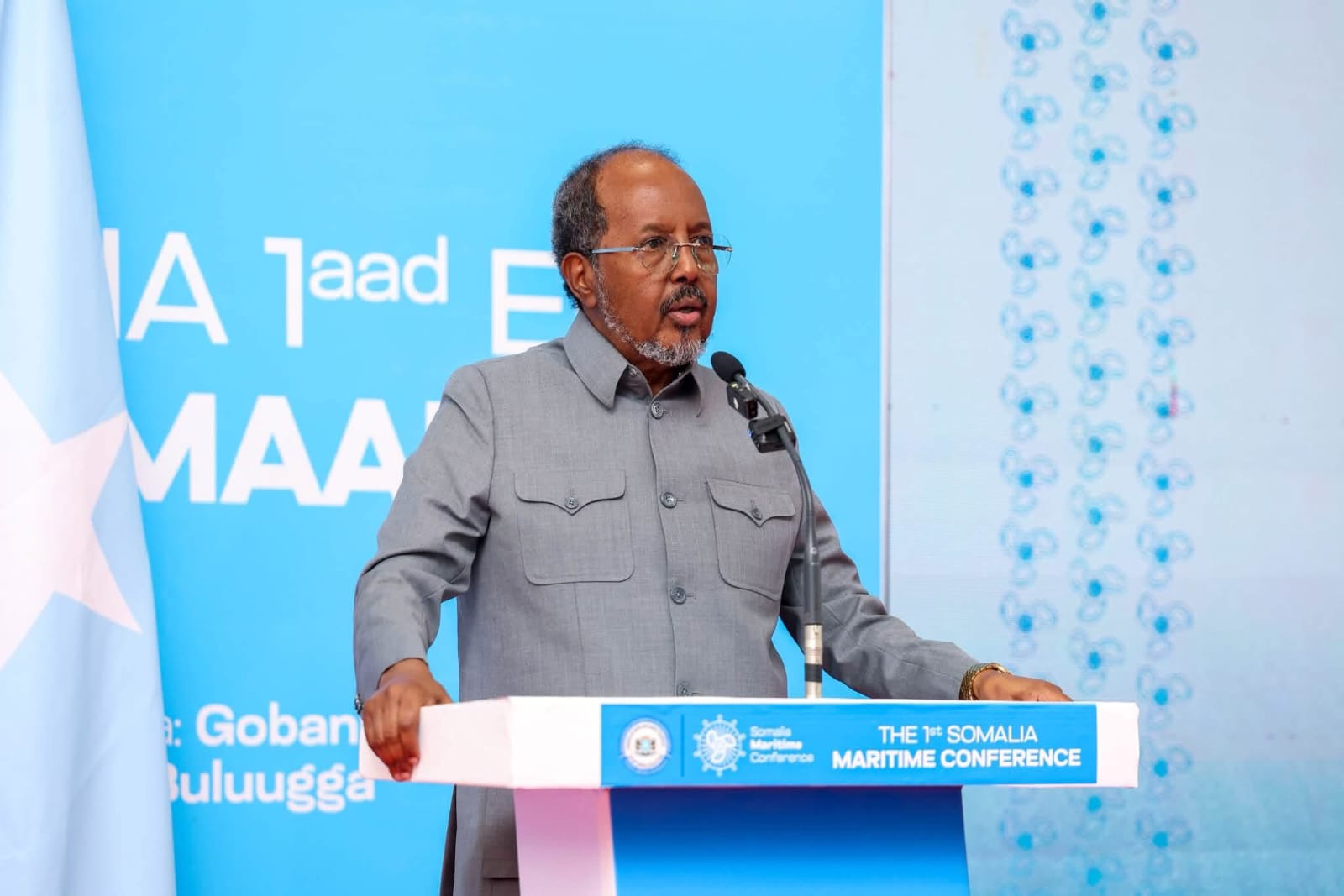
Somalia has taken a significant step toward redefining its economic future by turning its attention to one of its greatest yet largely untapped assets the sea.
On Monday, President Hassan Sheikh Mohamud officially launched the first-ever Somali Ocean Conference in Mogadishu, outlining an ambitious vision to safeguard the country’s maritime sovereignty, expand sea transport, strengthen the blue economy, and position Somalia as a leading maritime nation in the Horn of Africa and the Indian Ocean.
The landmark conference, organized by Somalia’s Ministry of Ports and Maritime Transport, brought together government officials, maritime experts, policymakers and stakeholders to discuss the future of Somalia’s vast maritime sector.
The gathering reflected the government’s growing commitment to transforming the country’s more than 3,300-kilometre coastline into a pillar of national development after decades in which insecurity, weak institutions and illegal exploitation of marine resources limited its economic potential.
Opening the conference, President Hassan Sheikh described Somalia’s maritime domain as one of the country’s most valuable strategic assets, capable of driving long-term economic growth, creating employment opportunities for thousands of young people and strengthening regional trade connections.
“Somalia is reclaiming its place not only as a secure nation, but also as a leading maritime nation in the Horn of Africa and the Indian Ocean,” the President said.
His remarks underscored the government’s broader strategy of rebuilding state institutions while positioning Somalia as an attractive destination for international investment.
With one of Africa’s longest coastlines stretching along the Gulf of Aden and the Indian Ocean, Somalia possesses immense opportunities in fisheries, shipping, port development, offshore resources and marine tourism sectors that remain largely underdeveloped despite their enormous economic potential.
President Hassan Sheikh stressed that the country’s coastline should no longer be viewed merely as a geographical feature but as a national economic engine capable of transforming livelihoods across Somalia.
“Our coastline is a national resource that can drive economic growth and create jobs for our young generation,” he said, emphasizing the need to harness marine resources for the benefit of Somali citizens.
The President also urged greater public participation in the maritime economy, encouraging communities to take advantage of opportunities available in fishing, marine trade and other ocean-based industries.
“We must encourage our people to benefit from the country’s marine resources,” he said, calling for increased investment in skills, innovation and sustainable use of Somalia’s coastal wealth.
The conference also highlighted Somalia’s expanding international partnerships in rebuilding its maritime institutions. President Hassan Sheikh acknowledged the support provided by the Government of Türkiye, revealing that Turkish maritime experts are working alongside Somali authorities to strengthen technical capacity and modernize the country’s maritime sector.
“Government of Türkiye has sent maritime experts to support our country,” the President noted, describing the cooperation as part of broader efforts to improve maritime governance, port management and the development of Somalia’s blue economy.
Türkiye has emerged as one of Somalia’s closest strategic partners over the past decade, supporting the country in areas including infrastructure, security, education and institutional development. Maritime cooperation now appears to be another pillar of that growing partnership as Somalia seeks to rebuild its economy through sustainable exploitation of its marine resources.
Beyond domestic reforms, President Hassan Sheikh used the conference to deliver a clear message to the international business community, declaring that Somalia is ready to welcome foreign investment into its maritime sector.
“Somalia is open for international business. I call on global investors to come to our country and invest,” he said.
The invitation reflects growing confidence within the Somali government that improving security and governance can create a more attractive environment for international investors. Authorities hope investments in ports, logistics, fisheries, shipping infrastructure and marine industries will accelerate economic recovery while generating employment for a youthful population facing high unemployment.
The blue economy has increasingly become a priority for many coastal African nations seeking new sources of economic growth. For Somalia, the sector presents opportunities not only to expand exports and government revenues but also to strengthen food security through sustainable fisheries, improve regional connectivity and reduce dependence on traditional sources of income.
The conference also carries strategic significance beyond economics. By emphasizing maritime sovereignty, the Somali government is reinforcing its commitment to protecting the country’s territorial waters and ensuring that Somalia maintains control over its maritime resources.
The issue has gained increasing importance in recent years as Mogadishu seeks to combat illegal fishing, improve maritime security and safeguard its exclusive economic zone.
Developing stronger maritime institutions is expected to play a critical role in protecting Somalia’s waters while enhancing cooperation with regional and international partners on issues including maritime safety, environmental protection and trade.
The inaugural Somalia Maritime Conference therefore marks more than the launch of a new annual forum. It signals a shift in national priorities, placing the ocean at the centre of Somalia’s long-term development agenda.
By combining investments in infrastructure, stronger maritime governance, international partnerships and sustainable management of marine resources, the government hopes to unlock the enormous economic value of the country’s coastline.
For a nation whose history and geography have long been tied to the sea, the conference represents an effort to transform that natural advantage into tangible economic progress.
President Hassan Sheikh’s message was clear: Somalia intends to reclaim its maritime identity, leverage its strategic location and build a blue economy capable of creating jobs, attracting investment and positioning the country as a major maritime hub in the region. If successfully implemented, that vision could become one of the defining pillars of Somalia’s economic transformation in the years ahead.