

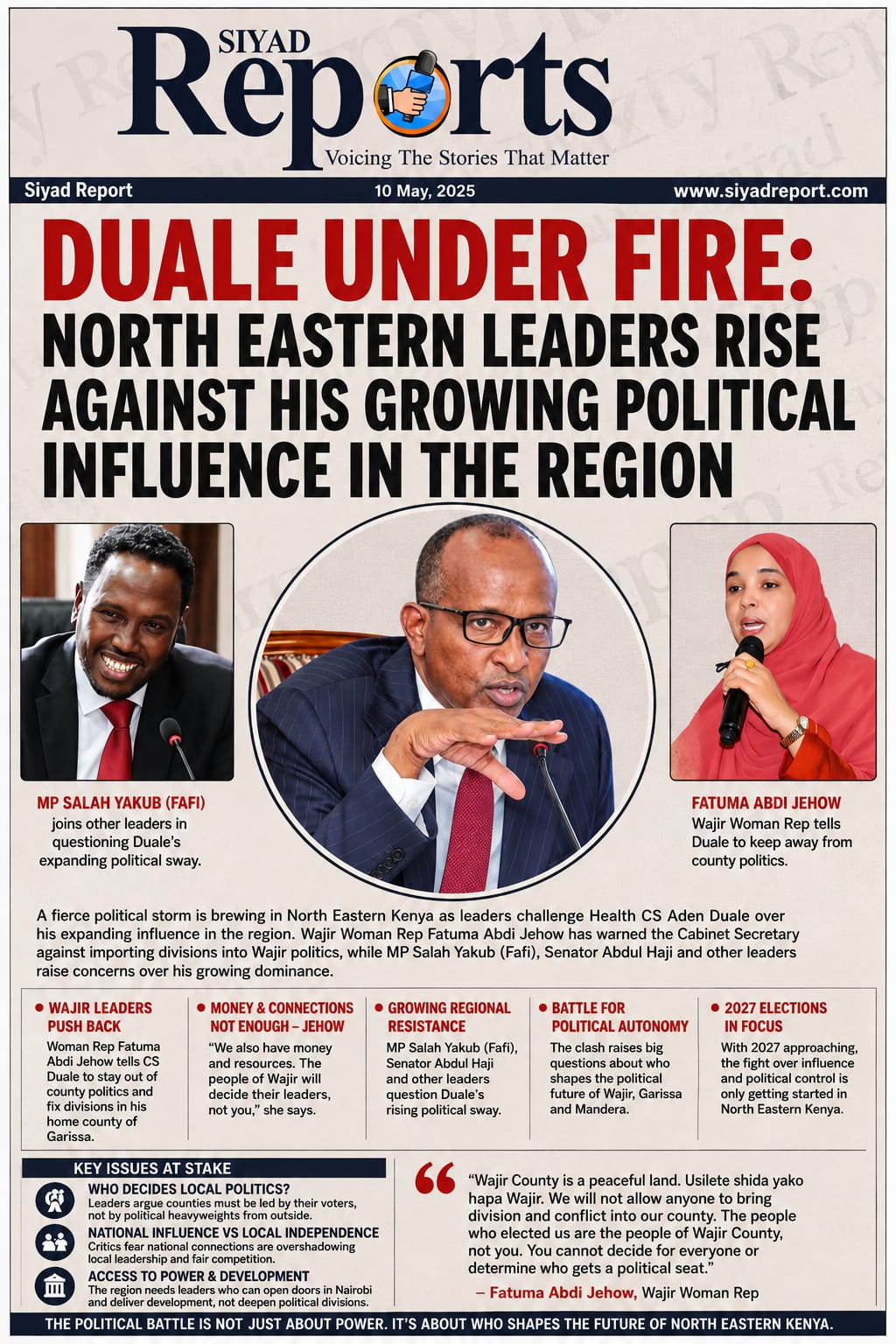
A political confrontation that has been building beneath the surface of Northeastern Kenya’s politics has now burst into the open, exposing a deeper and increasingly consequential struggle over power, influence and political authority in a region that has historically struggled to establish one undisputed centre of political gravity.
At the heart of the latest confrontation is Health Cabinet Secretary Aden Duale, whose growing influence within the national government and longstanding political relationship with President William Ruto have increasingly placed him at the centre of political conversations across Northeastern Kenya, while a section of regional leaders is becoming increasingly vocal about what they perceive as an expanding political role that extends beyond his national responsibilities.
The latest and most direct challenge has come from Wajir County Woman Representative Fatuma Abdi Jehow, who has delivered one of the strongest public rebukes yet against Duale’s perceived involvement in Wajir politics.
Jehow has told the Cabinet Secretary to keep away from the county’s political affairs and instead concentrate on addressing what she described as political divisions in his home county of Garissa, accusing him of contributing to tensions among political actors there and warning him against bringing what she described as tribal politics and division into Wajir County.
Her remarks represent a significant escalation in the increasingly public disagreement over Duale’s political influence in Northeastern Kenya.
Jehow’s message was direct and unmistakable. She insisted that Wajir is a peaceful county whose political future must be determined by its own people rather than by powerful individuals seeking to influence local leadership from outside.
“Wajir County is a peaceful land. Usilete shida yako hapa Wajir. We will not allow anyone to bring division and conflict into our county,” she said, making it clear that she views any attempt to import regional political rivalries into Wajir as a threat to the county’s political stability and unity.
Her remarks also reflected a broader sentiment among politicians who believe that local voters should retain the final authority over political leadership and electoral choices.
The Woman Representative went further by directly challenging the influence that comes with financial resources, political networks and access to powerful figures within the national government. She argued that money, helicopters and political connections do not give any individual the authority to determine who should lead Wajir or who should secure a particular political seat.
“We also have money and resources. The people who elected us are the people of Wajir County, not you. You cannot decide for everyone or determine who gets a political seat,” she said.
The statement was not merely a rejection of Duale’s alleged political involvement; it was also a declaration that Wajir’s political space should remain firmly in the hands of its electorate.
The significance of Jehow’s intervention, however, extends far beyond the immediate exchange between two politicians.
It has opened another front in a much larger debate that has been developing across Northeastern Kenya over who should shape the region’s political direction, who should have the authority to negotiate its interests with Nairobi and whether national political influence should translate into the ability to determine local political outcomes.
The disagreement is therefore increasingly becoming less about the personalities involved and more about the structure of political power within a region where competing leaders have historically struggled to agree on a single centre of influence.
For decades, Northeastern Kenya has operated without one universally accepted political kingpin. Political influence has moved between Garissa, Wajir and Mandera, with different leaders emerging at different moments depending on their electoral strength, relationship with the government of the day, national visibility and ability to mobilise political support.
Unlike some regions of Kenya that have occasionally rallied around one dominant political figure, Northeastern Kenya has generally remained politically fragmented, with influential leaders maintaining their own constituencies, networks and ambitions.
That fragmentation has sometimes allowed individual politicians with strong national relationships to acquire influence beyond their immediate electoral bases.
Duale occupies a particularly powerful position within this political equation. As a veteran politician with decades of experience in national politics, he has built a political profile that extends well beyond his home constituency and has developed relationships within the national political establishment that few politicians from Northeastern Kenya can match.
His longstanding relationship with President William Ruto has further strengthened his position, giving him considerable access and visibility within the national government at a time when many regional politicians are competing for the attention and confidence of the same political centre.
That influence is precisely what increasingly unsettles some politicians in Northeastern Kenya. For Duale’s critics, the concern is not simply that he remains politically active or maintains relationships with leaders across the region.
Their concern is the perception that his national influence is increasingly being translated into regional political influence, creating fears that political choices in counties such as Wajir could be shaped by powerful networks operating beyond the county itself.
In their view, the issue is therefore not whether Duale has the right to participate in political conversations, but whether his influence has reached a point where other regional leaders feel their political independence and ability to compete on equal terms are being undermined.
Jehow’s confrontation consequently represents something considerably larger than a disagreement between two politicians. It is fundamentally a contest over political autonomy and the right of individual counties to determine their own political leadership without external political pressure.
The question being raised is whether Wajir, Garissa and Mandera can independently determine their political futures according to the preferences of their voters, or whether the region’s political direction will increasingly be influenced by leaders who possess stronger relationships with Nairobi and the national government.
That question is likely to become even more important as political parties and individual politicians begin positioning themselves for the 2027 General Election.
The dispute also comes against the backdrop of criticism from other Northeastern politicians.
Fafi Member of Parliament Salah Yakub Farah and Senator Abdul Haji and other political leaders in the region have, in different political contexts, raised concerns about Duale’s influence and political approach, contributing to an emerging pattern in which several regional politicians appear increasingly willing to publicly question the Cabinet Secretary’s role in Northeastern politics.
While their individual positions and political interests may differ, the convergence of criticism around Duale’s influence suggests that the current disagreement cannot easily be dismissed as a single political dispute between Jehow and the Cabinet Secretary.
The common thread running through these disagreements is the concern among Duale’s critics that political space within Northeastern Kenya could become increasingly concentrated around one powerful figure.
They fear that a political structure built around one individual’s relationship with the national government could weaken the ability of other leaders to operate independently and could create an environment in which political influence becomes dependent on proximity to one centre of power.
Such concerns are particularly significant in a region where political representation is spread across several counties and constituencies, each with its own leadership ambitions and political interests.
There is, however, another interpretation of Duale’s influence that cannot simply be ignored. His supporters can argue that his political strength is not necessarily the result of an attempt to dominate Northeastern Kenya, but rather the product of decades of political experience, national visibility, institutional relationships and a longstanding connection to the country’s political establishment.
From this perspective, Duale is not imposing himself on Northeastern politics but exercising political influence that he has accumulated through years of national political engagement. His ability to access senior government officials and the President can therefore be viewed as an asset for the region rather than a threat to its political autonomy.
That is where the argument becomes significantly more complicated, because political influence is not automatically the same thing as political interference. A senior Cabinet Secretary from Northeastern Kenya will naturally have an interest in the affairs and development of the region, just as leaders from other parts of the country remain politically connected to their home regions.
The more difficult question is where legitimate political engagement ends and attempts to influence or determine local political outcomes begin. Establishing that distinction requires evidence, transparency and a willingness by political leaders to separate genuine concerns about regional leadership from ordinary competition for electoral influence.
That distinction is likely to become increasingly important as Kenya moves towards the 2027 General Election. Political alliances are already beginning to take shape, politicians are assessing their electoral strength and regional leaders are increasingly conscious that their relationship with the national government could influence their prospects.
In such an environment, accusations of political interference can easily become weapons in a much broader struggle for political relevance, while genuine concerns about the concentration of political influence can equally be dismissed as ordinary political rivalry. The challenge for voters is therefore to distinguish between political rhetoric and demonstrable political conduct.
The battle unfolding in Northeastern Kenya is ultimately about much more than individual personalities. It is about access to power, the distribution of political influence and the relationship between regional leadership and the national government.
President William Ruto sits at the centre of that equation because his administration remains the national political power structure with which regional politicians must engage.
For many leaders across Northeastern Kenya, maintaining a strong relationship with State House is strategically important because access to the national government can influence development priorities, political alliances, appointments and the ability to advocate for the region’s interests.
Duale’s advantage is that he has already established that relationship. His critics therefore face a difficult political calculation because challenging Duale within Wajir, Garissa or Mandera is one thing, while challenging the broader political network that connects him to the national government is an entirely different proposition.
This explains why the current confrontation carries significance beyond county-level politics: it is also a competition over who has the strongest political pathway to Nairobi and, ultimately, who can most effectively position Northeastern Kenya within the national political establishment.
This is why the emerging confrontation should not be dismissed as another regional political quarrel destined to disappear after one political rally or public statement.
It may instead represent the beginning of a broader realignment in Northeastern Kenya, particularly if more leaders begin openly questioning the extent of Duale’s influence and demanding greater political space for other regional actors.
The central question will be whether Northeastern Kenya continues operating through competing individual political power bases or whether its leaders eventually develop a collective political strategy that allows several centres of influence to coexist without turning every disagreement into a battle for regional supremacy.
The region has enormous political significance, yet its leaders have repeatedly struggled to maintain a unified political voice. Wajir has its own political interests and electoral calculations, Garissa has its own leadership structures and ambitions, while Mandera has developed its own political networks and competing interests.
Within each county, politicians are simultaneously competing for parliamentary seats, gubernatorial positions, influence within political parties and access to national decision-makers. That fragmentation creates an environment in which a politician with strong national connections can acquire influence that extends considerably beyond his or her immediate constituency.
This is arguably one of the biggest lessons emerging from the current confrontation. The strength of Duale’s political position may not necessarily come only from his ability to influence Northeastern politics; it may also come from the inability of his political competitors to build a sufficiently coordinated alternative.
If Jehow, Hangool, Abdul Haji and other regional leaders believe that Duale has become too powerful, the political question confronting them is therefore straightforward: what is their alternative?
Challenging a powerful national politician requires more than public speeches and criticism. It requires political organisation, a coherent regional agenda, electoral alliances and, most importantly, a convincing alternative vision capable of attracting voters across the region.
Public criticism can generate headlines, political rallies can produce enthusiastic crowds and social media confrontations can create temporary political momentum, but none of these automatically translates into sustainable political power.
A serious challenge to Duale’s influence would require leaders to demonstrate that they can work together despite their own political ambitions and differences. It would require them to convince voters that the region can benefit from a more distributed leadership structure without losing the national access and influence that Northeastern Kenya needs to advance its development priorities.
That is where the confrontation could eventually become decisive. The real political battle is not simply whether Aden Duale should keep away from Wajir politics.
The larger question is whether any individual politician, regardless of his national position or relationship with the President, should possess enough political influence to determine the direction of an entire region.
Jehow’s intervention has therefore touched a sensitive nerve because her argument is essentially that Wajir belongs to its voters, not to political patrons, national power brokers or external political networks seeking to influence the county’s leadership choices.
That message is likely to resonate with politicians and voters who fear that their own political space is shrinking. At the same time, however, the confrontation could deepen an already fragmented political environment if it becomes excessively personalised rather than focused on policy, accountability and the interests of the people.
Northeastern Kenya cannot afford a political culture in which every disagreement between leaders becomes a contest over personalities while the region’s broader development needs receive less attention.
The region continues to confront major challenges involving education, healthcare, infrastructure, unemployment, drought, insecurity and economic opportunity, all of which require sustained engagement with the national government.
Northeastern Kenya needs leaders who can open doors in Nairobi, influence national policy, secure development resources and ensure that the region’s priorities remain visible within government. The political challenge is therefore not to eliminate national influence, but to ensure that such influence is used to strengthen the region rather than become a mechanism for controlling its local political choices.
The same national access that makes Duale politically powerful can also be an important asset for Northeastern Kenya if it is deployed in a way that benefits communities across the region and respects the political independence of individual counties.
President Ruto’s role will also remain critical in determining how this political contest develops. As long as the President continues to trust and work closely with Duale, the Cabinet Secretary will retain significant political weight within the national government and, by extension, considerable influence within Northeastern political conversations.
For his opponents, this means that challenging Duale inevitably raises another question: are they challenging Duale alone, or are they also competing for the President’s confidence and access to the national power centre? That question could become one of the defining political calculations for Northeastern leaders as the country approaches the 2027 General Election.
The region may ultimately be forced to choose between politics built primarily around individual personalities and politics built around collective interests. A personality-driven political structure can be powerful when a leader has strong national connections, but it can also become vulnerable when competing leaders begin to feel excluded from political decision-making.
A collective approach, on the other hand, could allow Wajir, Garissa and Mandera to negotiate with the national government from a stronger position while preserving the political independence of each county.
The difficulty is that such an approach requires leaders to put regional interests ahead of personal political rivalries, something that has historically been difficult in Northeastern Kenya.
The current confrontation therefore provides an important warning. If regional leaders cannot agree on how political power should be shared and how different centres of influence can coexist, competition for political dominance could deepen divisions that have historically weakened Northeastern Kenya’s bargaining power at the national level.
But if the disagreement produces a serious conversation about regional leadership, accountability, political autonomy and the proper relationship between national and county politics, it could ultimately become a more constructive turning point for the region.
Jehow has drawn a line in the sand, making it clear that she does not believe Wajir’s political future should be determined by individuals outside the county, regardless of their national stature or political connections.
Duale’s critics appear increasingly unwilling to accept what they perceive as an expanding political shadow over Northeastern Kenya, while Duale remains one of the most nationally connected political figures to emerge from the region and one of the politicians best positioned to influence conversations within the national government. That combination makes the current contest unlikely to disappear quickly.
The coming months will reveal whether this is simply another political confrontation destined to fade after the next rally or whether it represents the beginning of a much larger struggle over who controls the political narrative of Northeastern Kenya.
What is becoming increasingly clear, however, is that the region is entering another critical battle over political influence, national access and local autonomy.
The question before Northeastern Kenya is no longer simply who will win the next election, but whether the region can build a political system in which no single individual is able to define its future and in which national influence becomes a tool for collective progress rather than a source of division.
For now, one message from Wajir is unmistakable: Northeastern Kenya is entering another battle for political influence, and this time, the question is not simply who wins an election, but who gets to decide where the region goes next.