

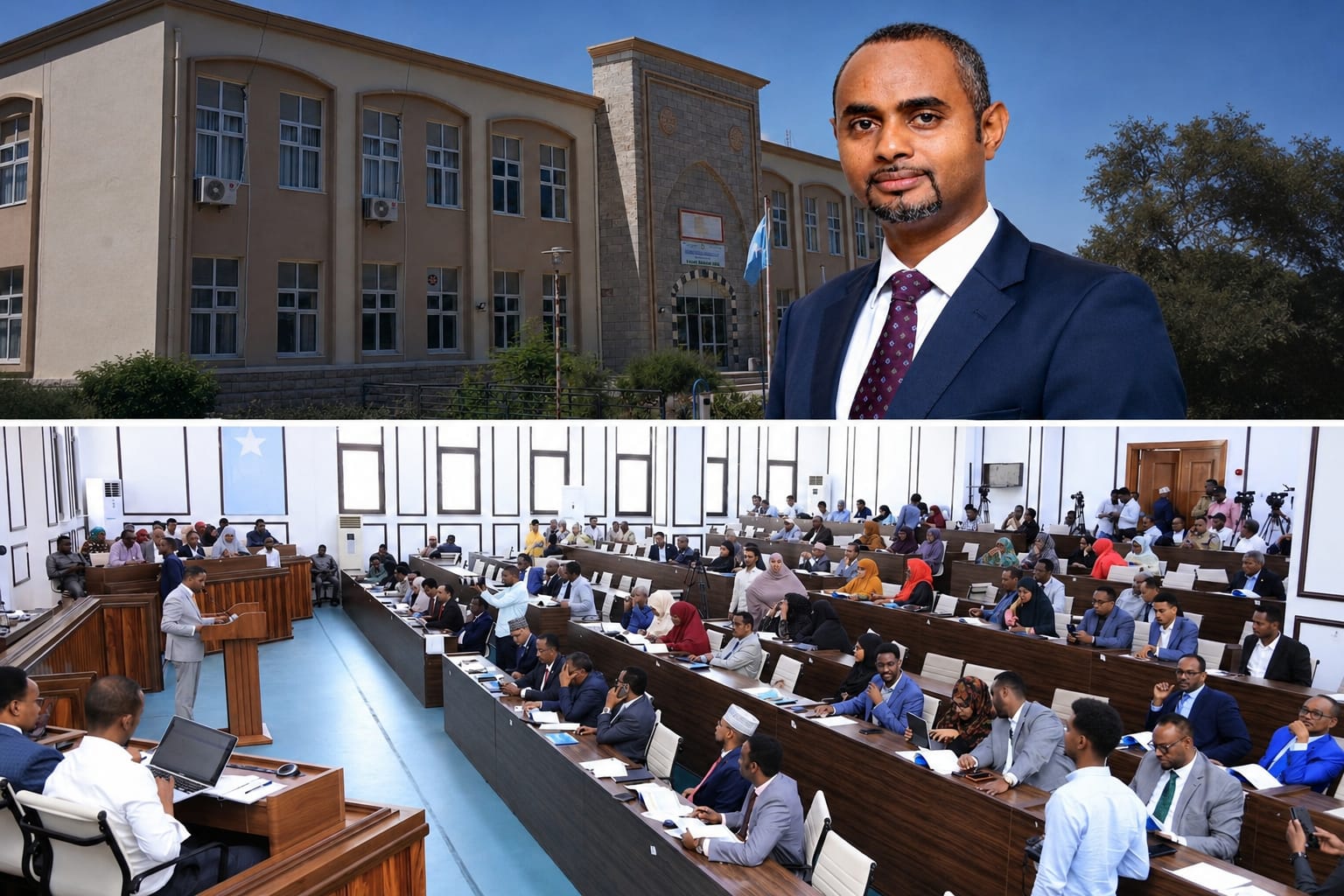
Somalia’s political landscape is entering another tense moment as lawmakers prepare to elect the next Speaker of the House of the People, with the government throwing its weight behind Minister of Ports and Maritime Transport Abdulkadir Mohamed Nur Jama in an increasingly competitive race for one of the country’s most powerful constitutional positions.
Jama and Abdulkadir Omar Moallim “Daada” are the final two candidates cleared to contest the speakership, following the issuance of their official candidacy certificates by the parliamentary electoral committee.
Members of the House of the People are expected to vote on Monday, August 10, 2026, to determine who will succeed Sheikh Aden Mohamed Nur Madobe, whose departure from Parliament followed his election as President of South West State on June 10.
The contest has increasingly become more than a parliamentary leadership race, with the government viewing the speakership as a critical political position as Somalia heads into a period of heightened political competition over constitutional reforms, elections and the country’s future political direction.
Government allies have intensified lobbying for Jama, seeking to secure enough support among lawmakers to make him the next Speaker and effectively position him as the country’s second most senior political figure after the President.
Jama’s campaign has therefore attracted significant attention in Mogadishu, with members of Parliament returning to the capital from different parts of Somalia and abroad ahead of the vote.
The race comes at a particularly sensitive time for Somalia. Relations between the federal government and opposition groups have deteriorated over proposed constitutional amendments, electoral arrangements and questions surrounding political mandates and term limits.
Opposition lawmakers have previously mounted strong resistance to constitutional changes advanced by the government, arguing that major political and constitutional decisions require broader consensus.
The political confrontation took a more serious turn in June when armed clashes were reported in Mogadishu, adding to concerns over the country’s increasingly polarised political environment.
The Somalia Salvation Forum has now rejected Monday’s speakership election, alleging that the process has not been sufficiently inclusive and accusing the presidency of blocking some potential candidates while threatening others.
The opposition group described the process as “one-sided”, raising questions over the legitimacy of the parliamentary contest at a time when political divisions remain deep.
The accusations have added another layer of controversy to an election that is already being closely watched by political actors across Somalia.
Jama, however, enters the final stage of the contest with significant government support and an active lobbying operation behind his candidacy. His backers are expected to spend the final hours before the vote consolidating support among lawmakers and persuading undecided MPs.
His rival, Abdulkadir Omar Moallim “Daada”, will be seeking to present himself as an alternative at a time when some lawmakers and opposition figures are concerned about excessive concentration of political power around the executive.
The speakership carries considerable influence in Somalia’s political system. The Speaker controls parliamentary proceedings, helps shape the legislative agenda and plays an important role in managing relations between Parliament, the executive and other political institutions.
Since June 20, First Deputy Speaker Saadia Yasin Haji Samatar has served as acting Speaker following Madobe’s departure.
The race was initially broader, with Sa’adad Mohamed Nur Aliyow entering the contest before resigning as State Minister for Interior, Federal Affairs and Reconciliation to pursue the speakership. Foreign Affairs Minister Abdisalam Ali “Dhay” also withdrew from the race.
By the close of registration, the contest had narrowed to the two Abdulkadirs.
As lawmakers prepare to cast their ballots, Monday’s election is therefore shaping up as a test not only of individual political strength but also of the government’s ability to consolidate parliamentary support.
A victory for Jama would strengthen the government’s influence inside Parliament at a crucial moment, while a win for Daada could provide a political boost to lawmakers seeking greater independence from the executive.
With Somalia already facing intense debate over constitutional reforms, elections and political power, the outcome of the speakership vote could have consequences far beyond the walls of Parliament.