

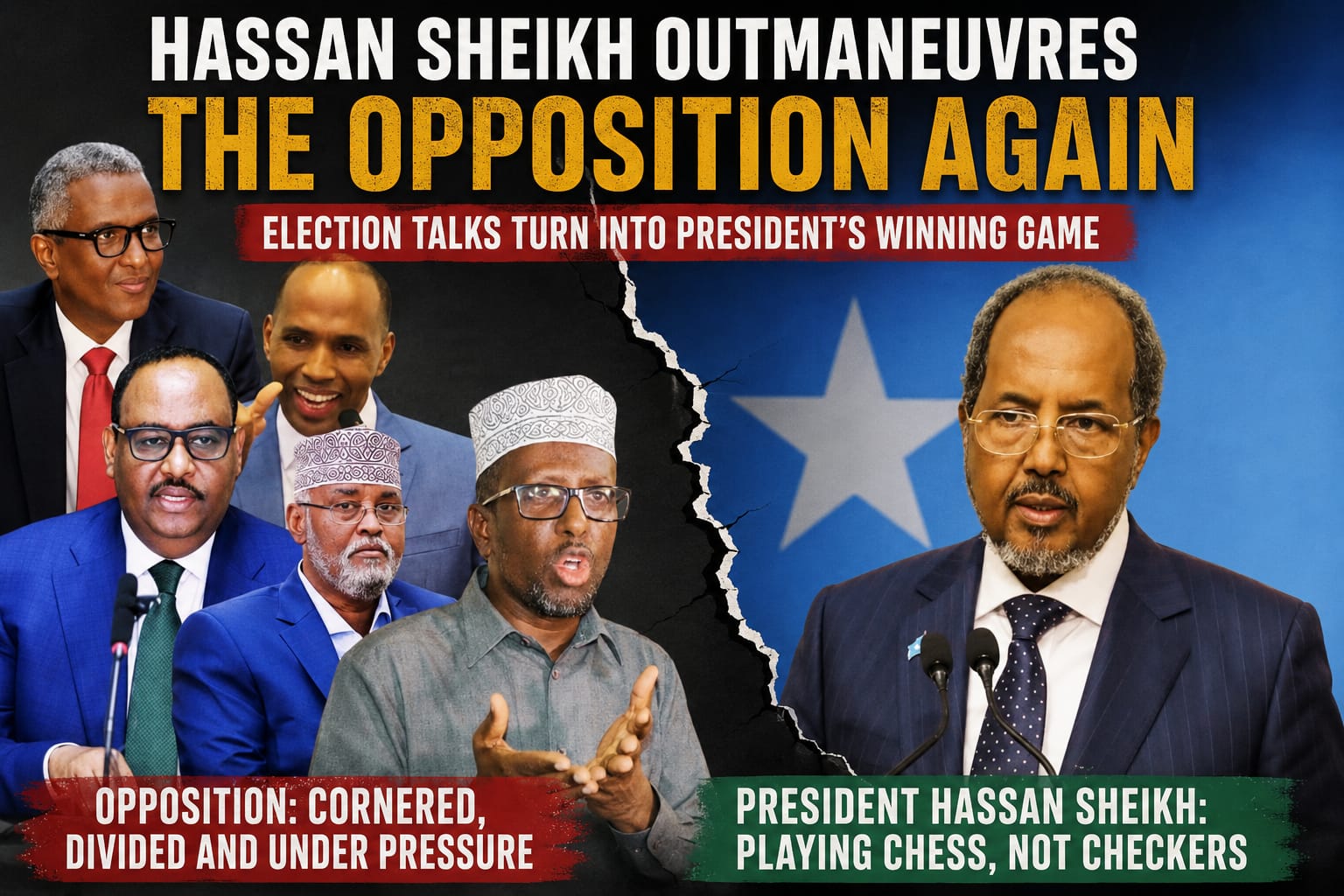
The latest political talks between the Federal Government of Somalia and opposition leaders in Muqdisho were never just about elections. Behind the diplomatic language, handshakes, and mediation efforts stood a much bigger struggle over the future political direction of Somalia, the survival of the current administration, and the battle over who defines democracy in the country.
At the center of the negotiations stood President Hassan Sheikh Mohamud calm, strategic, and increasingly confident in his political calculations. Across from him sat opposition figures who entered the talks hoping to pressure the government into reversing course on electoral reforms, only to discover that the president had already carefully shaped the battlefield long before the negotiations began.
The meeting itself was heavily backed and observed by international actors including the United Nations, the African Union, African Union Transition Mission in Somalia, the United States, and the United Kingdom. Officially, these actors positioned themselves as neutral mediators pushing Somalia toward consensus and stability. But politically, many Somali observers believe their stance revealed something much deeper.
For years, Western governments and international institutions have consistently supported long-serving African leaders who maintain stability, cooperate on security matters, and preserve regional order, even while facing accusations of democratic stagnation or authoritarian tendencies. The examples often cited across the Horn of Africa are Yoweri Museveni and Ismaïl Omar Guelleh two of East Africa’s longest-serving leaders, both of whom continue enjoying close relations with Western governments despite criticism from democracy advocates.
That contrast is important because it helps explain what many analysts now see in Somalia’s evolving political environment.
On one side of the African political spectrum are military-driven revolutionary governments such as Ibrahim Traoré and the Sahel juntas that openly confront Western influence. These governments have seen strained relations with European nations and in some cases sanctions, diplomatic isolation, or reduced cooperation.
On the other side are leaders who maintain electoral systems, work closely with international institutions, preserve counterterrorism partnerships, and gradually consolidate political power through state institutions rather than military coups. This second model receives far more tolerance and support from international partners because it preserves predictability.
Many Somali political observers increasingly believe President Hassan Sheikh Mohamud has carefully studied that second model and is now attempting to adapt it to Somalia’s fragile political landscape.
The election debate itself exposed this strategy very clearly.
For months, the opposition had hoped to pressure Villa Somalia into abandoning the “one person, one vote” agenda entirely and returning to Somalia’s clan-based indirect electoral system. Their calculation was simple: the indirect model gives opposition elites, clan elders, and regional political networks greater bargaining power. It limits the influence of centralized party structures and reduces the advantage of incumbency.
But during the talks, Hassan Sheikh signaled that completely removing direct elections from Somalia’s future is no longer negotiable.
According to accounts emerging from the discussions, the president framed the issue as a choice between two paths: a hybrid model or a direct one-person-one-vote system.
That statement immediately changed the atmosphere inside the talks.
The president reportedly reminded participants that he had already invested significant political capital into electoral reforms and could not reverse course entirely. He also referenced the progress made in places like Banadir and South West State where political mobilization linked to the ruling Justice and Solidarity Party, commonly known as JSP, has reportedly expanded rapidly.
That point was politically crucial.
The government appears increasingly convinced that a transition toward party-based politics benefits the presidency more than the old clan-based arrangement. Under a direct or partially direct electoral system, political parties gain organizational importance, urban mobilization becomes decisive, and national visibility matters more than traditional clan gatekeeping structures.
In such an environment, an incumbent president controlling state machinery, diplomatic relationships, security structures, and national messaging naturally gains a major advantage.
The opposition immediately understood the implications.
For them, the proposed “choices” did not look neutral. Both the hybrid model and one-person-one-vote system appeared designed in ways that could strengthen the president politically ahead of future elections. That explains why opposition figures reportedly became increasingly agitated during the discussions.
To them, the negotiations began to feel less like open dialogue and more like a structured process whose final destination had already been decided.
The International Factor and the Silent Endorsement of Hassan Sheikh’s Strategy
Perhaps the most important element of the entire political drama is not what the Somali actors said publicly, but what international mediators refused to say.
The opposition reportedly pushed for reconsideration of clan-based indirect elections. Yet the mediators including Western actors and international organizations did not openly endorse that demand.
That silence itself became politically meaningful.
International actors have long argued that Somalia must transition toward democratic systems based on political parties and broader public participation rather than clan formulas. Even though Somalia’s political reality remains deeply clan-centered, Western governments increasingly view direct elections as symbolically important for state-building and institutional legitimacy.
This placed the opposition in a difficult position.
If they openly reject one-person-one-vote entirely, they risk appearing anti-democratic in the eyes of both the Somali public and international partners. Yet if they accept the president’s framework, they may walk into an electoral terrain that strongly favors the incumbent administration.
That is precisely where Hassan Sheikh appears to have strategically cornered them.
The president reportedly offered the opposition a year to go back, consult, and develop an agreed election framework. On the surface, that sounds conciliatory and inclusive. Politically, however, it shifts enormous pressure onto the opposition itself.
Now the burden is no longer on the government to prove flexibility. Instead, the opposition must produce a realistic alternative that satisfies both Somali stakeholders and international mediators without eliminating the direct election agenda altogether.
That is an extraordinarily difficult balancing act.
By insisting that “removing one-person-one-vote entirely will not be discussed,” the president effectively established a political red line while still appearing open to dialogue. It was a sophisticated negotiation move because it allowed him to maintain the image of compromise while protecting his core strategic objective.
The proposal to create joint committees further reinforced this approach.
The government will form its own committee. The opposition will form another. Both sides will discuss models and eventually attempt to agree on a unified framework acceptable to Somalis.
Again, on paper, this sounds like consensus-building.
But politically, it buys the presidency something extremely valuable: time.
Time to strengthen party structures.
Time to deepen international backing.
Time to consolidate alliances.
Time to continue presenting the administration as the only force capable of guiding Somalia toward democratic transition.
Meanwhile, the opposition risks fragmentation, internal disagreements, and public confusion over what exactly it stands for beyond opposing the president.
This is why many observers now describe Hassan Sheikh’s approach as a chess game rather than ordinary politics.
Every move appears calculated several steps ahead.
While the opposition focused heavily on resisting certain reforms, the presidency appears to have focused on shaping the entire political framework within which future debates will occur.
The result is a negotiation environment where even compromise can indirectly strengthen the incumbent.
Another critical factor is international legitimacy.
The Somali government today enjoys significant diplomatic engagement with Western capitals, regional governments, and security partners because of counterterrorism cooperation, regional stabilization efforts, and state-building initiatives. International actors prioritize stability in Somalia partly because instability affects the entire Horn of Africa region.
That reality gives Hassan Sheikh additional leverage.
Western governments may privately criticize democratic shortcomings or political tensions, but they are also deeply concerned about maintaining continuity in security cooperation against Al-Shabaab.
This creates a situation where international actors often prefer managed political evolution over destabilizing confrontation.
For the opposition, that international environment is frustrating.
They may believe the political playing field is increasingly tilted toward the presidency, yet they also understand that major international actors are unlikely to fully back efforts that could derail the broader state-building agenda.
That is why the current talks represent more than just an electoral disagreement.
They reveal a deeper transformation in Somali politics itself.
For decades, Somali politics revolved around clan negotiations, elite bargaining, and transitional arrangements. Now, Somalia appears to be entering a new phase where political parties, international legitimacy, institutional control, and public democratic narratives are becoming more central.
Hassan Sheikh Mohamud seems determined to place himself at the center of that transformation.
Whether one supports or opposes him politically, it is increasingly difficult to ignore the strategic nature of his approach.
The opposition entered the talks hoping to slow or reverse the president’s electoral project. Instead, they now face mounting pressure to propose an alternative model that still accommodates some form of direct electoral transition.
That is why the talks ended with the opposition appearing politically cornered rather than politically strengthened.
The president did not completely shut the door on compromise. He instead narrowed the room within which compromise can happen.
And in politics, controlling the boundaries of discussion is often more powerful than winning the argument itself.
Somalia’s next political phase will now depend on whether the opposition can reorganize itself, produce a coherent electoral vision, and regain momentum before the government further entrenches its position.
But for now, the latest round of talks has delivered one unmistakable message:
President Hassan Sheikh Mohamud is not merely reacting to Somalia’s political transition he is attempting to engineer it on his own terms.