

As another election season slowly begins to take shape across Northern Kenya, a familiar political ritual is quietly returning. Across Garissa, Wajir and Mandera conversations are already taking place long before official campaigns begin.
In villages and towns, inside hotels and community halls, under tents erected for political gatherings and in private meetings attended by influential figures, discussions are underway about who will occupy political office after the next election. For many residents, these developments are neither unusual nor unexpected.
They have become part of the political culture of the region. Elders are consulting, political aspirants are building alliances, community leaders are negotiating and clan representatives are weighing options. Long before ordinary voters begin evaluating candidates, important political decisions are often being discussed behind closed doors.
Eventually, endorsements will be announced, candidates will emerge, communities will be informed of decisions reached through consultations and negotiations, and political alignments will begin to take shape.
Standing nearby, cameras rolling and microphones switched on, will be journalists.At first glance, this may appear entirely normal.
Journalists are expected to report political developments wherever they occur. Their responsibility is to inform the public about important events and ensure citizens remain aware of what is happening around them.
Yet beneath the surface of this seemingly routine political coverage lies a growing concern that deserves serious public discussion.
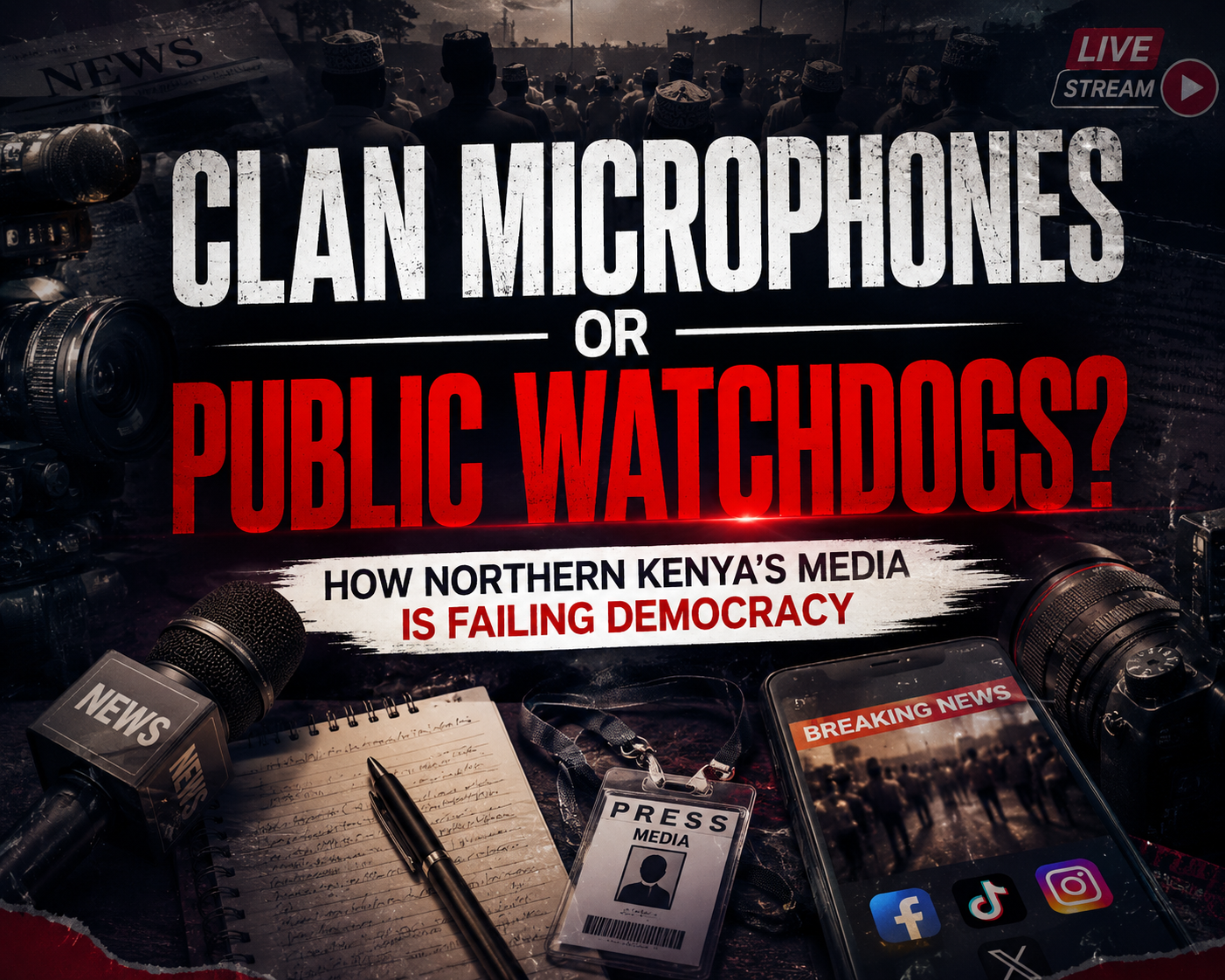
Increasingly, a difficult question is emerging across Northern Kenya: are journalists simply reporting the story, or have sections of the media become part of the story itself?
The question is uncomfortable because it challenges one of the most important institutions in any democratic society. Journalism occupies a unique position in public life. Politicians seek votes, elders seek influence, communities seek representation and citizens seek services and development.
Journalists, however, are expected to serve a different purpose. Their role is to act as independent observers who ask difficult questions, challenge powerful interests, verify information and ensure that those seeking public office are subjected to meaningful public scrutiny.
This responsibility becomes even more important during election periods because elections are not merely exercises in choosing leaders.
They are moments when citizens assess competing visions for the future, compare ideas and determine who is best positioned to address public challenges. For this process to function effectively, citizens require information. They need facts, analysis and journalists willing to investigate claims rather than simply repeat them.
When journalism fulfills this responsibility, democracy becomes stronger. When journalism abandons this responsibility, democracy becomes weaker.
Across much of Northern Kenya, negotiated democracy has become one of the defining features of political competition. Supporters of the system argue that it has played an important role in reducing political tensions and preventing conflicts that sometimes accompany highly contested elections.
They point to periods of relative peace and stability as evidence that the approach has benefits, arguing that community consensus helps avoid divisions and allows political transitions to occur with fewer confrontations.
These arguments deserve acknowledgment because they reflect genuine concerns about stability and social cohesion.
Many people across the region sincerely believe negotiated democracy has contributed to peaceful coexistence and reduced political hostility. For some communities, it is viewed not merely as a political mechanism but also as a conflict-management strategy designed to preserve harmony.
However, recognizing these arguments does not eliminate the need for scrutiny. In fact, it makes scrutiny even more necessary. Whenever political decisions become concentrated among a relatively small group of influential actors, important democratic questions inevitably arise.
Who participates in decision-making? Who is excluded? How are competing views represented? To what extent do ordinary citizens influence outcomes? Are candidates selected because of their qualifications and ideas, or because of political connections and clan calculations?
These are not questions that should be answered only by politicians or elders. They are questions that journalists should be asking on behalf of the public. A healthy democracy requires more than political stability. It also requires accountability, transparency and informed participation.
Citizens deserve to understand not only what decisions are being made but also how those decisions are reached and what consequences they may have for the future of their communities.This is where journalism should play its most important role.
Rather than merely reporting that a candidate has been endorsed, journalists should be examining the broader significance of the endorsement itself.
They should be asking how the decision was reached, questioning whether alternative voices were heard, evaluating the qualifications of those seeking office and investigating promises, records and policy proposals.
Their responsibility is not to support negotiated democracy or oppose it. Their responsibility is to scrutinize it.
WHEN REPORTERS BECOME PART OF THE STORY
Over the past decade, Northern Kenya has witnessed an extraordinary expansion of its media landscape.
Technological advances and the rise of social media have transformed the way information is produced and consumed. Dozens of online television stations, digital news platforms, YouTube channels, Facebook-based media outlets and independent broadcasters now compete for audiences across the region.
On paper, this should represent a major victory for democracy. A larger media sector should create more opportunities for public debate.
More journalists should mean greater scrutiny of political leaders. More platforms should provide citizens with greater access to information, while increased competition should encourage stronger journalism and higher professional standards.
Reality, however, is often more complicated. The existence of more media outlets does not automatically produce better journalism.
The existence of more cameras does not automatically produce more accountability. The existence of more livestreams does not automatically produce more scrutiny.
Instead, many observers have begun noticing a different trend. Rather than serving as independent watchdogs, sections of the media ecosystem appear increasingly integrated into the political structures they are supposed to monitor.
In some cases, journalists and media platforms seem less focused on examining political processes and more focused on amplifying them.This trend becomes especially visible during election periods.
A clan meeting is organized and media outlets immediately rush to cover it. Elders gather and cameras are positioned to capture every moment. Endorsements are announced and livestreams begin within minutes. Political speeches are uploaded, shared and distributed across multiple platforms.
For days, and sometimes weeks, public discussion revolves around endorsements, declarations and political calculations. There is nothing inherently wrong with covering such events.
They are undeniably newsworthy and often carry significant political implications. The problem lies elsewhere.
The problem arises when coverage stops at the endorsement itself.Citizens are told who has been endorsed but not necessarily why that individual deserves public office.
Audiences hear extensive discussions about clan alignments but receive limited information about policy proposals. Political calculations dominate headlines while governance issues struggle to attract similar attention.
In many cases, the endorsement itself becomes the dominant political story while the candidate’s actual vision for leadership receives far less attention.
Public discussion shifts toward who has been chosen rather than what they intend to do once elected. As a result, issues that directly affect citizens risk being pushed aside as political calculations take centre stage.
The public interest gradually becomes secondary to the political process itself.This creates a serious information gap within the democratic process. A voter cannot make an informed decision based solely on knowledge of endorsements.
Citizens need more than political announcements. They need detailed information about candidates’ plans, qualifications and records. They need to understand how aspiring leaders intend to address unemployment, improve healthcare, expand educational opportunities, strengthen local economies and manage public resources.
Without this information, democratic participation becomes weaker because citizens are denied the knowledge necessary to evaluate leadership choices on the basis of performance, competence and vision.
The consequences extend far beyond media coverage. When politicians are not subjected to meaningful scrutiny, they face fewer incentives to explain their policies. When campaign promises are not questioned, they become easier to make and easier to forget.
When political discussions focus primarily on endorsements rather than governance, public expectations begin to change. Citizens gradually become accustomed to hearing who has been chosen rather than evaluating why they should support that choice. Over time, this can fundamentally alter the nature of political participation.
Instead of encouraging voters to assess ideas, the system encourages them to assess alliances. Instead of promoting policy debates, it promotes political calculations. Instead of rewarding competence, it risks rewarding connections.
The long-term implications for democracy are profound. Democratic systems function best when leaders know they will be held accountable by an informed and engaged public. Accountability does not emerge automatically.
It requires institutions willing to ask difficult questions and challenge powerful interests. Journalism is one of those institutions. That is why the role of journalists matters so deeply. When a journalist questions a politician about healthcare, they are speaking on behalf of patients struggling to access treatment.
When a journalist investigates public spending, they are speaking on behalf of taxpayers. When a journalist examines campaign promises, they are speaking on behalf of voters seeking honest leadership.
The power of journalism lies not in its ability to broadcast political speeches but in its willingness to interrogate them.Yet maintaining this independence becomes increasingly difficult when journalists become closely connected to political actors.
One of the greatest threats to journalism anywhere in the world is proximity to power. Access can be valuable, but it can also create dependence. Relationships can provide opportunities, but they can also create conflicts.
The closer journalists become to political networks, the harder it becomes to maintain the distance necessary for independent reporting. Northern Kenya is not unique in facing this challenge. Media platforms operate in competitive environments.
They require audiences, visibility and financial sustainability. Political events often generate attention and engagement. Livestreams attract viewers. Endorsement ceremonies create content. The incentives are obvious.
However, journalism is ultimately defined not by convenience but by responsibility. Its highest obligation is not to political actors. Its highest obligation is to the public.This reality becomes even more important when considering the impact media coverage has on younger generations.
Thousands of young people across Northern Kenya consume political information primarily through digital platforms. The content they encounter shapes their understanding of leadership, citizenship and democracy.
If media coverage consistently emphasizes endorsements while neglecting policy discussions, younger audiences may begin to view politics primarily as a contest of identities rather than a competition of ideas.
That shift carries serious consequences. Future leaders may conclude that securing endorsements matters more than developing solutions. Aspiring politicians may focus more energy on negotiations than governance.
Citizens may lower their expectations regarding accountability because they rarely see accountability practiced in public discourse.This is how democratic culture gradually changes. Not through dramatic events or sudden transformations, but through repetition.
When the same patterns are repeated election after election, they eventually become normal. Practices that once generated concern become accepted. Expectations begin to decline.
Citizens adapt to a political environment in which difficult questions are increasingly absent. This is why the current moment matters.Northern Kenya possesses talented journalists, respected broadcasters and dedicated media professionals who continue to practice ethical journalism despite significant pressures.
Their work demonstrates that independent reporting remains possible. They show that journalism can still fulfill its democratic purpose even in challenging environments. The challenge is ensuring that such journalism becomes the norm rather than the exception.
As the region moves closer to another election season, the media faces an important choice. It can continue functioning primarily as a platform for amplifying political declarations and endorsement politics, or it can embrace a broader role as an institution dedicated to accountability, transparency and public service.
The future of Northern Kenya should not be determined solely in political gatherings, endorsement halls or private negotiations among influential figures. It should also be shaped by informed citizens equipped with accurate information and meaningful public debate.
That is the foundation of democracy, and that foundation depends heavily on journalism.The microphone was never intended merely to amplify power. Its democratic value lies in its ability to question power, challenge narratives and create accountability.
Similarly, the camera was never designed simply to record political events as they unfold. Its greatest purpose is to examine those events critically and provide citizens with a clearer understanding of what lies beneath the surface.
The journalist was never meant to function as a political messenger. The journalist was meant to serve the public.Until that responsibility is fully embraced, a difficult question will continue to hang over every election season in Northern Kenya.
Are journalists acting as watchdogs of democracy, or are they increasingly becoming loudspeakers for negotiated power?
The answer may determine not only the future of journalism in Northern Kenya, but the future of democracy itself.