

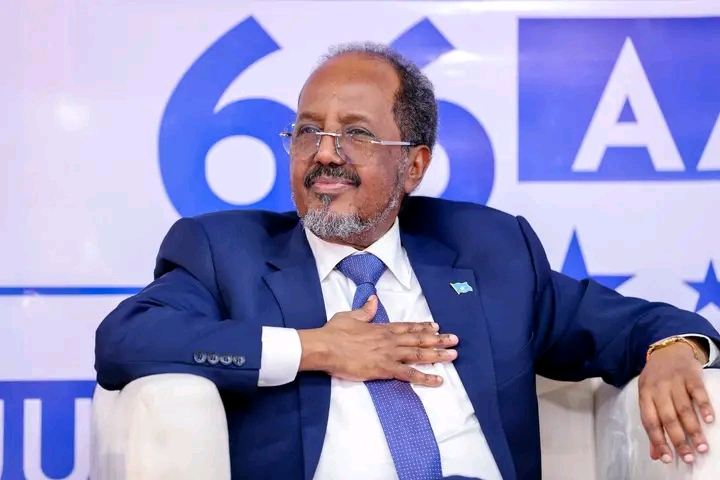
President Hassan Sheikh Mohamud has strongly pushed back against claims by the European Union that Somalia has failed to cooperate in accepting deported individuals, insisting that the Federal Government has never refused to receive verified Somali citizens and that any disagreement revolves around the need for proper identification of those being returned.
The issue emerged after the European Union announced visa restrictions affecting Somali passport holders, citing what it described as insufficient cooperation by Somalia in the readmission of individuals ordered to leave EU member states.
The decision has generated widespread discussion among Somalis at home and abroad, with many questioning the basis of the restrictions and the implications for ordinary Somali citizens seeking to travel to Europe.
Speaking during his Independence Day address on Thursday night, President Hassan Sheikh directly addressed the matter, rejecting suggestions that Somalia had refused to accept its own nationals.
According to the President, Somalia’s position has remained consistent: every verified Somali citizen has the right to return to their homeland and will be welcomed back.
However, he argued that the government has a responsibility to ensure that individuals being deported under Somali identity are genuinely Somali nationals before accepting them.
“Everyone in Europe has surrendered or registered themselves as Somali. Even some people from neighboring countries have claimed to be Somali. What we are saying is that we should verify who they are, because the European Union has not refused to return our own citizens to us,” President Hassan Sheikh Mohamud said.
The President’s remarks highlight a longstanding challenge facing immigration authorities in both Europe and Somalia.
For decades, Somalia’s prolonged conflict, displacement crises, and large diaspora communities have created complex questions around identity verification.
European governments have often encountered difficulties establishing the nationality of undocumented migrants, while Somali authorities have repeatedly stressed the importance of confirming citizenship before accepting deportees.
In his address, President Hassan Sheikh emphasized that Somali citizenship cannot be denied to legitimate nationals and that the country remains committed to receiving its citizens.
“Citizens of the Federal Republic of Somalia have the right to this country; they cannot be denied, nor can they be prevented from belonging to it. However, what we have witnessed and experienced over the years is that some people who were repatriated had claimed to be Somali, but when they arrived, it turned out that they were not actually Somali,” the President stated.
The comments were widely interpreted as a direct response to the European Union’s justification for imposing visa restrictions on Somali passport holders.
The EU has argued that the measures were introduced because of concerns regarding cooperation on readmission procedures for individuals who do not have the legal right to remain within EU member states.
According to the European Union, the restrictions are linked to Somalia’s handling of the return and readmission process.
EU officials have maintained that cooperation on migration management, including the identification and acceptance of nationals ordered to leave European countries, remains an important component of relations between Brussels and partner nations.
The visa restrictions are expected to affect Somali citizens applying for Schengen visas, potentially resulting in stricter requirements, longer processing times, and additional scrutiny during visa applications.
While the exact implementation may vary across EU member states, the move represents a significant development in relations between Somalia and the European bloc.
However, President Hassan Sheikh’s remarks suggest that Somalia does not view the matter as a refusal to accept its citizens but rather as a question of ensuring accuracy and fairness in determining who qualifies as a Somali national.
His argument centers on the belief that nationality verification is necessary because some individuals from neighboring countries or other regions may have falsely claimed Somali identity while seeking asylum or refugee protection in Europe.
According to the President, Somalia cannot simply accept every individual presented as Somali without conducting proper checks and verification procedures.
The President’s position is likely to resonate with many Somalis who believe that citizenship should be protected through clear identification processes. Supporters of the government’s approach argue that accepting individuals whose nationality cannot be confirmed could create legal, administrative, and security challenges for the country.
At the same time, the issue reflects broader international debates over migration, deportation policies, and the responsibilities of countries of origin.
European governments have increasingly sought stronger cooperation agreements with countries whose nationals are subject to deportation orders, while many African governments have called for greater safeguards to ensure that those being returned are correctly identified.
For Somalia, the matter carries additional sensitivity because of the country’s complex history of displacement and migration.
Millions of Somalis have lived abroad over the past three decades, and Somali communities have established themselves across Europe, North America, the Middle East, and Africa.
In some cases, documentation challenges have complicated efforts to verify nationality, particularly for individuals who left Somalia at a young age or were born outside the country.
President Hassan Sheikh’s Independence Day remarks therefore framed the debate not as a rejection of deportees, but as a defense of Somalia’s right to determine who qualifies as one of its citizens.
His message was clear: Somalia welcomes its people and recognizes their constitutional right to belong to the nation. What the government seeks, he said, is a transparent process that distinguishes genuine Somali citizens from individuals who may have adopted Somali identity for immigration purposes.
As discussions continue between Somalia and European partners, the issue is likely to remain an important diplomatic topic.
The visa restrictions have drawn attention to the delicate balance between migration management, international cooperation, and national sovereignty.
For now, President Hassan Sheikh has publicly rejected the notion that Somalia is refusing to take back its citizens. Instead, he has argued that the country is asking for one thing only: verification.
In his view, Somalia’s doors remain open to every legitimate Somali citizen. The challenge, he insists, is ensuring that those being returned are truly who they claim to be.