

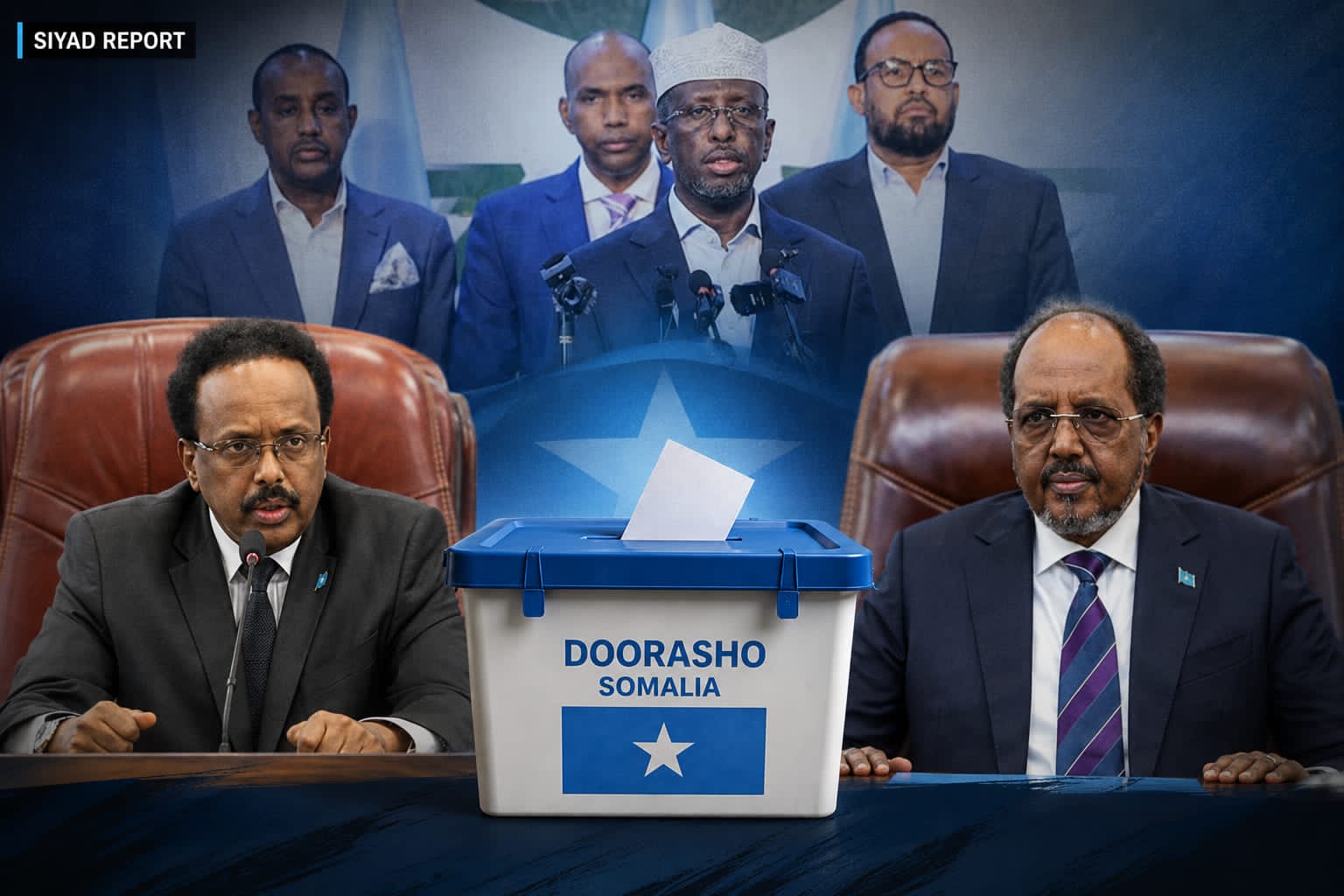
Somalia’s electoral debate has entered a new and more complicated phase after former President Mohamed Abdullahi Mohamed “Farmaajo” and the Nabad iyo Nolol movement unveiled an alternative electoral proposal just days after the Somali Future Council (SFC) presented its Transitional Direct Elections Model (TDEM) 202
What initially appeared to be a contest between the Federal Government and a united opposition has rapidly evolved into a broader debate over competing visions for the country’s political transition, with Farmaajo’s intervention reshaping the dynamics ahead of the next round of internationally mediated negotiations.
The significance of Farmaajo’s proposal lies not only in its content but also in its timing. The Somali Future Council had sought to establish a common opposition position by proposing a transitional electoral framework that would allow citizens to directly elect members of the Federal Parliament and State Parliaments while temporarily preserving the 4.5 power-sharing formula.
The model was designed as a compromise between Somalia’s constitutional ambition of achieving universal suffrage and the political realities that continue to shape governance, security, and representation across the country.
Under the TDEM proposal, elections would be implemented through a political agreement between the Federal Government and the opposition, with no political parties participating during the transitional period. Instead, officially recognized traditional elders would continue allocating parliamentary seats among clans under the existing 4.5 arrangement, while citizens would directly vote for candidates competing within those allocated seats.
The proposal also calls for federal and state electoral commissions to jointly administer the process, with all parliamentary elections taking place on the same day. Supporters argue that the framework offers a realistic pathway toward direct elections without abruptly dismantling political arrangements that have underpinned Somalia’s fragile stability for nearly two decades.
Before political actors had fully digested the implications of the TDEM proposal, Farmaajo and Nabad iyo Nolol introduced an alternative vision. Their proposal supports direct voting but departs from the SFC model by advocating a political party-based system, same-day voter registration and voting, and a closed-list proportional representation model.
In many respects, the proposal mirrors key principles that President Hassan Sheikh Mohamud’s administration has consistently championed, particularly the central role of political parties in organizing elections and the objective of accelerating Somalia’s transition toward a nationwide democratic electoral system.
That convergence has become one of the most consequential developments in Somalia’s electoral politics. While Farmaajo remains one of the country’s most prominent opposition figures, his proposal overlaps with important elements of the Federal Government’s preferred electoral architecture.
At the same time, it differs substantially from the SFC’s transitional approach, creating multiple opposition perspectives rather than a single negotiating position. The result is a more complex political landscape in which debates are no longer defined simply by government versus opposition, but by competing strategies for reaching the shared goal of direct elections.
Political observers have offered differing interpretations of Farmaajo’s intervention. Some argue that presenting an alternative proposal at this stage could weaken the Somali Future Council’s ability to negotiate from a unified position by introducing competing opposition frameworks just as mediation efforts intensify.
According to this view, the Federal Government may find greater room for maneuver if opposition actors are advancing different electoral blueprints instead of rallying around a single proposal.
Others, however, interpret Farmaajo’s move differently. They argue that the proposal should not necessarily be viewed as an attempt to divide the opposition but rather as an effort to broaden the national conversation around electoral reform and demonstrate that support for direct elections extends across Somalia’s political spectrum.
From this perspective, competing proposals are a reflection of democratic negotiation rather than political fragmentation, and they may ultimately provide mediators with additional opportunities to identify areas of convergence.
The Federal Government has maintained that Somalia should proceed toward a party-based electoral system capable of replacing the country’s clan-centered political arrangements with institutional competition among national political organizations.
Government officials argue that meaningful democratic consolidation requires strengthening political parties, establishing predictable electoral institutions, and moving beyond transitional governance models. Critics, however, question whether the necessary legal, administrative, and security conditions exist to implement such a system nationwide within the current political environment.
The Somali Future Council takes a more gradual approach. While it equally endorses the long-term objective of one-person, one-vote elections, it argues that Somalia’s immediate priority should be achieving political consensus through a transitional framework that preserves stability while expanding direct public participation. Supporters contend that retaining the 4.5 formula temporarily is a pragmatic recognition of current realities rather than an endorsement of permanent clan-based politics.
They argue that prematurely abandoning consensus mechanisms could generate new disputes over constituency boundaries, voter registration, electoral administration, and representation.
These competing visions became the focal point of internationally mediated discussions between the Federal Government and the opposition. Although both sides reaffirmed their commitment to advancing Somalia’s democratic transition, negotiations concluded without agreement after each delegation presented its preferred electoral model.
International facilitators subsequently announced that separate consultations would continue with both parties before negotiations resume on July 20, with the objective of narrowing remaining differences and identifying common ground.
Despite their disagreements, the proposals also reveal important areas of convergence. All major political actors now publicly support the principle of direct citizen participation in choosing representatives, a significant evolution from previous indirect electoral models.
The principal disagreements concern how quickly Somalia should transition toward full party politics, what role clan-based power sharing should continue to play during the interim period, and which institutions should administer the process.
As the July 20 negotiations approach, Somalia’s political future may depend less on which proposal prevails outright than on whether elements from each framework can be combined into a broadly acceptable compromise.
The emergence of multiple electoral blueprints reflects not only the diversity of political opinion within Somalia but also the complexity of managing a democratic transition in a country still balancing constitutional aspirations with practical governance challenges.
Whether Farmaajo’s intervention ultimately reshapes alliances, strengthens the search for consensus, or further complicates negotiations will become clearer in the weeks ahead. What is already evident, however, is that Somalia’s electoral debate has entered a decisive new chapter one in which the contest is no longer simply over the destination of democratic reform, but over the path the country should take to reach it.