

For decades, North Eastern Kenya occupied a distinctive place in Kenya’s electoral politics. The counties of Garissa, Wajir, Mandera, Isiolo and Marsabit often leaned toward opposition politics, particularly during the era of former Prime Minister Raila Odinga’s presidential bids.
While local clan dynamics, individual candidates and constituency interests always influenced voting patterns, the broader regional perception remained consistent: North Eastern was generally viewed as an opposition-leaning bloc whose electoral choices reflected both historical grievances and a desire for alternative national leadership.
Today, however, that political identity is undergoing one of the most significant transformations since the return of multiparty democracy.
As President William Ruto intensifies preparations for his re-election campaign, North Eastern Kenya is increasingly emerging as one of his strongest political allies. The shift is no longer limited to isolated endorsements by individual politicians. It is becoming an organized political movement involving governors, cabinet secretaries, members of parliament, senators, county leaders and influential community figures who are publicly declaring support for the President’s second-term bid.
President William Ruto enjoys his strongest regional backing in the North Eastern, where 59% of respondents say they would support his presidential bid, according to a new Ipsos opinion poll.
The survey places North Eastern well ahead of all other regions in support for the President. Ruto leads the presidential race with 32% support nationally, followed by Kalonzo Musyoka and Edwin Sifuna, who are tied with Fred Matiang’i at 12% each.
Ruto’s other strongholds are the Rift Valley, where he commands 46% support, and Nyanza at 40%.
In Garissa, Wajir and Mandera counties, his nearest challenger is Edwin Sifuna at 8%, followed by Kalonzo Musyoka and Fred Matiang’i, each at 6%. Rigathi Gachagua has 4%, Babu Owino 3% and former Chief Justice David Maraga 2%.
The poll also found that 13% of voters in North Eastern remain undecided, while none preferred not to state their choice.
The report also stated, Kalonzo Musyoka leads in Eastern with 40% support, while Central Kenya remains highly competitive, with no aspirant reaching 20% and 26% of respondents undecided.
In Western counties, the race is largely between Ruto (35%) and Edwin Sifuna (26%), while Nairobi remains fluid, with 24% of respondents yet to decide.
The findings indicate that North Eastern remains President Ruto’s strongest political base as the country gradually shifts its attention towards the next General Election.
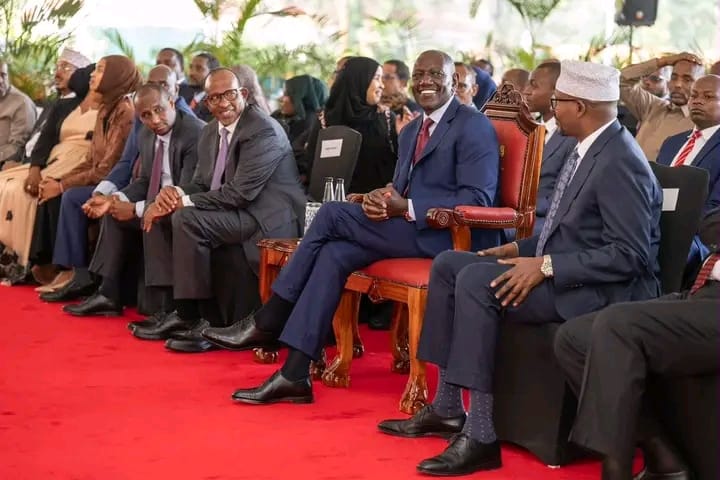
The political symbolism of leaders from Isiolo, Marsabit, Garissa, Wajir and Mandera meeting President Ruto at State House extends far beyond a routine consultative engagement. It represents a visible consolidation of political alliances and reflects a broader calculation by regional leaders that the centre of political influence has shifted.
Unlike previous administrations, President Ruto has consistently portrayed North Eastern not as a peripheral region but as a central pillar in his government’s development agenda. His administration has repeatedly emphasized investments in infrastructure, water projects, electricity, roads, education, healthcare and security. Whether these projects fully meet public expectations remains open to debate, but politically they have created a narrative that the region is finally receiving sustained national attention after decades of complaints about marginalisation.
For many residents, marginalisation has never simply been a campaign slogan. It has been a lived reality characterised by inadequate infrastructure, limited investment, recurring droughts, poor connectivity, insecurity and insufficient public services. Successive governments promised transformation, yet many communities continued to feel excluded from Kenya’s mainstream economic development.
President Ruto’s administration appears determined to frame itself as the government finally addressing those long-standing inequalities. The creation of the National Infrastructure Fund, with promises to finance energy generation, water harvesting, irrigation and strategic infrastructure, fits neatly into that narrative. If implemented effectively, such investments could significantly reshape livelihoods across one of Kenya’s most climate-vulnerable regions.
Politics, however, is rarely driven by development alone.
The changing political landscape in North Eastern also reflects a broader realignment of Kenya’s national politics following the 2022 General Election. The opposition coalition that once commanded overwhelming loyalty across many parts of the country has experienced internal changes, leadership transitions and shifting alliances. Raila Odinga’s decision to cooperate with President Ruto on several national issues has altered traditional political divisions and reduced the sharp distinction that previously defined government and opposition politics.
Without a clearly unified opposition offering an alternative vision for the region, many North Eastern leaders have recalculated their political strategies.
Access to government has become an increasingly important political currency. County governments rely heavily on cooperation with the national government to implement major development projects. Governors seeking roads, dams, hospitals, electricity expansion, drought mitigation programmes and security investments often find greater political incentive in maintaining cordial relations with State House than positioning themselves in opposition.
This calculation is particularly significant in North Eastern Kenya, where large-scale infrastructure projects depend almost entirely on national government funding. Leaders increasingly recognise that political proximity to the Presidency may accelerate resource allocation, policy attention and implementation of long-promised projects.
The prominence of senior regional figures within President Ruto’s administration has further reinforced this shift. Cabinet Secretaries, principal secretaries and senior state officials originating from North Eastern have become influential voices within government. Their appointments have strengthened perceptions that the region enjoys unprecedented access to the country’s highest decision-making structures.
Electoral trends also suggest that this political transformation did not begin overnight. Although Raila Odinga won North Eastern counties in previous elections, cracks within the opposition’s traditional dominance had already begun to emerge during the 2022 General Election. In Garissa County, for example, President Ruto secured decisive victories in constituencies such as Fafi and Balambala despite losing the county overall. These results demonstrated that support for Kenya Kwanza was gradually expanding rather than appearing suddenly.
Recent opinion polling indicates that the trend has accelerated considerably. An Ipsos survey placing President Ruto’s approval in North Eastern at 59 percent suggests that the region has become one of the President’s strongest emerging support bases. While opinion polls should always be interpreted cautiously and public attitudes can change before an election, the figures reinforce what political observers have increasingly witnessed through public rallies, endorsements and government engagements.
Another defining feature of this shift is the growing unity among many regional leaders. Historically, North Eastern politics has often been characterised by intense local competition, clan rivalries and fragmented political alliances. Although those dynamics remain influential, recent months have seen more leaders publicly speaking with a common voice regarding national politics. Their message has been remarkably consistent: they intend to make North Eastern one of President Ruto’s most dependable political strongholds.
Whether this unity will endure until the next General Election remains uncertain. Kenyan politics is highly fluid, and alliances frequently evolve as elections approach. Political loyalty often depends on continued delivery of development promises, equitable resource distribution and successful management of local interests.
For President Ruto, maintaining this emerging political fortress will require more than symbolic meetings and public declarations. The durability of the alliance will ultimately depend on whether promised projects translate into visible improvements in the daily lives of ordinary citizens. Roads must be completed, water projects must function, electricity must reach underserved communities, young people must find employment opportunities, livestock-based economies must become more resilient to climate shocks and security concerns must continue to improve. These are the measurable indicators by which voters will eventually judge political promises.
At the same time, the opposition faces its own strategic challenge. If North Eastern continues drifting toward Kenya Kwanza, opposition parties risk losing one of the regions that historically contributed significantly to their national electoral coalition. Rebuilding that relationship would require presenting a compelling alternative vision capable of persuading both political leaders and ordinary voters that opposition politics offers greater long-term benefits.
The region’s changing political identity also illustrates a broader characteristic of Kenyan democracy: no voting bloc remains permanently loyal to one political formation. Electoral behaviour increasingly reflects perceptions of development, access to state resources, representation and leadership performance rather than historical political identities alone.
North Eastern’s evolving alliance with President Ruto therefore represents more than a regional political story. It demonstrates how governance, development commitments and strategic political engagement can reshape electoral geography within a relatively short period. As Kenya gradually enters another election cycle, North Eastern is likely to become one of the country’s most closely watched political regions. What was once widely regarded as opposition territory is steadily positioning itself as a potential cornerstone of President William Ruto’s re-election strategy.
Whether this transformation becomes permanent or proves to be a temporary political realignment will depend on developments over the coming months. But one conclusion is already difficult to dispute: North Eastern Kenya is no longer sitting on the margins of Kenya’s political conversation. It has become one of the regions that could significantly shape the country’s political future, with its shifting alliances serving as a powerful reminder that in Kenyan politics, no voting bloc remains permanently tied to one side.