

For decades, journalism in North Eastern Kenya was largely viewed as a profession dominated by men. Cultural barriers, limited opportunities and deeply rooted stereotypes kept many women away from newsrooms, field reporting and leadership positions in the media. The profession was often perceived as demanding, risky and unsuitable for women, leaving many talented voices unheard.
Today, however, that story is slowly changing. Across Garissa, Wajir and Mandera counties, women are steadily claiming their place in journalism. They are reporting from conflict zones, producing radio programmes, writing investigative stories, managing digital platforms and highlighting issues that directly affect their communities. Their growing presence is reshaping not only who tells the stories, but also which stories receive attention.
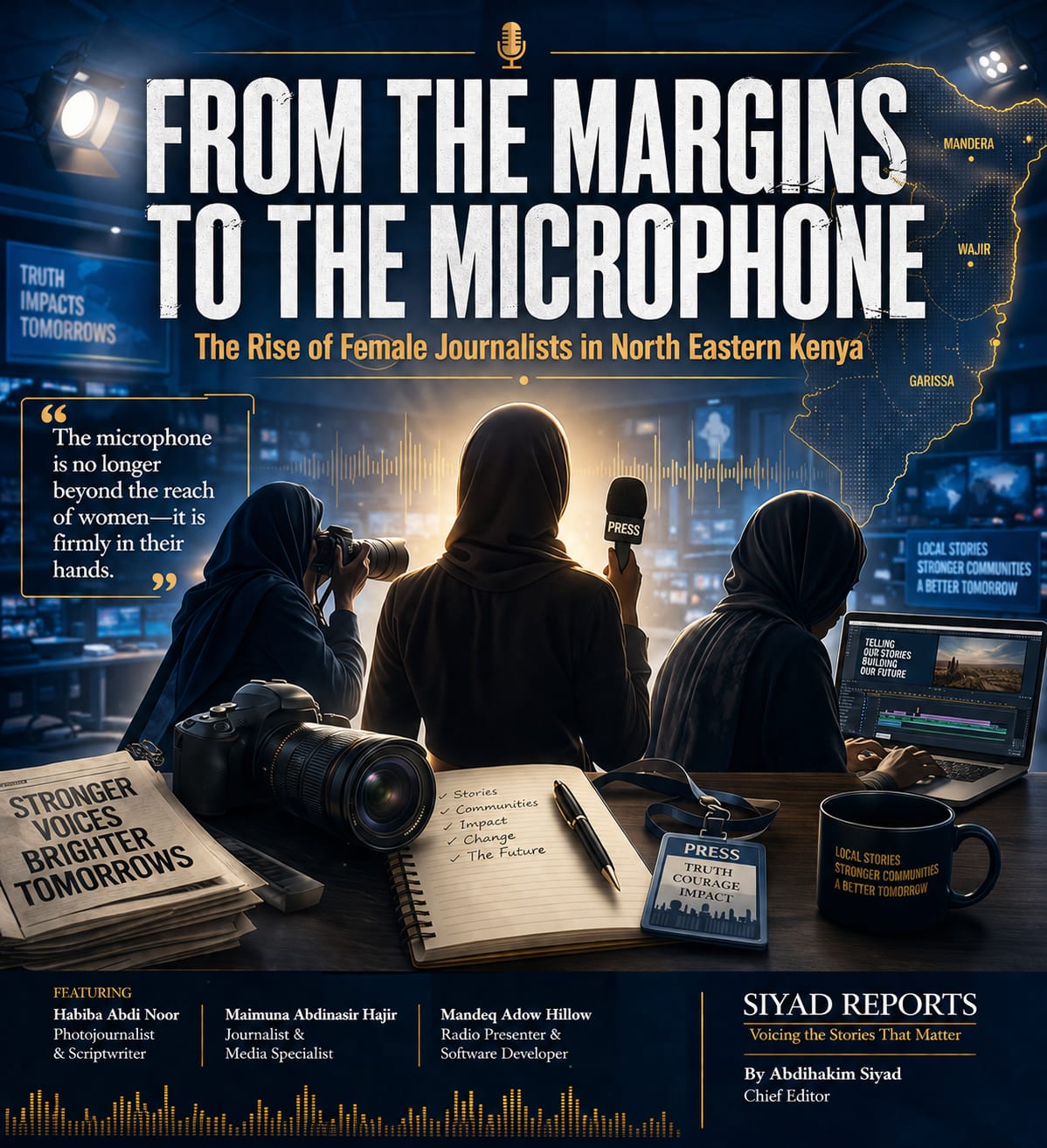
To understand this transformation, Siyad Reports Chief Editor Abdihakim Siyad sat down with three accomplished women journalists from the region, Habiba Abdi Noor, a photojournalist and scriptwriter based in Wajir; Maimuna Abdinasir Hajir, a journalist and communication and media specialist; and Mandeq Adow Hillow, a radio presenter and software developer. Their experiences reveal the determination, resilience and optimism driving the rise of women in the region’s media industry while also exposing the barriers that still need to be broken.
For Habiba Abdi Noor, the decision to pursue journalism was shaped by a defining moment that exposed the gender imbalance within field reporting. While still a student journalist, she covered the Gonana clan conflict in 2016, an assignment that would leave a lasting impression on her career.
“One of my defining moments came in late 2016 when I covered the Gonana clan conflict as a student journalist. I noticed that every journalist on the ground was male, which made me question why there were so few women in field reporting. That experience inspired me to pursue field journalism and help break barriers for women in the profession,” Habiba told Siyad Reports.
Her experience reflects a reality that many female journalists in North Eastern Kenya understand all too well. Seeing an absence of women covering major events became the motivation to ensure future generations would not face the same isolation. Rather than allowing the imbalance to discourage her, Habiba chose to become part of the solution by entering spaces where women had long been underrepresented.
As more young women join journalism schools and enter newsrooms, Habiba believes confidence will be just as important as technical skills. She says succeeding in journalism requires resilience, professionalism and a willingness to keep learning regardless of the obstacles encountered.
“My message to young female journalists is to be bold and confident. Trust your training and let professionalism guide you, rather than the pressures or personalities you encounter in the field. Journalism will challenge you, so stay disciplined, focused, and committed to continuous learning. Keep growing, and never be afraid to ask for help or seek guidance along the way,” she said.
Her advice speaks to the realities of a profession that constantly demands adaptability. Whether covering elections, humanitarian crises or breaking news, journalists must remain calm under pressure while maintaining ethical standards. For young women entering the profession, confidence becomes a powerful tool for overcoming doubt and earning credibility.
Despite encouraging progress, Habiba acknowledges that equality has not yet been fully achieved. She says women journalists continue to face workplace challenges that often make it harder for them to perform their duties.
“Female journalists face challenges everywhere, but in Wajir County, many are underestimated or belittled by their male counterparts, and at times may not even receive support when facing technical challenges in the field. Journalism is competitive, so it’s important to be prepared for any situation and remain resilient. To create lasting change, we need greater awareness within the media fraternity and a more inclusive, supportive environment where female journalists can thrive,” she explained.
Her observations highlight an important issue beyond recruitment. Increasing the number of women in newsrooms is only part of the solution. Building supportive workplaces where women are respected, mentored and given equal opportunities to grow into leadership positions remains equally important.
Journalist and communication specialist Maimuna Abdinasir Hajir believes representation plays a critical role in inspiring the next generation of women journalists. According to her, young girls need visible role models who demonstrate that success in journalism is possible.
“They need to know they have mentors who are waiting for them in the newsroom and in leadership roles. They need to know those women they are looking up to are the ones who fought for them to be future leaders in media and future editors in the newsroom,” Maimuna said.
Her words underscore the importance of visibility. Every woman presenting a news bulletin, reporting from the field or managing a newsroom sends a powerful message to girls watching from classrooms and villages across North Eastern Kenya that their dreams are valid and achievable.
Looking to the future, Maimuna remains optimistic. She believes opportunities will continue expanding for women who are prepared to embrace change, sharpen their skills and take advantage of emerging platforms.
“The future is always bright for the optimistic individual. My message to a young upcoming woman journalist is to use the resources that you have at hand and start somewhere. The market needs a ready and skilled journalist,” she said.
Her advice reflects the changing nature of journalism, where smartphones, social media and digital storytelling have lowered the barriers to entry. Today’s journalists no longer need to wait for employment in established media houses before beginning to tell meaningful stories.
Digital journalism has undoubtedly transformed the profession, particularly for women seeking to overcome traditional barriers. Social media has created new opportunities to reach audiences directly while building independent platforms for storytelling.
Still, those opportunities come with risks.
“Nearly three out of ten women face digital abuse globally. However, women journalists are utilizing the digital space, surpassing media restrictions and reaching wider audiences,” Maimuna observed.
Her remarks capture the double-edged nature of the digital era. Online platforms provide unprecedented opportunities for women to amplify their voices, yet they also expose them to harassment and abuse. Even so, many continue to use these tools to challenge stereotypes, tell overlooked stories and expand public conversations.
Radio presenter and software developer Mandeq Adow Hillow offers a more cautious assessment of progress. While acknowledging important achievements, she believes the overall number of women in journalism has not increased as much as many would hope.
“There’s no much improvement in the number of female journalists at the moment. The figure remained the same, hence there’s a drop due to restrictions of family circumstances such as maternity, taking care of kids and family pressure,” Mandeq told Siyad Reports.
Her assessment reminds us that professional growth cannot be separated from social realities. Family responsibilities continue to affect many women’s careers, limiting opportunities for advancement and contributing to the shortage of female journalists in some parts of the region.
Nevertheless, Mandeq believes women have had a significant influence on the issues receiving media attention. Their close engagement with communities has helped bring greater visibility to stories affecting ordinary families.
“They’ve influenced it through actively engaging with the community; creating awareness by radio talk shows, contributing ideas on their own media platforms and taking part at meetings that discuss or educate those issues in society,” she explained.
From maternal health and education to gender-based violence and youth empowerment, women journalists have expanded public discourse by highlighting concerns that directly affect communities but have often received limited attention in mainstream reporting.
Even with those contributions, Mandeq says many female journalists continue to encounter barriers both inside and outside the newsroom.
“Some of the challenges include competition from their colleagues whereby some of them refuse to offer help or assist at work issues. Also in the field female journalists tend to be discouraged or looked down upon by the patriarchal society whereby news coverage or reporting is given to male journalists because of the belief in men leadership in every aspect of work. That makes some women shy, not show up or contribute less to their work,” she said.
She believes overcoming these challenges requires determination from women themselves as well as broader institutional support.
“Some of the ways to overcome those challenges is by female journalists standing up for themselves, not being hindered by the challenges they come across and being bold enough to learn or do any task without fearing its challenges,” she added.
Taken together, the experiences of Habiba Abdi Noor, Maimuna Abdinasir Hajir and Mandeq Adow Hillow reveal a profession undergoing gradual but meaningful transformation. Their stories differ, yet they are united by a common message: women belong in every corner of journalism from the newsroom and the studio to the frontlines of breaking news.
Their journeys demonstrate that progress is measured not only by increasing numbers but also by changing attitudes, creating opportunities and ensuring that women have equal access to leadership, mentorship and professional development. They have challenged stereotypes, inspired young girls and broadened the range of stories being told across North Eastern Kenya.
As the media industry continues to evolve, their voices serve as both a reminder of how far women journalists have come and a call to action for the work that still lies ahead. The future of journalism in North Eastern Kenya will not be defined solely by technology or changing audiences, but by the diversity of voices telling the stories.
Ultimately, the microphone is no longer beyond the reach of women it is firmly in their hands. With every story they tell, every community they serve and every barrier they break, women journalists are informing the public, inspiring the next generation and helping shape a more inclusive, representative and resilient future for journalism in North Eastern Kenya.