

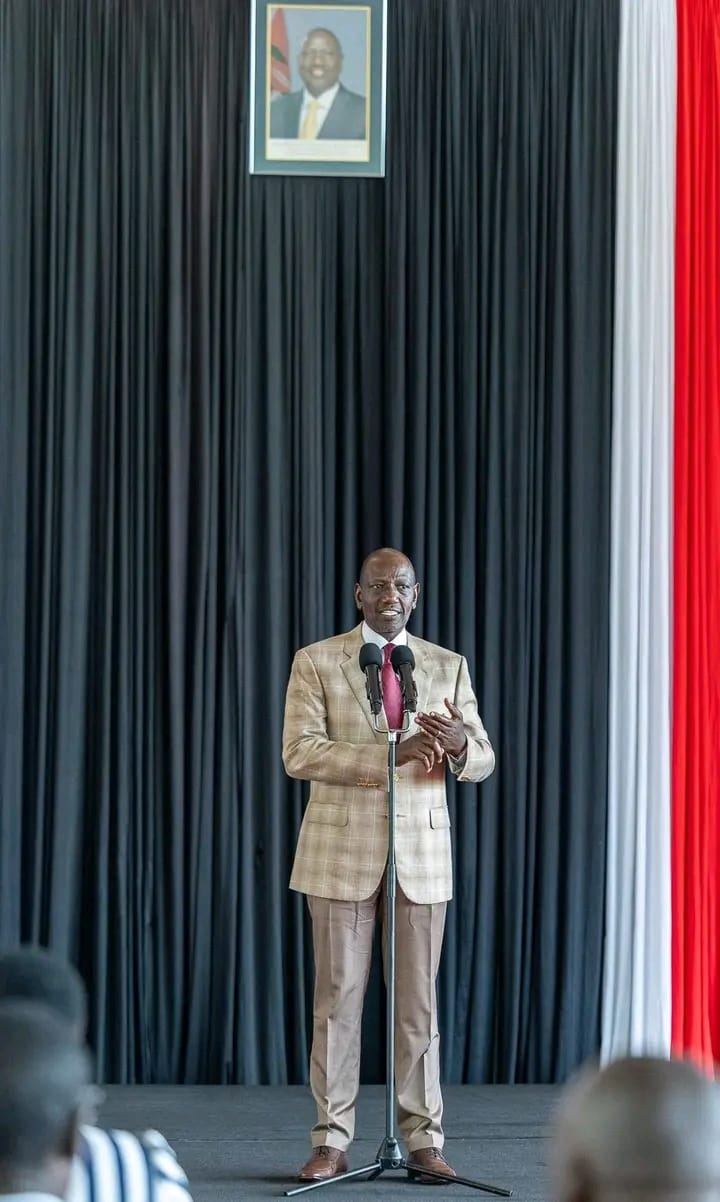
President William Ruto remains the man to beat in the race for the 2027 General Election, but the political terrain beneath him is shifting rapidly.
While opinion polls continue to place him ahead of every individual challenger, recent political events most notably the Ol Kalou parliamentary by-election have injected fresh uncertainty into what many had assumed would be a straightforward re-election campaign.The Ol Kalou outcome has become far more than a constituency contest.
It has evolved into a national political barometer, offering both government and opposition camps an early glimpse into the mood of voters less than two years before Kenyans head back to the ballot.For President Ruto, the election delivered a sobering reminder that incumbency alone may not guarantee a second term.The latest national surveys still present him as the frontrunner.
According to TIFA Research’s May 2026 poll, Ruto leads the presidential field with 24 percent support, ahead of Kalonzo Musyoka at 19 percent, Fred Matiang’i at 14 percent, Edwin Sifuna at 10 percent and former Deputy President Rigathi Gachagua at 9 percent. Significantly, TIFA noted that the President’s rating was his highest since May 2025, when he stood at 18 percent.
Another survey by Infotrak released in July paints an even stronger picture for the Head of State, placing him at 32 percent, while Kalonzo trails at 13 percent and both Matiang’i and Sifuna register 12 percent each. Yet perhaps the most revealing finding is that no candidate comes anywhere close to the constitutional threshold of 50 percent plus one vote required to win outright.If those numbers were replicated in an election, Kenya would almost certainly be headed for its first presidential runoff.
That reality creates both opportunity and danger for Ruto.His biggest advantage today is that the opposition remains fragmented. Instead of confronting one formidable challenger, he faces several influential politicians competing for the same anti-government vote.
Kalonzo Musyoka, Fred Matiang’i, Edwin Sifuna and Rigathi Gachagua each command different regional and political constituencies, making it difficult for any one of them to emerge as a dominant alternative.As long as that division persists, Ruto retains a mathematical advantage.The President also continues to benefit from the enormous advantages that come with incumbency.
His administration has intensified nationwide development tours while promoting flagship projects including roads, affordable markets and youth empowerment initiatives such as the NYOTA programme. The broad-based government arrangement with ODM has also enabled him to campaign alongside leaders who were once among his fiercest political rivals, allowing him to project an image of national unity rather than partisan competition.
Politically, the arrangement appears to be yielding dividends in regions previously considered hostile.Polling indicates that Ruto has made significant gains in Nyanza while maintaining considerable support across Northern Kenya, suggesting that his strategy of expanding beyond his traditional Rift Valley base may be bearing fruit.Yet beneath these encouraging indicators lie serious warning signs.
The greatest challenge facing the President remains Mount Kenya.The region overwhelmingly backed him in 2022, effectively delivering State House. Today, however, polls suggest that his popularity there has declined sharply. At the same time, Rigathi Gachagua has consolidated substantial political influence within the region following his fallout with the President.
That changing dynamic has fuelled intense debate among political analysts over whether Ruto should continue investing heavily in rebuilding support in Mount Kenya or redirect his political energy toward consolidating gains in western Kenya, Nyanza, North Eastern and the Coast.The Ol Kalou by-election has only intensified that conversation.Senior Counsel Ahmednasir Abdullahi argued that the result should serve as a political wake-up call for State House.
He suggested that the President faces a clear strategic decision: continue relying on assurances that significant Mount Kenya support can still be recovered, or fundamentally rethink his electoral coalition before 2027.Ahmednasir contended that Ruto may ultimately need to shift his political calculations toward other regions if Mount Kenya remains politically hostile.
His assessment reflects an increasingly discussed theory within Kenya’s political circles that the President’s path to re-election may depend less on recovering lost ground in Central Kenya and more on assembling a broader coalition elsewhere.
Former Mandera Senator Billow Kerrow echoed similar sentiments, arguing that the President should accept the political reality emerging from Mount Kenya instead of continually attempting to reverse it.”I hope President Ruto’s idealized fantasy with Murima folks has run its course. It’s time to sever the tattered bond,” Kerrow wrote, suggesting that political resources might produce greater returns in regions more receptive to the President’s message.
Whether such advice proves strategically sound remains uncertain.Mount Kenya remains one of Kenya’s largest voting blocs, making it difficult for any presidential candidate to ignore entirely. However, politics is ultimately about numbers, and coalition-building has historically determined presidential victories more than regional dominance alone.
Adding further pressure is the growing political mobilisation among Kenya’s youth.The anti-government demonstrations witnessed over the past three years from the 2023 cost-of-living protests to the 2024 Finance Bill demonstrations and subsequent protests in 2025 have transformed sections of the youth into an increasingly organised political constituency.
Analysts argue that millions of newly registered young voters could significantly influence the outcome of the next election, particularly if economic frustrations persist.For the opposition, that demographic presents an opportunity.For the government, it presents both a challenge and a test of policy delivery.
Former Deputy President Rigathi Gachagua has sought to capitalise on that growing anti-government mood. Following the Ol Kalou by-election, he declared, “It is finished, it is over Mr. President. The people are resolute that they will not vote for this rogue administration again.”While such statements reflect political rhetoric rather than electoral certainty, they underline the opposition’s belief that dissatisfaction with the government is translating into votes.
Political analyst Mutahi Ngunyi also interpreted the Ol Kalou outcome as evidence that the President may need to reconsider where he invests his political capital.He argued that continued efforts to win back Mount Kenya could prove politically costly if voter attitudes remain unchanged, urging the President instead to strengthen alliances within Luo Nyanza and the Mulembe region.
Such perspectives increasingly point toward one central question: can Ruto build a winning coalition without relying heavily on the region that propelled him to power in 2022?Even among supporters of the President, there is recognition that Ol Kalou exposed deeper political realities.
Ahmednasir Abdullahi, despite supporting Ruto’s re-election, described the by-election as a painful lesson. He argued that Kenyan voters rejected intimidation, questioned campaign approaches centred solely on promises of development and reminded political leaders that citizens expect honesty rather than election-season pledges.His broader conclusion was that political strategy heading into 2027 must be grounded in voter sentiment rather than assumptions.
For President Ruto, however, the message remains one of confidence rather than concern.Speaking after the Ol Kalou contest, the Head of State dismissed suggestions that the by-election fundamentally altered the national political landscape.”Elections are not a matter of life and death. There will be Kenya after the election and we must live together as brothers and sisters of one nation,” the President said, while urging leaders to respect democratic outcomes regardless of political affiliation.
In Swahili, he added, “Hata yule Mbunge amechaguliwa jana kule Ol Kalou, sasa twende kazi. Wananchi wakisha amua, sisi wote tunatembea pamoja,” signalling his intention to move beyond the by-election and focus on governing.The President has consistently maintained that his re-election campaign will rest not on political rhetoric but on his administration’s record in office.
He continues to argue that infrastructure development, economic reforms, job creation and youth empowerment will ultimately persuade Kenyans to renew his mandate.Whether that message resonates will depend largely on events over the next twelve months.
Economic performance remains perhaps the single biggest variable. If inflation eases, employment opportunities expand and flagship government programmes produce tangible results, the President could strengthen his electoral position considerably.Conversely, prolonged economic hardship would provide fertile ground for opposition mobilisation.
Equally important will be whether opposition leaders can overcome personal ambitions and unite behind a single presidential candidate.
Individually, none currently matches Ruto’s polling numbers. Collectively, however, their combined support already exceeds his in several surveys.That arithmetic explains why coalition negotiations are likely to dominate Kenyan politics over the coming year.
Ultimately, the Ol Kalou by-election did not decide the 2027 election. But it fundamentally changed the conversation.It reminded State House that regional political loyalties are not permanent. It emboldened opposition leaders who believe momentum is shifting. It revived debate about coalition arithmetic, running mates and electoral strategy.
Above all, it confirmed that Kenya’s next presidential election is unlikely to be a routine defence of incumbency.William Ruto remains the frontrunner. He controls the instruments of government, leads every major opinion poll and continues expanding political alliances beyond his traditional bases.Yet frontrunner does not mean favourite beyond doubt.
Between now and August 2027, the President must hold together his existing support, deepen gains in Nyanza, North Eastern and other emerging regions, improve economic confidence, reconnect with young voters and navigate the increasingly complex politics of Mount Kenya all while hoping the opposition fails to unite behind a single challenger.
The road to State House in 2027 remains open.But after Ol Kalou, it appears far steeper than it did only a few weeks ago.