

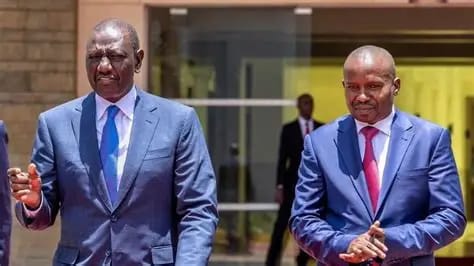
Kenya’s political landscape is steadily shifting as the country moves closer to the 2027 General Election, forcing President William Ruto and his allies to confront difficult political realities. With every passing month, the battle is becoming less about government performance alone and increasingly about electoral arithmetic, regional alliances and strategic political compromises that could ultimately determine whether President Ruto secures a second and final constitutional term.
The latest debate has centred on the future of Deputy President Prof. Kithure Kindiki following remarks by Senior Counsel Ahmednasir Abdullahi, who suggested that he does not expect President Ruto to formally remove his deputy from the 2027 ticket.
“I don’t think President William Ruto will drop Prof. Kithure Kindiki as his running mate for the 2027 Presidential election. I think, Prof Kindiki will be very understanding and resign. Either way, it must be before October 2026 or it will be TOO LATE.”
Although the remarks remain Ahmednasir’s personal political assessment and not an official government position, they have revived debate over whether Kenya’s second-highest office could once again become the centrepiece of pre-election negotiations.
As things stand today, President Ruto faces a far more complicated electoral environment than he did in 2022. The coalition that propelled him to State House has undergone significant political changes. Former Deputy President Rigathi Gachagua, once regarded as the administration’s most influential political mobiliser in the Mt Kenya region, has become one of the President’s fiercest critics, reshaping the political conversation within a region that overwhelmingly supported Kenya Kwanza four years ago.
Whether President Ruto can recover substantial support in Mt Kenya remains one of the biggest unanswered questions heading into the election cycle. If the region becomes increasingly competitive, State House strategists may be forced to reconsider how the national ticket is structured.
Beyond Mt Kenya, the political map presents both opportunities and challenges.
In Western Kenya, opposition voices have grown stronger. Leaders such as Nairobi Senator Edwin Sifuna have consistently criticised the Kenya Kwanza administration, while Trans Nzoia Governor George Natembeya has emerged as an increasingly influential political figure in the region. Their growing visibility reflects an evolving political contest where Western Kenya is expected to remain one of the country’s most fiercely contested voting blocs.
Within ODM circles, discussions have also emerged regarding the possibility of the deputy presidency forming part of any future power-sharing arrangement. Suna East MP Junet Mohamed has publicly indicated that he would support Wycliffe Oparanya for the deputy president’s position should broader political negotiations between Kenya Kwanza and ODM deepen ahead of 2027. While no official agreement exists, such statements have fuelled speculation that the office of deputy president could become a bargaining chip in coalition-building.
The Coast region similarly remains politically fluid, with several influential leaders maintaining independent political positions while others continue working within the broad-based government framework. Voting trends there have historically shifted between elections, making it another strategic battleground.
Nairobi, Kenya’s political and economic capital, presents a unique challenge. Unlike previous elections where voting patterns sometimes favoured one coalition more clearly, the capital increasingly appears divided between supporters of the government and the opposition. Urban economic concerns, unemployment, the high cost of living and governance issues are expected to shape voting decisions more than traditional ethnic alignments, making Nairobi one of the most unpredictable counties in the country.
Ukambani also remains an important electoral consideration. Wiper Party leader Kalonzo Musyoka continues to enjoy significant political influence across the region. Nevertheless, analysts argue that President Ruto may still secure a portion of votes there through local political alliances and development projects, even if the broader region remains largely aligned with Kalonzo’s political base.
Rift Valley continues to represent President Ruto’s strongest political foundation. However, modern presidential elections in Kenya cannot be won by relying on one region alone. Every successful presidential campaign has required broad regional support stretching well beyond a single voting bloc.
North Eastern Kenya has increasingly become central to Kenya Kwanza’s electoral calculations. Recent remarks by Health Cabinet Secretary Aden Duale, who claimed the region commands approximately five million votes, illustrate the importance that government leaders attach to the area. While the exact voter figures can be debated against official electoral registers, there is little doubt that Garissa, Wajir and Mandera, alongside neighbouring counties, remain politically significant in determining national outcomes.
The government’s continued investment in infrastructure, education, healthcare and identification card reforms across the region has also been interpreted by political observers as part of broader efforts to consolidate support ahead of the next election.
Against this backdrop emerges perhaps the most sensitive political question facing President Ruto: should he retain Prof. Kithure Kindiki as his running mate or consider selecting another figure capable of strengthening support in regions where Kenya Kwanza faces growing political competition?
Kindiki’s supporters argue that the Deputy President has remained loyal, disciplined and largely avoided public political confrontation. Since assuming office, he has concentrated on government assignments and maintained a relatively low political profile compared to previous holders of the office.
Replacing such a loyal deputy, they argue, could project instability within the administration and raise questions about political trust among senior government officials.
On the other hand, Kenyan politics has often demonstrated that electoral strategy sometimes outweighs loyalty. Running mates are frequently evaluated not only on governance but also on their ability to deliver regional votes, strengthen coalition agreements and broaden national appeal.
If President Ruto concludes that retaining Kindiki offers the strongest path to re-election, the current ticket may remain intact. However, if political advisers determine that another region holds the key to securing victory, pressure could mount for changes before campaign season begins.
Ahmednasir Abdullahi’s suggestion introduces another possible scenario—that rather than being dismissed, Kindiki could voluntarily step aside should wider political negotiations require a different running mate. Such a move, however, remains entirely speculative and neither President Ruto nor Deputy President Kindiki has indicated any intention to alter the current leadership arrangement.
Timing could also prove decisive. Political parties traditionally begin consolidating alliances well before official nominations. Delayed decisions risk creating uncertainty, confusing campaign structures and weakening coalition unity. This explains why many political observers believe any significant changes to the presidential ticket would need to occur well before formal campaigns intensify.
Ultimately, the debate surrounding Prof. Kindiki’s future reflects a much larger political question facing President William Ruto. The President is not merely choosing a running mate; he is attempting to assemble a national coalition capable of navigating Kenya’s evolving electoral landscape. Every region now carries greater strategic value than it did four years ago, and every political decision will be measured against one overriding objective winning a second term.
Whether that strategy ultimately involves retaining Prof. Kindiki, reaching deeper into Mt Kenya, accommodating Western Kenya through coalition politics or maintaining the current ticket remains one of the defining political questions as Kenya steadily marches towards the 2027 General Election. For now, the Deputy President remains firmly in office, but the political conversation surrounding his future is unlikely to fade anytime soon.