

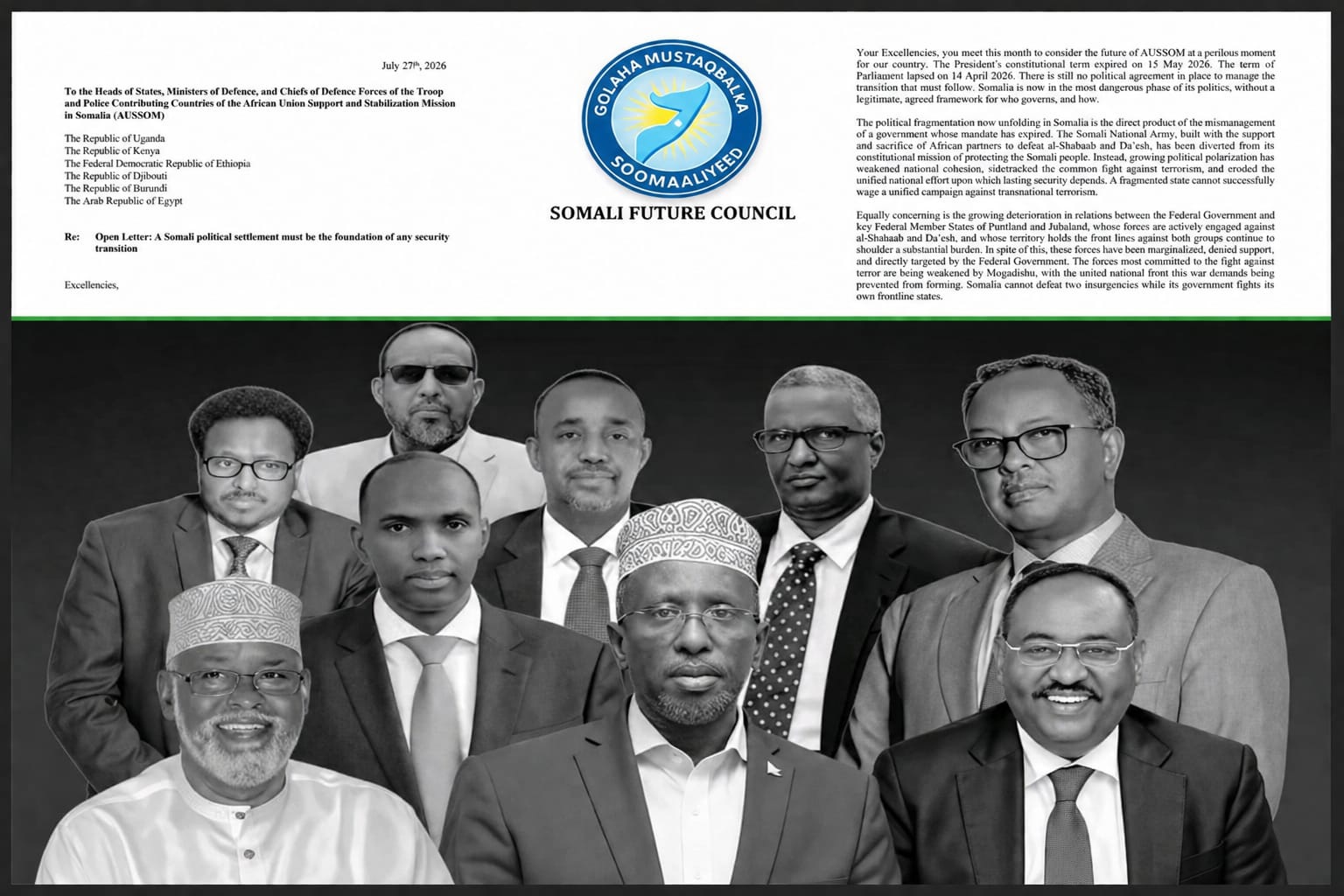
newly formed coalition of Somali political leaders has issued one of its strongest challenges yet to the Federal Government of Somalia, calling for the establishment of an inclusive transitional governing council and urging the international community to make any future security support conditional on a negotiated political settlement.
In a three-page open letter dated July 27, 2026, the Somali Future Council a political platform bringing together former national leaders, opposition figures, and the presidents of Puntland and Jubbaland addressed heads of state, defence ministers, and military chiefs from countries contributing troops and police to the African Union Support and Stabilization Mission in Somalia (AUSSOM).
The letter comes at a critical moment as African Union member states, together with the United Nations, Somali authorities and troop-contributing countries, review the future of AUSSOM beyond 2026 amid ongoing security challenges and funding constraints.
The council argues that Somalia’s security crisis can no longer be separated from its political crisis, insisting that military operations alone cannot stabilize the country without first restoring political legitimacy.
“The Somali political settlement must be the foundation of any security transition,” the letter states, making clear that the group believes Somalia has entered a constitutional and political vacuum following the expiration of President Hassan Sheikh Mohamud’s constitutional mandate.
According to the council, the president’s constitutional term ended on May 15, 2026, while the mandate of Parliament expired on April 14, 2026. It argues that no consensus has since been reached on the framework governing the country’s political transition.
“As you meet this month to consider the future of AUSSOM,” the letter reads, “Somalia is now in the most dangerous phase of its politics, without a legitimate, agreed framework for who governs, and how.”
The council says this absence of an agreed political roadmap has fueled deepening political fragmentation, weakened national institutions and undermined the country’s campaign against Al-Shabaab.
While acknowledging the sacrifices made by African Union forces over nearly two decades, the signatories argue that those gains risk being reversed if Somalia’s political divisions continue unresolved.
The letter opens by expressing gratitude to troop-contributing countries, praising thousands of African soldiers who have served and lost their lives in Somalia’s pursuit of peace.
“Their service has protected not only Somalia but also the wider Horn of Africa,” the council writes, describing African solidarity as central to confronting regional security threats.
However, the council contends that the achievements of the Somali National Army and international partners have increasingly been undermined by political polarization.
It claims that the federal government has diverted the country’s security institutions away from their constitutional role of protecting citizens, arguing that political disputes have weakened national cohesion, distracted security forces from counterterrorism operations and eroded the united national effort required to defeat extremist groups.
“A fragmented state cannot successfully wage a unified campaign against transnational terrorism,” the letter states.
Particular concern is expressed over deteriorating relations between the Federal Government and the administrations of Puntland and Jubbaland.
The council argues that the two federal member states continue to shoulder a significant share of frontline operations against Al-Shabaab and ISIS but have instead faced political isolation and reduced support from Mogadishu.
According to the signatories, these disputes have weakened the overall national security architecture by creating internal political battles while security forces remain engaged against insurgent groups.
The letter also links Somalia’s current political uncertainty to growing concerns among international partners over the sustainability of AUSSOM.
It argues that the ongoing financial challenges surrounding the United Nations Support Office in Somalia (UNSOS) and AUSSOM are symptoms of a deeper governance crisis rather than simply donor fatigue.
“The greatest challenge is the absence of a legitimate government the world can trust and engage with,” the council writes, adding that “no mission can substitute for a state, and no measure of foreign sacrifice can secure a country whose own leadership has forfeited its legitimacy.”
As an alternative, the Somali Future Council proposes the formation of an inclusive Transitional Council tasked with collectively overseeing constitutional, electoral and governance matters until legitimate national institutions can be peacefully renewed.
According to the proposal, such a body would restore political legitimacy, rebuild national confidence, safeguard the neutrality of the Somali National Army and ensure that the transition is managed in an inclusive, transparent and credible manner.
The council insists that dialogue and compromise not unilateral political decisions must define Somalia’s next political chapter.
It therefore calls upon troop-contributing countries attending discussions on the future of AUSSOM to encourage a negotiated political settlement before committing to any future security arrangements.
The signatories argue that future international military engagement should be directly tied to progress toward an inclusive political agreement capable of restoring constitutional order.
“Somalia urgently needs an inclusive political settlement, and this should be the condition and foundation of any continued engagement,” the letter says.
The appeal is addressed to Uganda, Kenya, Ethiopia, Djibouti, Burundi and Egypt, whose military and police personnel form the backbone of AUSSOM operations inside Somalia.
Copies of the letter were also sent to the Chairperson of the African Union Commission, the African Union Peace and Security Council, African members of the United Nations Security Council, IGAD, the United States, the United Kingdom, the European Union, Türkiye and the United Nations Transition Mission in Somalia (UNTMIS).
The timing of the letter is politically significant.
The African Union is currently conducting a strategic review of AUSSOM as member states consider the future of international peace support operations in Somalia beyond the current mandate. Those discussions are expected to shape both military planning and international financial commitments at a time when Somalia continues to face persistent threats from Al-Shabaab while also navigating deep political disagreements over constitutional reforms, elections and federal relations.
The Somali Future Council’s intervention therefore seeks to influence not only Somalia’s domestic political trajectory but also the calculations of international partners who continue to finance and support the country’s security institutions.
The letter also reflects a growing strategy among opposition leaders to internationalize Somalia’s political crisis by arguing that security and governance are inseparable. Rather than asking foreign partners to increase military assistance alone, the council is effectively urging them to use their political leverage to encourage negotiations among Somali stakeholders.
Whether that appeal gains traction remains uncertain.
The Federal Government has consistently defended its constitutional reforms and political roadmap, maintaining that state-building and security operations must continue simultaneously. Government officials have also rejected accusations that federal institutions lack legitimacy, arguing that ongoing constitutional processes provide a legal basis for governance during the transition.
Should the opposition’s proposal receive serious consideration from regional and international partners, it could fundamentally reshape the debate over Somalia’s political future. However, it is also likely to deepen tensions between Villa Somalia and opposition leaders, particularly if external actors begin linking future security assistance to political negotiations.
Ultimately, the Somali Future Council’s letter marks a significant attempt to redefine the conversation around Somalia’s future. Rather than focusing solely on defeating Al-Shabaab through military means, it argues that lasting security can only emerge from a legitimate and broadly accepted political settlement. As the African Union and its partners deliberate on the next phase of AUSSOM, the council’s message is clear: military stabilization without political consensus, it says, risks prolonging rather than resolving Somalia’s long-running crisis.