

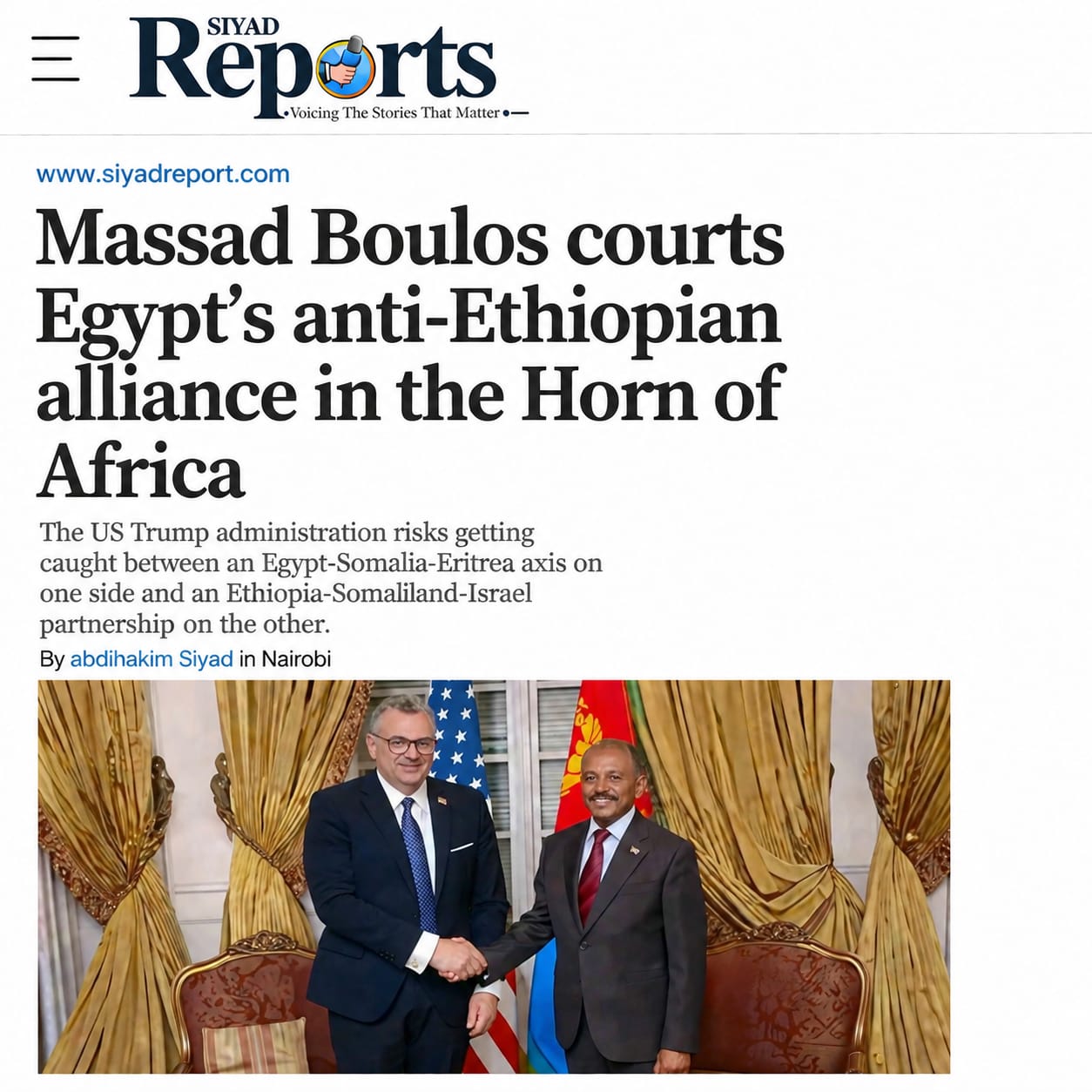
The United States has dismissed reports suggesting it is aligning itself with a regional bloc opposed to Ethiopia, amid growing geopolitical competition and shifting alliances in the Horn of Africa.
The response comes after The Africa Report, a France-based publication often viewed as sympathetic to Ethiopia, published an analysis claiming that Addis Ababa has become increasingly concerned that Washington is engaging with countries viewed as strategic rivals in the region.
According to the publication, Ethiopian officials believe the United States is working more closely with governments that are competing with Ethiopia for influence across the Horn of Africa and the Red Sea corridor. The report specifically pointed to recent diplomatic engagements by U.S. Senior Advisor for Africa and the Middle East Massad Boulos, who reportedly held talks with countries seen as forming part of an Egypt-led regional alliance.
The report argued that the administration of U.S. President Donald Trump risks finding itself caught between two emerging geopolitical camps whose interests increasingly diverge over security, regional influence and access to the Red Sea.
It described one bloc as comprising Egypt, Somalia and Eritrea, while the other consists of Ethiopia, Somaliland and Israel.
According to the publication, the growing competition between these alignments could complicate Washington’s diplomatic efforts as it seeks to maintain strong relations with all parties while promoting regional stability.
The Horn of Africa has, in recent years, become one of Africa’s most strategically significant regions, attracting increased attention from global powers because of its proximity to the Red Sea, one of the world’s busiest maritime trade routes. At the same time, longstanding disputes between regional states have intensified, making diplomatic engagement increasingly delicate.
Relations between Ethiopia and Egypt remain strained over the Grand Ethiopian Renaissance Dam (GERD), with Cairo maintaining that the dam threatens its long-term water security while Addis Ababa insists the project is essential for its economic development and poses no danger to downstream countries.
Meanwhile, Ethiopia’s relationship with Somalia has also experienced significant tension following Addis Ababa’s memorandum of understanding with Somaliland signed in early 2024. Somalia strongly rejected the agreement, arguing that Somaliland remains part of its sovereign territory and that any agreement concerning its coastline or territorial resources must be negotiated through the Federal Government in Mogadishu.
Although Somalia and Ethiopia later moved to restore diplomatic relations through Turkish-mediated negotiations, analysts say mistrust has not entirely disappeared, particularly as regional actors continue to pursue competing strategic interests.
Against this backdrop, The Africa Report suggested that recent U.S. diplomatic outreach has fueled concerns within Ethiopia that Washington may be gravitating toward countries that frequently oppose Ethiopian positions on regional issues.
However, Massad Boulos has firmly rejected those claims.
In a statement posted on X on Wednesday, Boulos described the reports as false and misleading, saying they inaccurately portrayed his diplomatic engagement in the Horn of Africa as an effort to build an alliance against Ethiopia.
He said such claims do not reflect the objectives of U.S. diplomacy and warned that they risk inflaming already sensitive regional tensions.
Boulos stressed that the United States continues to work closely with Ethiopia alongside every country in the Horn of Africa and the wider Red Sea region in pursuit of shared interests, including regional peace, stability and economic cooperation.
He further emphasized that engagement with one country should never be interpreted as hostility toward another, arguing that the United States does not conduct its foreign policy by creating rival alliances or encouraging divisions among regional partners.
Instead, he said, Washington’s approach is based on engaging all governments across the region to prevent conflict, strengthen dialogue and promote lasting peace and security.
His remarks appear aimed at reassuring Addis Ababa that recent meetings with other regional governments should not be viewed as evidence of a strategic shift in U.S. policy.
The statement also reflects Washington’s broader challenge of balancing relationships with multiple countries whose interests increasingly clash over security, territorial disputes and regional leadership.
The Horn of Africa has become increasingly fragmented, with countries pursuing different security partnerships and foreign policy priorities. Somalia has deepened security cooperation with Egypt following its diplomatic dispute with Ethiopia over Somaliland, while Eritrea has maintained close ties with Cairo on several regional issues. Ethiopia, on the other hand, has sought to strengthen relations with Somaliland while also expanding partnerships with countries that support its broader strategic ambitions.
These evolving relationships have led analysts to describe the region as one shaped by overlapping alliances rather than fixed blocs, making diplomacy increasingly complex for international partners such as the United States.
Washington has consistently maintained that it seeks constructive relations with all governments in the Horn of Africa, recognising that regional stability depends on cooperation rather than confrontation.
At the same time, the United States has significant interests across the region, including counterterrorism cooperation, maritime security in the Red Sea, humanitarian assistance, economic investment and efforts to prevent conflicts that could further destabilise East Africa.
Maintaining strong relations with Ethiopia also remains strategically important for Washington given Ethiopia’s large population, regional influence and central role in the African Union, whose headquarters are located in Addis Ababa.
Likewise, the United States continues to engage Somalia on security cooperation, particularly in supporting efforts against Al-Shabaab, while also maintaining diplomatic engagement with Egypt, Eritrea and other regional partners.
Boulos’ statement therefore serves not only as a rejection of the specific report but also as a broader reaffirmation of longstanding U.S. policy that seeks engagement across the region rather than choosing sides in regional rivalries.
Whether those assurances ease Ethiopia’s concerns remains to be seen. As competition for influence in the Horn of Africa continues to intensify, global powers are increasingly required to navigate a delicate diplomatic landscape where engagement with one country can quickly be interpreted by another as a strategic realignment.
For now, Washington insists that its objective is not to build competing alliances but to work with all countries in the Horn of Africa and the Red Sea region in support of peace, stability and shared regional interests.