

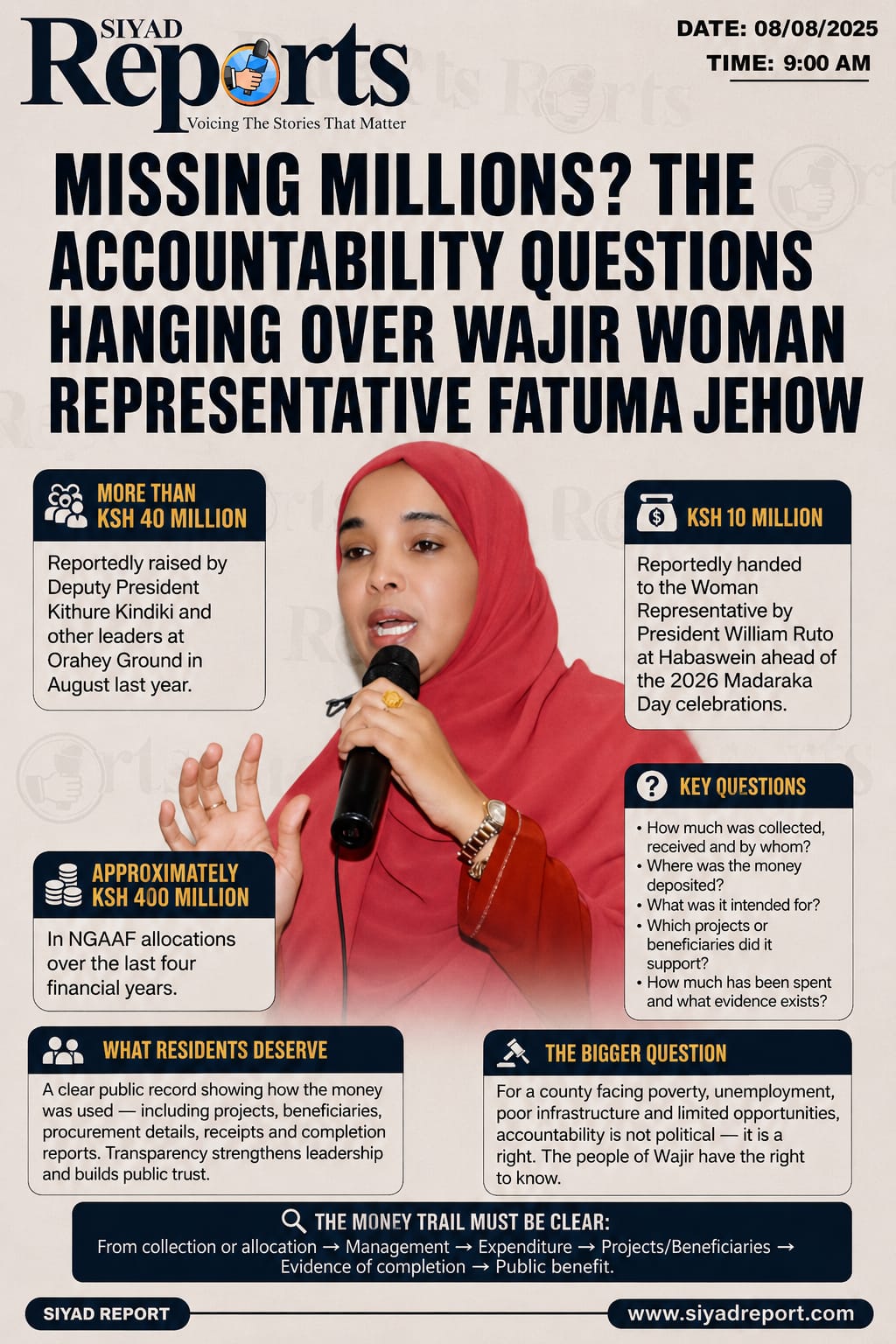
Wajir County is facing a growing accountability question over millions of shillings reportedly raised or allocated for the benefit of residents, with attention now turning to Woman Representative Fatuma Jehow and the need for a clear public account of how these resources were received, managed and utilized.
At the centre of the debate are three significant figures: more than KSh 40 million reportedly raised by Deputy President Kithure Kindiki and other leaders at Orahey Ground in August last year; KSh 10 million reportedly handed to Jehow by President William Ruto at Habaswein ahead of the 2026 Madaraka Day celebrations; and approximately KSh 400 million in NGAAF allocations over the last four financial years.
Together, these figures represent an enormous amount of money by any standard. For a county where communities continue to raise concerns about poverty, unemployment, inadequate infrastructure, education challenges, healthcare needs and limited economic opportunities, the question of what happened to resources intended for public benefit cannot simply be brushed aside as political noise.
The issue is particularly important in a county where many residents depend on public programmes, community support and government-funded interventions to meet basic needs. When millions of shillings are announced or allocated in the name of communities, residents are entitled to ask whether those resources reached the people and projects they were meant to benefit.
That does not automatically mean wrongdoing occurred. It simply means that large sums of money require an equally serious standard of accountability.
It is a question of accountability.
It is a question of transparency.
And, above all, it is a question of whether the people of Wajir have been given enough information about resources mobilized in their name.
The first issue dates back to August last year at Orahey Ground, where Deputy President Kindiki and other leaders reportedly participated in a fundraising drive that generated more than KSh 40 million.
Fundraising events involving senior national leaders often attract significant public attention because the money raised is generally understood to serve a particular community purpose.
Once such an event is over, however, the public interest does not end with the announcement of the amount raised. In fact, that is where accountability should begin. There is an important difference between money that was pledged, money that was actually collected and money that was ultimately spent. A credible public account should therefore make that entire process clear.
How much exactly was collected? Who contributed? Was the entire amount received? Where was the money deposited or transferred? Who had authority over it? What was it intended to finance? Which projects were eventually supported? And how much remains, if anything?
Those are not hostile questions. They are basic questions that should accompany any substantial public fundraising exercise. The larger the amount involved, the greater the public interest in knowing what happened to it.
If, for example, the funds were intended for community development, residents should be able to identify the projects that benefited and establish whether the projects were completed. If the funds were intended for education, there should be a record showing the institutions, students or programmes that received support.
If the money was distributed through community groups or other structures, those mechanisms should also be identifiable.
This kind of documentation matters because public trust is built not simply by announcing that money has been raised, but by demonstrating what that money ultimately achieved.
The second figure is the KSh 10 million reportedly given at Habaswein by President William Ruto, one day before the country marked Madaraka Day in Wajir.
The timing and setting made the occasion politically significant. The President was in Wajir as the county prepared to host a historic national celebration, and the reported allocation created expectations among residents that the money would translate into tangible community benefits.
Again, the central issue is not to presume that the money was misappropriated.
There is no justification for turning an accountability question into an accusation without evidence.
The bigger issue is much simpler: where is the public record showing how that KSh 10 million was used?
If it funded scholarships, residents should know how many students benefited, the criteria used to select beneficiaries and how much was allocated for the education programme. If it supported community projects, residents should know which projects were selected, where they are located, how much they cost and whether they were completed.
If it went towards vulnerable households, the criteria and beneficiary groups should be documented. If it remains unspent, that should also be publicly disclosed.
The purpose of asking these questions is not to create an impression of guilt. Rather, it is to establish a factual record. If the money was used properly and for the intended purpose, documentation would provide a straightforward way of demonstrating that to the public.
This is why transparency does not weaken a leader. In fact, it strengthens public confidence. A leader who can produce clear records of what was received, what was spent and what was achieved is in a stronger position to answer critics than one who responds only through political statements.
The third and potentially largest question concerns NGAAF, through which approximately KSh 400 million is reported to have been allocated over the last four financial years.
This is where the accountability conversation becomes substantially bigger.
NGAAF is not ordinary political money. It exists to support community development and address needs at constituency level. Consequently, residents have a legitimate interest in understanding how allocations are prioritized and converted into actual programmes and projects.
Four years of allocations potentially amount to hundreds of millions of shillings passing through a system designed to serve ordinary citizens. At that level, accountability should not be limited to a few highly visible projects or public ceremonies. It should provide a broader picture of how resources were distributed across different sectors and communities.
What did Wajir receive? Which wards benefited? How much went into education? How much went into health? How much supported women, youth and vulnerable groups? How many projects were completed? How many beneficiaries received assistance? What procurement processes were followed? And what independent records can verify the spending?
These questions become even more important because public accountability cannot depend entirely on political speeches, social-media photographs or occasional project launches.
A photograph of a leader handing over equipment does not, by itself, explain the total amount spent. A list of beneficiaries does not automatically reveal whether the allocation represented value for money. A project launch does not tell residents whether the final expenditure matched the original budget.
There is a difference between showing that something was delivered and demonstrating that public resources were used efficiently to deliver it. A complete accountability process should allow residents to understand not only what was purchased or constructed, but also how much it cost, who supplied it, where the resources came from and whether the final result matched the original plan.
That is particularly important when the same constituency receives allocations year after year. Residents should be able to look back over the four-year period and identify the cumulative impact of those resources. They should be able to see whether the money produced classrooms, bursaries, medical support, water projects, youth programmes, women empowerment initiatives or other measurable interventions.
The accountability question is therefore not simply about asking, “Where is the money?” It is also about asking, “What did the money achieve?”
That distinction matters. Public resources should ultimately be measured by outcomes, not only by announcements.
The people of Wajir deserve more than political symbolism. They deserve records.
There is therefore an opportunity to turn the current controversy into a broader demonstration of transparent leadership and responsible management of community resources.
A comprehensive accountability report should clearly identify the amount received, when it was received, the purpose for which it was received and how the money was eventually spent. It should also identify the projects or beneficiaries involved and, where procurement was undertaken, provide enough information to show how suppliers or contractors were selected and what was ultimately delivered.
For projects that were completed, residents should be able to see evidence of completion and, where appropriate, the location and scope of the project. For scholarships or other forms of direct assistance, the public should be able to understand the eligibility criteria and the broad number of beneficiaries.
The purpose is not necessarily to expose private personal information about individual beneficiaries, but to provide enough aggregate information for the public to verify that the programmes actually existed and reached the intended groups.
If there are inaccuracies in the figures circulating publicly, those inaccuracies should also be corrected with official documentation.
If some of the money was never under the control of the person or office being questioned, that too should be clearly stated and supported by records. If another institution, committee, organization or individual was responsible for managing particular funds, that distinction should be made clear so that accountability is directed at the correct institution or person.
That clarification would also help separate different categories of money that are currently being discussed together. Public fundraising proceeds, presidential support and NGAAF allocations may have different legal, administrative and financial structures.
Treating them as one pool of money could create confusion. A proper accounting should therefore identify each source separately, explain who controlled it and show how it was used.
If funds were spent properly, the evidence should settle the debate.
That is the power of transparency.
The danger, however, is allowing an accountability debate to become a political battle between personalities. Wajir does not need another endless argument over who supports whom. It needs a culture where every leader handling public resources understands that citizens have the right to ask difficult questions.
This is particularly important as the region moves closer to another election cycle. Political competition can easily transform questions about public resources into accusations between rival camps. Once that happens, the original issue can become buried beneath political slogans, personal attacks and competing loyalties.
But public money should not belong to a political camp.
Accountability should not depend on whether a resident supports or opposes a particular politician. The same standard should apply to every elected leader and every institution entrusted with community resources.
The issue should therefore not be reduced to political popularity, personalities or the 2027 political contest. The fundamental question is whether millions raised or allocated for the people can be traced from the moment they were received to the moment they delivered a measurable public benefit.
That is the real test.
And the question is bigger than one individual or one constituency. Across North Eastern Kenya, public accountability remains an issue that deserves far greater attention.
In Wajir, Garissa and Mandera, residents regularly hear about development allocations, empowerment programmes, bursaries, community projects and other interventions involving substantial public resources. Yet the political conversation often focuses more on who announced the money, who launched the project or which political leader should receive credit than on the complete financial trail behind those interventions.
The region’s leaders should therefore recognize that political representation comes with a responsibility to explain how public resources are used, while residents should demand evidence-based accountability regardless of political affiliation.
Development cannot be judged only by speeches, handshakes, photographs or project launches; it should also be judged by records, completed projects, measurable outcomes and whether ordinary citizens actually received the intended benefit.
The wider North Eastern accountability debate should also move beyond selective scrutiny. If Wajir residents are asking questions about millions allocated to their county, similar questions should be asked wherever substantial public resources are involved in Garissa and Mandera.
The standard should be consistent: every allocation should have a clear purpose, every expenditure should have supporting documentation, every major project should have an identifiable outcome and every institution entrusted with public resources should be prepared to explain its decisions.
This is how the region can begin moving from personality-driven politics to performance-driven politics, where leaders are judged not simply by their influence but by what they can demonstrate they delivered with the resources entrusted to them.
Ultimately, the most important issue is the money trail. Where did the money originate? When was it received? Who controlled it? Where was it deposited? What was it intended to finance? How much was actually spent, on what, and for whose benefit? And can every major expenditure be supported by records that residents can independently understand and scrutinize?
Because when tens or hundreds of millions of shillings are involved, the public should not be left to rely on political speeches or competing claims. There should be a traceable journey from the money raised or allocated, through its management and expenditure, to the final project, programme or beneficiary.
Until that trail is made clear, the question that continues to hang over Wajir and, more broadly, over the accountability culture of North Eastern Kenya remains simple:
Where did the millions go?