

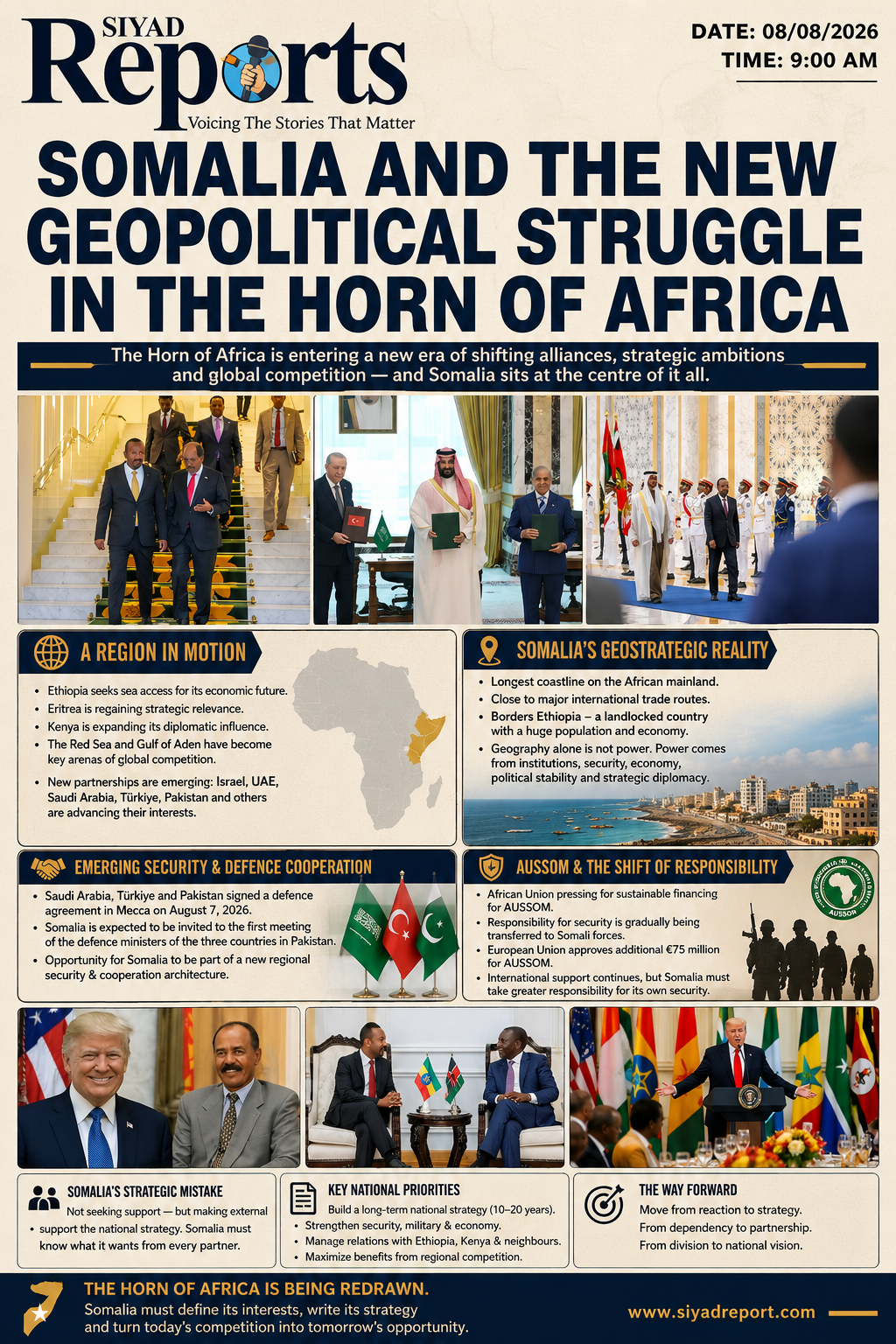
The Horn of Africa has entered a new phase. Ethiopia is seeking a way out of the geographical constraints imposed by its lack of direct access to the sea, Eritrea has once again become a country that must be taken seriously, Kenya is expanding its diplomatic role, while the Red Sea and the Gulf of Aden have become arenas where multiple international interests are competing.
At the same time, regional powers are building new relationships. Israel and the United Arab Emirates are seeking new avenues of influence as well as security and economic partnerships, while Saudi Arabia, Türkiye and Pakistan signed a defence agreement in Mecca on August 7, 2026. This agreement demonstrates that countries in the region want to develop capabilities they can rely on themselves, rather than depending entirely on external powers.
All these developments directly affect Somalia.
But Somalia’s problem today is not that it is unimportant. The problem is that its geopolitical importance has not yet been transformed into a clear national strategy.
We remain preoccupied with disputes between the Federal Government, the opposition and some of the federal member states, electoral politics, and questions of who supports the government and who supports the opposition. These are genuine issues that need to be addressed. However, when domestic politics becomes the only thing we focus on, we lose sight of the changes taking place beyond Somalia’s borders.
Ethiopia is thinking about ports and its economic future. Kenya is working to strengthen its diplomatic weight. Eritrea is being viewed in a new light by international powers, including the United States. Egypt is closely monitoring developments in the Horn of Africa and the Red Sea. At the same time, Türkiye, Saudi Arabia, Pakistan, the UAE and Israel are each building relationships designed to protect and advance their own interests.
Somalia, by contrast, often finds itself waiting to see what others intend to do.
This is where the strategic mistake begins.
Every government that comes to power in Mogadishu is dealing with circumstances that are larger than the politics of the administration of the day. Somalia has the longest coastline on the African mainland, sits close to major international trade routes, and borders Ethiopia a country with a large population and a significant economy, but without its own sovereign access to the sea.
Therefore, Somalia’s value is not merely something to be spoken about. It is a geographical reality. But geography alone does not make a country powerful. What turns geography into power is functioning institutions, a capable military, a strong economy, predictable domestic politics and a diplomacy that knows what it wants.
Somalia now appears to be moving closer to Saudi Arabia, Türkiye and Pakistan. There are even emerging indications that Somalia may be invited to the first meeting of the defence ministers of these three countries, which is expected to be held in Pakistan.
If this cooperation expands, Somalia could have an opportunity to become part of a new system of security and cooperation emerging in the region. But the mistake would be for Mogadishu to view every alliance as a place where it can simply hand over responsibility for its security.
Other countries are not building alliances to save Somalia. Each of them has its own interests.
That is where Somalia must begin.
If Saudi Arabia wants security, Türkiye seeks influence and cooperation, and Pakistan wants a strategic relationship, Somalia must also understand what it is bringing to the table and what it wants from these countries.
Similarly, Somalia must acknowledge that its relationship with the United States has moved beyond the idea that Washington will always come to Somalia in the same way it did in the past. The world has changed, and there is growing pressure for Somalia to gradually assume greater responsibility for its own security.
This can clearly be seen in the future of AUSSOM. The African Union has increasingly raised concerns surrounding the need to secure sustainable financing for the mission, while responsibility for security is gradually being transferred to Somali forces.
The European Union has also approved an additional €75 million for AUSSOM. This demonstrates that international support remains in place, but at the same time, the need for Somalia to take responsibility for its own security is becoming increasingly urgent.
Therefore, Somalia’s strategic mistake is not seeking external support. Every fragile country needs partners. The mistake occurs when external support is turned into the national strategy itself.
What Somalia needs is simply to distinguish between two things: a partner it works with and a strategy that belongs to Somalia itself.
If the United States provides support, Somalia must know what it wants from Washington. If Türkiye is increasing its influence, Somalia must have a clear plan for what it wants from Ankara.
If Saudi Arabia and Pakistan strengthen their relationship with Somalia, Mogadishu must come to the table with clearly defined interests. If Kenya continues to expand its influence, Somalia must have a policy for responding to it rather than simply watching from the sidelines.
The issue of Ethiopia, meanwhile, requires moving beyond heated rhetoric and immediate reactions. Ethiopia has a genuine need for access to the sea, while Somalia possesses a strategically important coastline and maritime territory. These two realities must be addressed through diplomacy, law and long-term planning that protects Somalia’s sovereignty while avoiding unnecessary conflict.
The most dangerous thing facing Somalia today is not only external conflict. It is the possibility that internal divisions will distract us from the major transformation taking place across the region.
Many Somalis support or oppose the system governing the Federal Government for political reasons, while others are strongly attached to their respective federal member states or political camps. That is a legitimate political reality. But when political divisions cause people to ignore the national interest, domestic politics becomes a strategic problem.
Governments can change. Presidents can change. Federal member states can change. But Somalia’s geographical position in the Horn of Africa and along the Red Sea will not change.
Therefore, what is needed today is not for all Somalis to agree on one political side. What is needed is a vision that rises above the conflict between the government and the opposition.
Somalia must develop a plan for managing the next ten to twenty years: its security, its military, its relationship with Ethiopia, its relationship with Kenya, its ports, the Red Sea, its relations with regional powers, and how it can benefit from the economic competition unfolding across the Horn of Africa.
If such a plan is absent, Somalia will continue to remain a place where other powers compete for influence.
If such a plan is developed, Somalia can turn that competition into an opportunity in which it has its own interests and gains.
The Horn of Africa is currently undergoing a redistribution of power. Every country is trying to determine where it stands on the new geopolitical map. Instead of merely reacting to these developments, Somalia must clearly define and put into a written national strategy what it wants to become.